



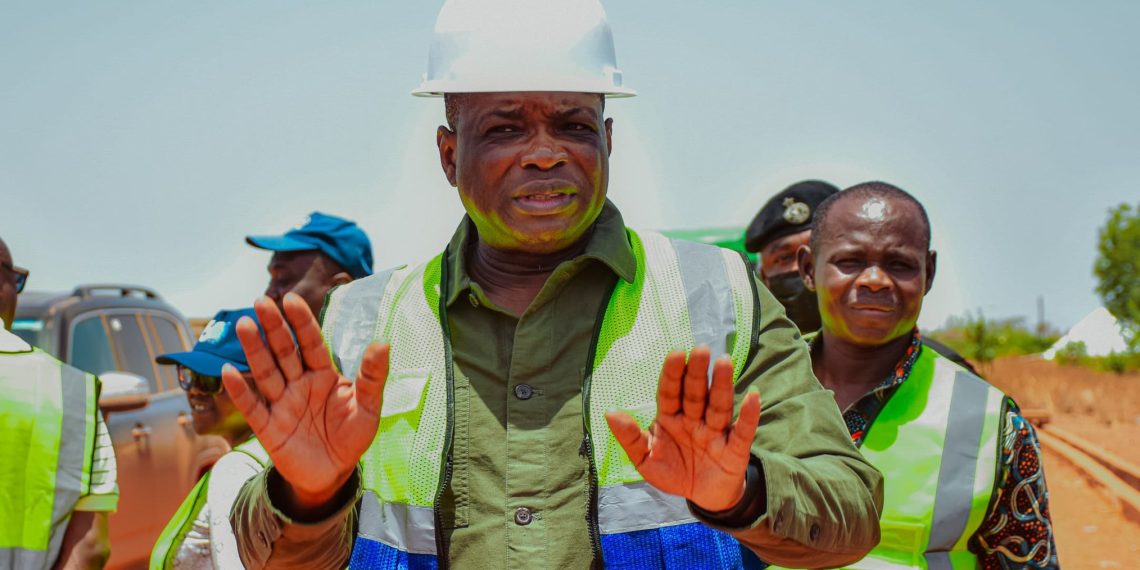
The Minister for Roads and Highways, Governs Kwame Agbodza, has issued a stern directive to engineers supervising government road projects across the country, urging them to exercise professional independence and hold contractors accountable regardless of their perceived political connections.
Speaking in an interview with Citi News, Mr. Agbodza said engineers must have the confidence to rely on their professional judgement and take decisive action when contractors fail to meet contractual obligations or comply with project specifications.
“No Contractor Is Bigger Than the Smallest Engineer”
The Minister’s comments come amid longstanding concerns about political interference in Ghana’s road infrastructure sector, where contractors with alleged ties to powerful political figures have often been accused of cutting corners, delaying projects, or disregarding technical standards without consequence.
Mr. Agbodza cautioned engineers against being intimidated by contractors who may be perceived as having close relationships with senior government officials, including ministers or the President himself.
“There was a culture where maybe engineers felt that contractor A is a friend of the minister or the president. If I go hard on him or her, they will report me and something will happen to me, and that is why you hear me saying that no contractor is bigger than the smallest engineer supervising you,” he said.
“So they should exercise the courage to deal with them. Even if my mother is a contractor, you are overseeing. Deal with him or her in the way that is within your professional view. I don’t think there is any contractor closer to me or the president or anybody who has got the licence to do the wrong thing or delay any project.”
The Minister’s remarks underscore the critical role of effective supervision in ensuring that road projects are delivered according to agreed specifications, timelines, and quality standards.
A Persistent Challenge in Ghana’s Road Sector
Political interference in the award and supervision of road contracts has been a recurring issue in Ghana, with successive governments facing criticism over the influence wielded by politically connected contractors. The phenomenon has, over the years, contributed to poorly executed projects, inflated contract sums, and delayed infrastructure delivery.
Engineers and industry watchers have long argued that without independence in supervision, the quality of public infrastructure suffers, ultimately affecting road safety, economic productivity, and public trust in government institutions.
Mr. Agbodza stressed that engineers on government projects should not allow political considerations or personal relationships to interfere with their responsibilities as professionals overseeing public infrastructure.
Professional Standards Must Guide Implementation
The Roads and Highways Minister’s stance signals a push for stricter enforcement of professional standards within the sector. He emphasised that engineers must have the courage to take appropriate action — whether that means ordering corrections, recommending sanctions, or halting work — when contractors fall short.
His message is expected to resonate with engineers who have, in the past, felt constrained by the fear of political reprisals for doing their jobs.
The comments also come as Ghana continues to grapple with a significant infrastructure deficit, with many roads across the country in poor condition and numerous projects stalled or abandoned. The government has repeatedly committed to improving road networks as part of its broader development agenda.
A Call for Accountability
Mr. Agbodza’s directive places responsibility squarely on the shoulders of supervising engineers, but also sends a clear message to contractors: political connections will not shield anyone from professional scrutiny.
The Minister’s assertion that “no contractor is bigger than the smallest engineer” is likely to be welcomed by professional bodies and civil society organisations advocating for greater transparency and accountability in the management of public funds.
As Ghana’s road infrastructure remains central to the country’s economic growth and connectivity, the effectiveness of project supervision will be a key test of the government’s commitment to value for money and quality delivery.


