

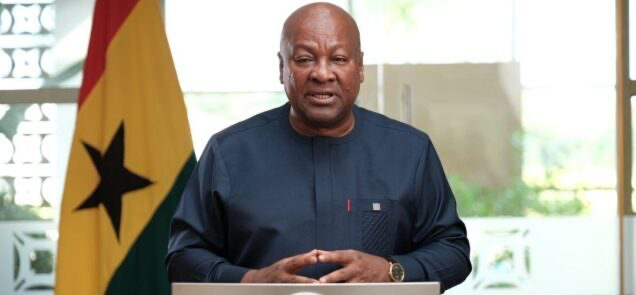
President John Dramani Mahama has defended his government’s decision to reject a $100 million health compact from the United States, describing the terms as “humiliating” and a direct threat to Ghana’s sovereignty.
Speaking at a Council on Foreign Relations engagement on the sidelines of the 81st United Nations General Assembly, Mahama said the proposed agreement collapsed because it demanded access to the health records of Ghanaians. The decision, he said, had full Cabinet backing and was taken in record time.
“It states that we shall give the United States our pathogen profile. It also says we should give our medical records. I mean, who takes another country’s medical records?” the President said, recounting the Cabinet’s swift rejection.
“It was humiliating. It was the compact that was thrown out in record time in our Cabinet. I’ve never seen anything thrown out as fast as that.”
The proposed five-year compact, valued at approximately $109 million, was part of Washington’s broader “America First Global Health Strategy,” introduced in September 2025. It was intended to replace funding previously provided through the United States Agency for International Development, or USAID, and to support Ghana’s efforts against HIV/AIDS, malaria, and tuberculosis.
But the terms reportedly went far beyond conventional public health support. Ghana was asked to share 25 years’ worth of citizens’ health records — five times the duration of the aid program itself. The deal also required Ghana’s national identification database, the GhanaCard biometric system, to be integrated with U.S. systems in real time, bypassing the country’s 2012 Data Protection Act.
Additional provisions raised further alarm. Medications and medical products entering Ghana under the program would have been exempt from inspection by the Food and Drugs Authority, a condition the President described as particularly unacceptable. Data protection officials later revealed that the agreement would have granted access to health datasets, metadata, dashboards, and data models to 16 U.S. entities without prior approval from Ghanaian authorities.
Arnold Kavaarpuo, executive director of Ghana’s Data Protection Commission, characterized the arrangement as “outsourcing the health data architecture of the country to a foreign body.”
The rejection has not been without financial consequences. Mahama disclosed that the abrupt withdrawal of U.S. aid had already created a $174 million gap in Ghana’s national budget, with the health sector alone facing a $74 million annual shortfall. The affected areas include medical research, HIV/AIDS testing laboratories, and the administration of the President’s Emergency Plan for AIDS Relief, or PEPFAR.
Still, the President linked the decision to a broader push for health sovereignty. He connected the rejection to the “Accra Reset,” an initiative he launched at the 80th UN General Assembly in 2025 to transition Africa from aid dependency to self-determination. The initiative followed the Africa Health Sovereignty Summit in Accra and aims to reimagine global health governance and build continental capacity for producing medicines and vaccines.
“That set the whole ball rolling and led to the whole issue of the Accra Reset,” Mahama said, recalling how Africa was “last in the queue” for COVID-19 vaccines.
Ghana’s decision places it alongside a growing list of African nations resisting what critics have termed “digital colonialism.” Zimbabwe withdrew from negotiations in February 2026, calling the terms “asymmetrical.” Zambia shelved a $2 billion health agreement in May after Washington linked it to a critical minerals pact. Kenya’s High Court temporarily suspended its own $1.6 billion framework following lawsuits from consumer groups.
The U.S. State Department has maintained that it does not disclose details of bilateral negotiations, stating only that it continues to “look for ways to strengthen the bilateral partnership” with Ghana.
Mahama, however, was unequivocal.
“We said no, we don’t want it. And we’re doing fine,” he said, reiterating that Ghana would not become a dumping ground under his watch.