



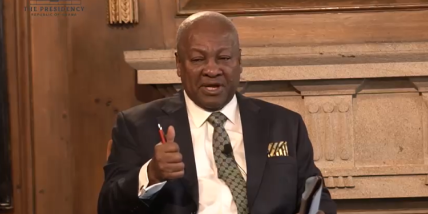
President John Dramani Mahama has announced that his government will proceed with plans to list 10 state-owned enterprises (SOEs) on the Ghana Stock Exchange (GSE), describing the move as a decisive step to improve governance and insulate the entities from political interference.
Speaking at the Council on Foreign Relations in New York on the sidelines of the United Nations General Assembly, President Mahama said listing the companies would fundamentally change how they are managed and make it harder for successive governments to remove management and dissolve boards at will.
He identified improved governance and reduced political interference as the two main objectives of the listings.
“One, because we want to improve their governance. And two, because we want to reduce political interference in those state-owned enterprises. If we list more of these companies, it makes it difficult for government to interfere and sack the management and dissolve the boards and all that,” he said.
A Sector Transformed
The President noted that state-owned enterprises had historically been associated with guaranteed salaries and benefits regardless of their financial performance.
“Even when they’re making losses, they’re asking for salary increments and asking for bonuses when you’ve made a loss,” he said.
That narrative is changing, according to the latest figures. SIGA’s 2025 State Ownership Report shows that Ghana’s SOEs recorded a consolidated net profit after tax of GH¢19.8 billion in 2025, a dramatic turnaround from an aggregate net loss of GH¢2.26 billion in 2024. Combined revenues across the sector increased from GH¢137.71 billion in 2024 to GH¢176.43 billion in 2025, while return on equity rose from minus 1.6 per cent to 15.7 per cent.
President Mahama attributed the improvement to measures implemented through the State Interests and Governance Authority (SIGA), including foreign exchange gains of approximately GH¢11.72 billion and a 42.5 per cent reduction in finance costs. He commended the Ghana National Petroleum Corporation, which recorded the highest average annual profit of approximately GH¢2.25 billion, followed by the Ghana Ports and Harbours Authority with GH¢1.41 billion and the Minerals Income Investment Fund with GH¢773.9 million.
The GSE Push
The Ghana Stock Exchange has been actively advancing the SOE listing programme, with Managing Director Abena Amoah confirming that the initiative enjoys strong support from President Mahama, who reaffirmed his backing during a recent visit to the London Stock Exchange.
GSE data shows some SOEs are in good shape and can list without hindrance. Entities identified as potential candidates include the Electricity Company of Ghana, BOSTenergies, GNPC Explorco, Ghana Airports Company Ltd, Tema Oil Refinery, GoldBod Jewelry, Ghana Re, GNPA Ltd, TDC Ghana Ltd, and Architectural Engineering Services Limited (AESL).
The market is also performing strongly. As of June 12, 2026, the GSE Composite Index was up by 64.67 per cent, building on three consecutive years of growth. Trading activity surged, with over 457,000 trades executed between January and May 2026, compared to approximately 63,000 during the same period in 2025 — an increase of over 625 per cent.
Background and Challenges
The push to list SOEs is not new. Ghana has previously attempted to use the stock exchange as a tool for privatisation and reform, but with limited success. Many SOEs historically failed to meet the listing requirements of the exchange due to poor performance and poor profitability, requiring considerable restructuring and substantial capital injection before they could remotely qualify.
More recently, SIGA and the GSE have engaged in strategic discussions to advance the listing of selected SOEs. SIGA Director-General Prof Michael Kpessa-Whyte emphasised the importance of ensuring local participation in the listing process to prevent strategic assets from falling into foreign hands.
“We have to be careful that we do not list some of our strategic assets whereby they may fall into foreign hands. So we have to make sure that we have the local capacity so that when you are listing these organisations, our local entrepreneurs and local institutions must take them up,” he stated.
The GSE has also urged Cabinet to approve the listing of viable SOEs on both the Ghana Fixed Income Market and the Ghana Stock Exchange to raise capital for their operations, highlighting that such listings would enhance transparency, efficiency, and access to long-term funding.
Broader Reform Agenda
The planned listings form part of a wider reform agenda targeting Ghana’s state-owned enterprise sector. In May 2025, President Mahama declared that struggling SOEs would either be merged, listed, or shut down to end what he termed “economic dead weight”.
The government has also taken a firmer stance on governance and accountability. President Mahama has warned SOE boards and chief executives against governance breaches, conflicts of interest, opaque procurement, and abuse of office, directing SIGA to report persistent violations directly to the presidency for administrative sanctions. On September 2, 2026, the President announced the dissolution of the boards of nine state institutions, including the GNPC.
The President has also warned that government will no longer absorb persistent financial losses incurred by SOEs and has directed that recruitment and promotion within state enterprises be strictly merit-based.
Investor Opportunity
President Mahama said listing the companies would create opportunities for Ghanaians, including those in the diaspora, to invest in state-owned enterprises through the Ghana Stock Exchange.
The GSE has welcomed the initiative, with Ms Amoah noting that pension reforms had resulted in pension fund assets growing to over GH¢100 billion, creating a pool of capital in need of investible opportunities. She has also called for a review of capital gains tax on listed securities to attract more investors and deepen market liquidity.
Caution Amid Optimism
Despite the impressive turnaround figures, some analysts have urged caution. Governance expert Dr Kwabena Donkor has noted that SOEs control approximately 50 per cent of Ghana’s state assets yet continue to suffer from chronic mismanagement and lack of accountability, identifying political interference, leadership deficits, and weak oversight as core issues.
President Mahama himself has cautioned that one successful year is not enough.
“These results are encouraging, but they must be understood within the context of a much stronger business environment,” he said, stressing that sustained performance remains the true measure of institutional excellence.
As Ghana moves to list its first batch of SOEs, the coming months will test whether the capital markets can deliver the governance transformation that decades of direct state control have struggled to achieve.


