



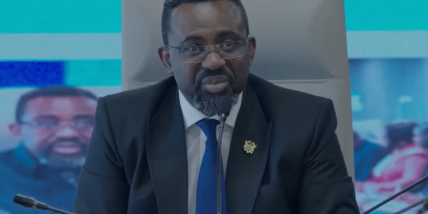
— Bank of Ghana Governor Dr Johnson Asiama has disclosed that he resigned from the Board of Directors of the Ghana Gold Board (GoldBod) about five months ago, amid opposition calls for his removal over an alleged conflict of interest.
Dr Asiama told journalists he no longer attends GoldBod board meetings and that the law establishing the state gold agency does not require the central bank governor to serve on its board personally.
“I resigned from the GoldBod Board about five months ago or so. I do not attend board meetings at the GoldBod at all,” he said.
His comments come after the New Patriotic Party (NPP) demanded his removal from the GoldBod Board, arguing that his position as BoG Governor could compromise oversight of an institution financed by the central bank. Former Finance Minister and NPP Member of Parliament for Karaga, Dr Mohammed Amin Adam, raised the issue at an NPP press briefing on September 1.
At the heart of the dispute is the relationship between the Bank of Ghana and GoldBod, particularly the central bank’s role in financing GoldBod’s gold-purchasing operations and reported losses under the Domestic Gold Purchase Programme (DGPP).
Dr Asiama, however, said the Ghana Gold Board Act, 2025 (Act 1140), allows the Bank of Ghana to be represented on the GoldBod Board by either the Governor or another BoG official not below the rank of director.
“The law that governs the activities of the GoldBod, there’s a provision there for Bank of Ghana to be represented either by the Governor or any other official up to the rank of a director,” he said. “It does not necessarily need the Governor to be there.”
GoldBod was established under Act 1140, which was assented to in April 2025, with a mandate to generate foreign exchange, support gold reserve accumulation and oversee, regulate and undertake gold trading. It took over from the Precious Minerals Marketing Company (PMMC). Its 13-member Board of Directors was inaugurated on May 19, 2025, and originally included Dr Asiama as BoG Governor.
In its initial phase, GoldBod operated as the Bank of Ghana’s gold-buying agent, with funds advanced to it used specifically to purchase gold for the central bank. From March 2026, it began implementing its own trading model under Act 1140.
The NPP has alleged that the arrangement created a conflict of interest. Dr Amin Adam argued that it was inappropriate for the Governor to remain on the board of an institution handling a programme financed by the Bank of Ghana while the central bank recorded losses from the same programme.
“You cannot be lending to GoldBod when your own institution, the Bank of Ghana, is making losses from the programme being handled by GoldBod, and still be lending to it,” he said. He demanded: “Remove the Governor of the Bank of Ghana from GoldBod’s board, since his own institution funds the programme.”
The financial stakes are significant. According to a Bank of Ghana response dated January 12, 2026, the DGPP and the associated Gold-for-Reserves scheme recorded audited losses totalling more than GH¢7 billion between 2022 and 2024. The programme lost GH¢74.44 million in 2022, GH¢1.553 billion in 2023 and GH¢4.068 billion in 2024, including losses from gold-for-oil transactions, reserve gold purchases and costs linked to the artisanal mining supply chain.
More recently, the International Monetary Fund’s Country Report No. 26/213 indicated that the significant scaling up of the DGPP in 2025 resulted in losses exceeding US1.9 billion when factoring in US$150 million in forgone revenue from the scrapped 1.5% withholding tax on unprocessed small-scale gold. He also claimed the Bank of Ghana financed GoldBod’s entire gold operations interest-free and that GoldBod was exempted from tax under Section 21 of the Act.
GoldBod has rejected claims of financial mismanagement. CEO Sammy Gyamfi has maintained that the agency recorded an operational surplus of GH¢909.7 million and an overall surplus of GH¢5.44 billion in 2025. The Bank of Ghana has also defended the programme’s strategic value, arguing that short-term accounting losses should be weighed against broader balance-of-payments benefits, including stronger foreign exchange buffers, reduced reliance on the US dollar and renewed confidence in the cedi.
President John Dramani Mahama has credited the GoldBod initiative with sanitising the gold sector and boosting export revenues, saying gold exports through the PMMC and GoldBod earned Ghana US$2.7 billion between January and April 2025.
The controversy has nonetheless escalated into a broader political confrontation. The NPP has demanded greater transparency over GoldBod’s agreements, finances and operations, and called for a full parliamentary inquiry. It has also challenged GoldBod’s reported GH¢5.45 billion surplus, arguing that it improperly included a GH¢4.54 billion government capital injection as revenue. The party wants the identities of foreign buyers, discounts granted to them and the commercial terms under which Ghana’s gold was sold to be disclosed.
The ruling National Democratic Congress (NDC) has dismissed the NPP’s criticisms as a deliberate political strategy, with National Chairman Johnson Asiedu Nketia describing the attacks on GoldBod as partisan.
Ghana is Africa’s leading gold exporter, earning more than US$11.5 billion from gold exports in 2024, with small-scale mining contributing about 40%, according to a 2025 Business Insider Africa report. But the country has historically struggled to maximise returns because of tax evasion, illegal exports, smuggling and weak oversight — challenges GoldBod was created to address.
The Bank of Ghana’s decision to stop pre-financing gold purchases from July 1, 2026, has been welcomed by the NPP, although Dr Amin Adam insists it does not remove the need to account for losses already incurred. As the debate continues, the central bank and GoldBod face mounting pressure to reconcile their figures and give Ghanaians a clearer picture of the programme’s financial performance.


