



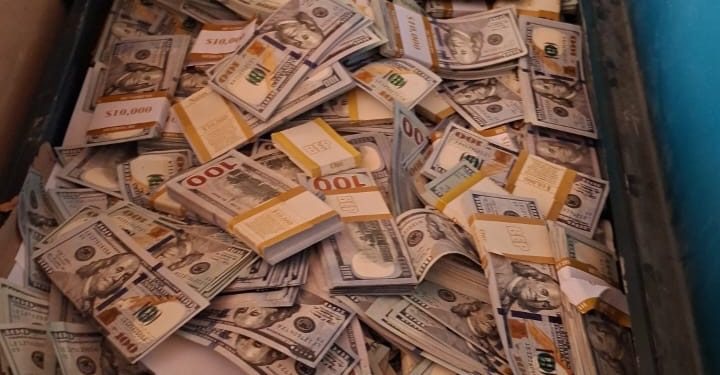
Sixteen people, including Ghanaian and foreign nationals, have been arrested and four counterfeit currency printing hubs dismantled in a sweeping National Security Council Secretariat (NSCS) crackdown on organised counterfeit-currency syndicates operating across the Greater Accra Region and surrounding districts.
The arrests followed six intelligence-led operations conducted between June 12 and July 24, 2026, targeting networks allegedly involved in the large-scale production, possession and distribution of counterfeit local and foreign currencies. The NSCS disclosed the operations in a statement on Tuesday, September 22, 2026.
Security operatives seized four counterfeit-currency printing machines, six vehicles and two motorcycles allegedly used by the syndicates to transport and distribute the fake notes. The NSCS said it recovered $543,000, GH¢196,600 and CFA60,000 in counterfeit notes that were ready for circulation.
The scale of the operation extended far beyond finished notes. Investigators also seized counterfeit coupons awaiting processing and printing with a staggering face value: $5,293,500, GH¢19,553,700 and CFA623,550,000. The distinction is significant — the Chronicle newspaper noted in its coverage that converting the unprocessed coupons into “counterfeit currency seized” would materially overstate the operation, as these materials had not yet been printed into usable notes.
A Network With Many Faces
The NSCS said the operations were carried out after months of covert intelligence gathering into reports of counterfeit currency entering commercial hubs, foreign exchange markets and financial networks.
According to the agency, the syndicates operated through structured networks involving technical printing operators, cross-border facilitators and commercial dispatch riders responsible for transporting counterfeit currency to buyers. Intelligence analysis revealed that some of the syndicates deliberately used churches and administrative offices of certain religious organisations to conceal their printing operations — the premises masking the noise and vibration from printing machines while also providing storage for materials and finished notes.
Operation by Operation: How the Raids Unfolded
June 12 — Amuzu, Kasoa: Security operatives raided a residential compound operating under the cover of a traditional spiritual centre. One suspect, Nana Nyarko Derrick Dapaah, was arrested. Seized items included a currency printing machine, fake gold bars, five mobile phones and substantial quantities of counterfeit notes and coupons. The operation was conducted in a suburb of Kasoa in the Central Region.
June 19 — Transnational Cell Intercepted: In an operation targeting a transnational criminal group specialising in the movement of bulk high-grade foreign counterfeit currency, seven suspects — three Ghanaians and four foreign nationals — were arrested. Three unregistered vehicles, a Honda CR-V, Toyota Highlander and Toyota Corolla, were impounded, along with $65,900 in counterfeit notes.
June 29 — Lashibi and Klagon: A raid on office premises in Lashibi and a follow-up search of the headquarters of a religious facility in Klagon led to five arrests. Investigators discovered printing equipment and a storage facility containing counterfeit-currency materials. The NSCS alleged that the church’s administrative offices and residential quarters were being used as a major production and storage facility. One printing machine, two operational vehicles and large volumes of unprocessed coupons — including more than $5.2 million and CFA623.5 million face value — were recovered. Rev. Emmanuel Boakye-Danquah was identified by the NSCS as a key suspect and remains at large.
July 9 — Lakeside Estate: Operatives intercepted a commercial dispatch rider near the Lakeside Shell Filling Station allegedly transporting pre-packaged counterfeit currency to buyers. Issah Ibrahim was arrested, while Adamu Haruna was listed as being at large. Five boxes containing counterfeit GH¢200 notes with an estimated face value of GH¢12,421,600 were seized, along with two registered motorcycles. The substantial face value of these finished GH¢200 notes — enough to fill five boxes — underscores the scale of the distribution operation that was disrupted.
July 21 — Nii Boi Town: Solomon Acheampong, 54, was arrested at a suspected regional distribution point. The NSCS identified Amankwah Bismark as a suspected kingpin who remains at large. A white Toyota Corolla, three mobile phones, GH¢500 in genuine currency and assorted counterfeit coupons were seized.
July 24 — Achimota and Amasaman: A raid at a hotel facility in Achimota (Mile 7) and a subsequent search of a residence in Amasaman resulted in the arrest of Osman Iddrisu, 50, described by the NSCS as a key technical operator. He was allegedly found with mobile printing equipment. The search of his residence uncovered what investigators described as a fully equipped secondary printing facility, where two printing machines and quantities of counterfeit notes and coupons were seized.
Legal Proceedings and Forfeiture
All 16 suspects have been remanded into state custody, and case dockets have been submitted to the Office of the Attorney-General and Ministry of Justice. The suspects and the seized physical and digital exhibits have been transferred to the Bureau of National Intelligence (BNI) for forensic examination and further investigations.
Formal prosecution proceedings are ongoing at the Accra High Court (General Jurisdiction), while security agencies continue efforts to locate other suspects identified during the investigations, including Rev. Boakye-Danquah, Adamu Haruna and Amankwah Bismark.
The NSCS said prosecutors had also begun processes to seek the forfeiture of vehicles, printing equipment and mobile devices allegedly used in the operations.
Under Ghana’s Currency Act, 1964 (Act 242), a person convicted of counterfeiting is liable to a term of imprisonment not exceeding ten years, or to a fine not exceeding two thousand penalty units, or to both. The Act also provides for terms of imprisonment not less than three years and not exceeding seven years for importing or exporting counterfeit coins or notes.
The Economic Toll of Counterfeiting
The crackdown comes amid growing concern about the economic impact of counterfeit currency on Ghana’s financial system and the livelihoods of ordinary citizens.
The Governor of the Bank of Ghana, Dr Johnson Asiama, has warned that counterfeiting threatens the stability of the local currency and contributes to the depreciation of the cedi. He explained that the existence of counterfeit notes contributes to inflation and affects the overall performance of the economy. “If you find anyone engaging in currency counterfeiting, whether it’s the cedi, the dollar, or any other currency, please, my phone number is all over the place. Send me a WhatsApp,” Dr Asiama said during a roundtable in July 2025.
The Governor also expressed concern about the alleged involvement of foreign nationals in counterfeiting activities. “The heartbreaking part is that I’m told a lot of foreigners are involved in this. They are counterfeiting Kwame Nkrumah’s cedis, the cedi he introduced. They are destroying it. And Ghanaians know these people,” he lamented.
The economic damage extends beyond monetary policy. Counterfeit currency undermines public trust in the cedi, distorts market prices, and leads to financial losses for unsuspecting individuals and businesses. Counterfeiters operate outside the tax net, depriving the government of revenue for public services like healthcare and education.
For traders in Ghana’s informal sector, where cash transactions dominate, the problem has become a daily reality. A July 2026 investigation by Citi Business News found traders in Accra markets displaying suspected counterfeit notes as evidence of recent losses. One trader, identified only as Madam Anointed, described how a single counterfeit GH¢200 note could wipe out the profit from multiple sales: “If I sell meat worth GH¢35 and a customer pays with a counterfeit GH¢200 note, I will give the customer the balance. Once I later discover the GH¢200 note is fake, the loss falls entirely on me”.
Traders have called on law enforcement agencies to intensify efforts to identify, arrest and prosecute those involved. “We have four counterfeit notes here. Government should make it clear that anyone caught using fake currency will be dealt with according to the law,” one trader told Citi Business News.
Vigilance Urged
The NSCS has urged financial institutions, property owners and administrators of religious facilities to remain vigilant and report suspicious high-volume printing activities and unusual foreign-currency transactions to security agencies. The call for vigilance is particularly pointed given that some of the syndicates allegedly used religious premises as cover for their operations.
The operations form part of broader efforts to disrupt organised criminal networks involved in currency counterfeiting and protect the integrity of Ghana’s financial system. The NSCS did not disclose whether any of the counterfeit currency had successfully entered circulation, nor did it identify specific financial institutions or businesses that may have been affected. Further details are expected to emerge as forensic examination of the seized exhibits and investigations into the suspects continue.
Re


