



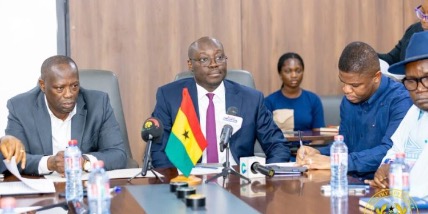
In a landmark move to bolster Ghana’s foreign exchange reserves and deepen local value addition, the government has formalised an agreement with large-scale mining companies requiring them to sell 30 per cent of their gold output to the Bank of Ghana and the Ghana Gold Board for domestic processing and refining.
The Memorandum of Understanding (MOU) was signed on Thursday at the Ministry of Finance in Accra, bringing together the Ministry of Finance, the Ministry of Lands and Natural Resources, the Bank of Ghana, the Ghana Gold Board, and the Ghana Chamber of Mines, which represents the country’s major mining firms. The agreement marks a critical step in the implementation of the Ghana Accelerated National Reserve Accumulation Programme (GANRAP), a flagship policy aimed at transforming Ghana’s gold sector from a raw-material exporter into a refined-products hub while strengthening the nation’s macroeconomic buffers.
A Product of Extensive Consultations
Speaking at the signing ceremony, Finance Minister Dr. Cassiel Ato Forson described the MOU as the culmination of months of intensive dialogue between the government, the central bank, the Gold Board, and the mining industry. He emphasised that the agreement was not imposed but reached through mutual understanding.
“Today’s signing of the memorandum of understanding signifies that we have successfully come to a mutual understanding that that policy will be implemented effective the date of signing,” Dr. Forson stated. He noted that the negotiations had addressed key operational concerns, including pricing mechanisms, logistics, and timelines, ensuring a smooth rollout.
Under the arrangement, the 30 per cent gold purchased from the mining companies will be processed and refined locally before being transferred to the Bank of Ghana to support the country’s reserve accumulation efforts. This, according to the Finance Minister, represents a significant step in the government’s broader strategy to strengthen Ghana’s external reserves, stabilise the cedi, and enhance macroeconomic stability.
A National Imperative
The Minister for Lands and Natural Resources, Mr. Emmanuel Armah-Kofi Buah, underscored the transformative potential of GANRAP. He described the programme as an initiative whose impact on macroeconomic stability and financial management cannot be overemphasised.
“For too long, we have exported our gold in raw form, only to import refined products at premium prices. This programme changes that narrative. It ensures that more of our gold stays here, creates jobs in refining, and adds to our national wealth,” Mr. Buah said.
He commended the Ghana Chamber of Mines and the large-scale mining companies for their cooperation throughout the negotiations, acknowledging that their buy-in was essential for the programme’s success. He also stressed the need for flexibility as the new arrangement takes shape, promising that his ministry would work closely with industry to resolve any emerging challenges.
Central Bank’s Commitment
The Governor of the Bank of Ghana, Dr. Johnson Pandit Asiama, expressed the central bank’s full commitment to the agreement. He acknowledged the collaborative efforts of the Gold Board, the Finance Ministry, and the Lands Ministry in bringing the parties together.
“The Bank of Ghana will work tirelessly to ensure that this programme delivers maximum benefits to the Ghanaian economy. We are looking at not just reserve accumulation, but also the development of local refining capacity that meets international standards,” Dr. Asiama said.
He added that the central bank would provide the necessary infrastructure and financial instruments to facilitate the smooth purchase and refining of the gold.
Industry Support with a Call for Incentives
The Chief Executive Officer of the Ghana Chamber of Mines, Mr. Eric Asubonteng, affirmed the industry’s full support for GANRAP, particularly its focus on strengthening Ghana’s macroeconomic resilience.
“Building a reserve buffer capable of helping the country withstand external shocks benefits not only the state but also every business operating in Ghana. A stable economy means stable input costs, predictable exchange rates, and a more attractive investment climate,” he said.
Mr. Asubonteng also welcomed the programme’s objective of developing internationally accredited gold refineries in Ghana. He disclosed that the Chamber had, even before GANRAP, begun exploring opportunities to support local gold refining, including engagements with refineries in Ghana and South Africa.
However, he offered a key caveat: he called for GANRAP to evolve beyond its current timeframe of 2028 and become an incentive-based system that encourages local processing and refining. He cited countries such as Tanzania, India, and South Africa, where tax breaks, subsidies, and preferential pricing are used to encourage local beneficiation of minerals.
“We need to look at GANRAP beyond even 2028. An incentive-led system would make local beneficiation more sustainable and attractive, not just for large-scale miners but also for artisanal and small-scale producers,” Mr. Asubonteng argued.
He suggested that such an approach could position Ghana as a major gold refining hub for the West African sub-region, leveraging the significant volumes of gold produced within Ghana and neighbouring countries like Burkina Faso, Mali, and Côte d’Ivoire.
Background: The Genesis of GANRAP
The Ghana Accelerated National Reserve Accumulation Programme was launched in late 2025 as part of the government’s post-COVID economic recovery strategy. The programme was born out of the realisation that Ghana, despite being Africa’s largest gold producer, held only modest foreign exchange reserves, leaving the economy vulnerable to external shocks such as commodity price crashes and currency volatility.
Historically, Ghana’s gold mining industry has exported almost all its output in doré form, with only a fraction refined locally. This meant that the country earned foreign exchange from exports but lost substantial value by not beneficiating the gold before sale. Moreover, the reserves held by the Bank of Ghana were largely denominated in foreign currencies, with little physical gold backing.
GANRAP aims to reverse this by mandating a portion of gold production to be purchased domestically, refined, and held as part of Ghana’s international reserves. The 30 per cent requirement for large-scale mines is the first phase; the government has indicated that it will extend similar provisions to small-scale and artisanal miners in the coming months.
Economic Implications
Economists have welcomed the MOU, noting that it could have multiple positive effects. First, it will increase the Bank of Ghana’s gold reserves, providing a tangible asset that can be used to defend the cedi during periods of currency pressure. Second, it will stimulate the local refining industry, creating jobs and retaining value that previously flowed overseas. Third, it will reduce Ghana’s reliance on imported refined gold products, saving foreign exchange.
However, some analysts have cautioned that the success of GANRAP depends on the capacity of local refineries to meet international purity standards (such as London Bullion Market Association accreditation) and the willingness of miners to accept pricing that reflects global spot rates minus refining costs. The MOU addresses these issues by committing the Gold Board to transparent pricing and the central bank to timely payments.
Next Steps
With the MOU signed, implementation is set to begin immediately. The Gold Board will coordinate with each mining company to set up monthly gold delivery schedules, while the Bank of Ghana will make arrangements for storage and refining. The Ministry of Lands and Natural Resources will monitor compliance and resolve any operational bottlenecks.
The Chamber of Mines has pledged to work with its members to ensure a smooth transition, while also continuing to advocate for a long-term incentive framework that benefits all stakeholders. As Mr. Asubonteng put it, “We are in this together. Our goal is a stronger Ghanaian economy, and GANRAP is a powerful tool to achieve that.”
The signing of the MOU has been hailed by civil society groups and trade unions as a bold step towards economic sovereignty. For now, all eyes are on the implementation phase, which will determine whether Ghana can finally unlock the full potential of its golden heritage.


