



The Association of Ghana Industries (AGI) has thrown its weight behind the government’s flagship 24-Hour Economy policy but has issued a stern warning: the initiative must be backed by tangible, well-consulted programmes, not just catchy rhetoric.
Speaking on Joy News’ PM Express Business Edition, the Chief Executive Officer of the AGI, Mr. Seth Twum-Akwaboah, stressed that the success of the policy will be determined not by the popularity of its name but by the practical steps taken to fundamentally alter the way businesses operate in Ghana.
“For me, I don’t bother so much about the clichés you create, whether it is 24-Hour Economy or 1D1F; that’s not really the issue for me. It is more of what you do within those policies,” Mr. Twum-Akwaboah said.
He urged the government to pay meticulous attention to how policies are developed and implemented, asking: “You can come up with any policy, but then, when you develop the policy, what has gone into the policy development? How consultative was its nature? What are the key policies or activities within the policy that you are trying to implement to change the status quo?”
From Confusion to Clarity
The AGI boss acknowledged that the 24-Hour Economy policy initially generated significant confusion among businesses and the public, with many unsure about what it actually entailed. However, he noted that ongoing consultations with the government have helped bring greater clarity to the initiative.
“I think we are making good progress because now it’s coming clearer. Government is defining,” he said, referring to the recent launch of a formal blueprint for the policy.
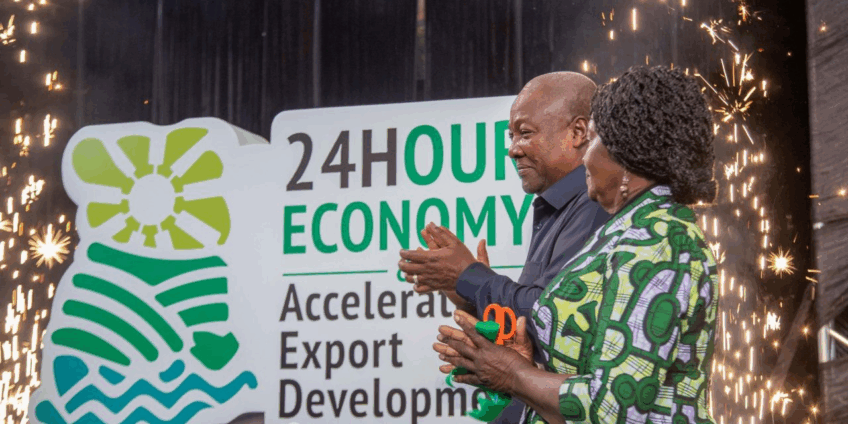
That blueprint, unveiled earlier this month by the Minister for Trade, Agribusiness and Industry, Mrs. Elizabeth Ofosu-Adjare, outlines a phased approach to extending economic activity beyond the traditional 8 a.m. to 5 p.m. window. It includes proposals for tax incentives for businesses operating night shifts, improved public transport and security during off-peak hours, and the prioritisation of reliable power supply to support round-the-clock production.
A Caution Against Overnight Expectations
Mr. Twum-Akwaboah, however, cautioned against unrealistic expectations that the policy would transform the economy overnight.
“When you hear a cliché, when you hear a mention of something like that, sometimes the expectation is that overnight things will change and everything will be a 24-hour economy. It doesn’t happen like that,” he explained.
He drew a parallel with the previous government’s One District, One Factory (1D1F) initiative, which he said faced similar unrealistic expectations. “All of a sudden, you think that every district is going to have an industry? Government has mentioned it. It’s an intention. It’s a vision. How do we work towards it?” he asked.
According to him, the focus should now be on identifying the specific interventions needed to make the 24-hour economy a reality, rather than debating the slogan itself.
Blueprint Promises, but Implementation is Key
Mr. Twum-Akwaboah expressed optimism about the blueprint, describing it as containing “a lot of interesting ideas” that could be game-changing if executed to the letter.
“If we’re able to implement it to the letter, I’m sure it will help change a lot of things,” he said.
He reaffirmed the AGI’s full support for the policy and disclosed that the association is already engaging the newly established 24-Hour Economy Secretariat on implementation issues.
“We are working with the 24-hour economy secretariat to implement some of the things they said they will implement. If we’re able to do it, it will be a game changer,” he added.
Background: The 24-Hour Economy Vision
The 24-Hour Economy policy was a central campaign promise of the National Democratic Congress (NDC) during the 2024 general elections. It was conceived as a strategy to unlock Ghana’s economic potential by keeping businesses, factories, and services operational around the clock, thereby creating jobs, increasing productivity, and reducing unemployment among the youth.
Proponents argue that a 24-hour economy would allow Ghana to compete with global manufacturing hubs, attract foreign direct investment, and maximise the use of existing infrastructure. However, critics have pointed to significant hurdles, including erratic power supply, inadequate security, and the high cost of labour at night.
The launch of the blueprint earlier this month was seen as a positive step, but business leaders like Mr. Twum-Akwaboah are now demanding a detailed action plan with clear timelines, measurable targets, and adequate funding.
The AGI’s Broader Concerns
The AGI has been a consistent voice for Ghanaian manufacturers and industrialists. In its recent Business Barometer, the association highlighted high electricity costs, limited access to credit, and unfair import competition as the top challenges facing businesses. A successful 24-Hour Economy, Mr. Twum-Akwaboah argued, must address these structural issues first.
“You cannot ask businesses to operate 24 hours if they cannot afford the power to run their machines. You cannot expect night shifts if workers have no safe transport home. The blueprint must translate into concrete actions on the ground,” he said.
He called for a collaborative approach between the government, the private sector, and labour unions to ensure that all stakeholders are aligned.
Way Forward
The AGI’s stance reflects a broader sentiment among Ghana’s business community: that while the 24-Hour Economy is a compelling vision, its credibility will ultimately hinge on execution. As the government rolls out the policy, all eyes will be on whether it delivers the promised incentives, infrastructure, and regulatory reforms.
For now, the AGI has made it clear that it will not settle for slogans. It is ready to work with the secretariat, but it will hold the government accountable for turning a bold idea into a tangible reality – one shift at a time.


