

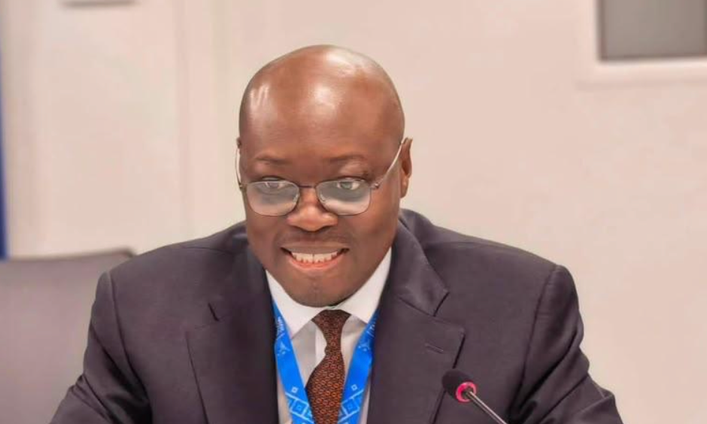
Finance Minister Dr Cassiel Ato Forson has called for a decisive break with the economic patterns that have held Ghana back, saying the country must now build on hard-won stabilisation to secure lasting prosperity, declaring: “We have stabilised the present. Now we must secure the future.”
Speaking during his New Economy engagement with faculty and students at the University of Ghana, Forson said Ghana had reached a moment when public policy must confront the underlying causes of its economic challenges rather than merely managing their symptoms. “History does not wait for countries that are afraid to decide,” he said. “There are moments when a nation must make a clear break with old patterns. There are moments when public policy must stop managing symptoms and start changing structures. This is such a moment for Ghana.”
The Finance Minister framed the next phase of Ghana’s economic journey as a test of the country’s willingness to make decisions that would shape the prospects of future generations. His remarks placed structural transformation at the centre of the New Economy agenda, with economic stability serving as the foundation for a more productive economy that creates decent jobs and raises incomes. The challenge, he indicated, is to move beyond addressing immediate pressures and to change the conditions that allow those pressures to recur—producing more at home, adding value to what Ghana grows and mines, and expanding opportunities for businesses and workers.
Background: From Crisis to Stability
Forson’s address comes as Ghana completes one of the most remarkable economic turnarounds in its recent history. In December 2022, the country defaulted on its external debt amid spiralling public debt, rapid cedi depreciation, and collapsing investor confidence, forcing a painful restructuring of approximately US3 billion IMF Extended Credit Facility. Inflation, which peaked at over 54% in December 2022, has since been brought down sharply, while the cedi has stabilised and gross international reserves have been rebuilt, albeit with the central bank still prioritising buffer accumulation.
The government formally concluded the ECF programme in May 2026 and transitioned to a 36-month non-financing Policy Coordination Instrument with the IMF—a framework that carries no direct disbursements but signals policy credibility to markets. The Fund’s latest Debt Sustainability Analysis moved Ghana from a high to a moderate risk of debt distress, with central government debt declining to about 45% of GDP, a level the IMF had initially projected Ghana would reach only by 2034. Moody’s upgraded Ghana’s sovereign rating to “B3” from “Caa1” on October 9, the second upgrade in a year, while Fitch lifted the country to “B” from “B-” in May.
Yet the Finance Minister’s address signals that the government views stabilisation as a means, not an end. Ghana’s economy grew 4.5% year-on-year in the third quarter of 2026, but policymakers have repeatedly warned that growth must become more inclusive and structurally transformative to absorb the hundreds of thousands of young people entering the labour market each year.
The New Economy Agenda
The “New Economy” engagement series, launched by the Ministry of Finance, is designed to engage citizens—particularly young people—on the government’s economic vision. Forson has used previous editions to outline plans for private-sector-led growth, fiscal discipline, and structural reforms aimed at reducing Ghana’s dependence on raw commodity exports. The government’s 24-hour economy initiative, championed by President John Dramani Mahama, is a centrepiece of this agenda, alongside plans to expand value addition in agriculture, mining, and petroleum—including the proposed Petroleum Hub in Jomoro, which recently secured a US$28 billion partnership for its second phase.
The Finance Minister’s emphasis on “changing structures” also reflects a broader shift in Ghana’s economic policy thinking, echoed by international partners. The World Bank has urged Ghana to move beyond fiscal consolidation toward reforms that boost domestic revenue mobilisation, improve the business environment, and build human capital. The IMF’s PCI programme includes objectives on economic diversification and inclusive growth, alongside fiscal transparency and financial sector stability.
Political and Economic Context
Forson’s address carries political weight as well. The governing National Democratic Congress marks its first full year in office following its decisive 2024 election victory, and the government is eager to translate macroeconomic stabilisation into tangible improvements in living standards ahead of the 2028 general elections. Critics, including the Minority in Parliament, have argued that stabilisation has come at a steep cost to households, citing high utility tariffs, fuel prices, and unemployment.
But the Finance Minister’s message on Monday was forward-looking. By framing the current moment as a historic inflection point, he sought to build public support for reforms that may require short-term sacrifice for long-term gain—including measures to broaden the tax base, restructure state-owned enterprises, and reduce the cost of governance. “History does not wait for countries that are afraid to decide,” he said, in a line that appeared designed to inoculate the government against criticism of difficult policy choices ahead.
The New Economy engagement at the University of Ghana also reflects the government’s strategy of courting young people, who formed a critical bloc in the 2024 election and whose support will be essential in 2028. By taking his message directly to students, Forson signalled that the government views youth as both beneficiaries and agents of the structural transformation it envisions.
Whether the New Economy agenda delivers on its promise will depend on execution—on whether the government can translate stabilisation into investment, jobs, and rising incomes. For now, the Finance Minister has set the terms of the debate: Ghana has moved past crisis management, and the harder work of building a resilient, productive economy has begun.