

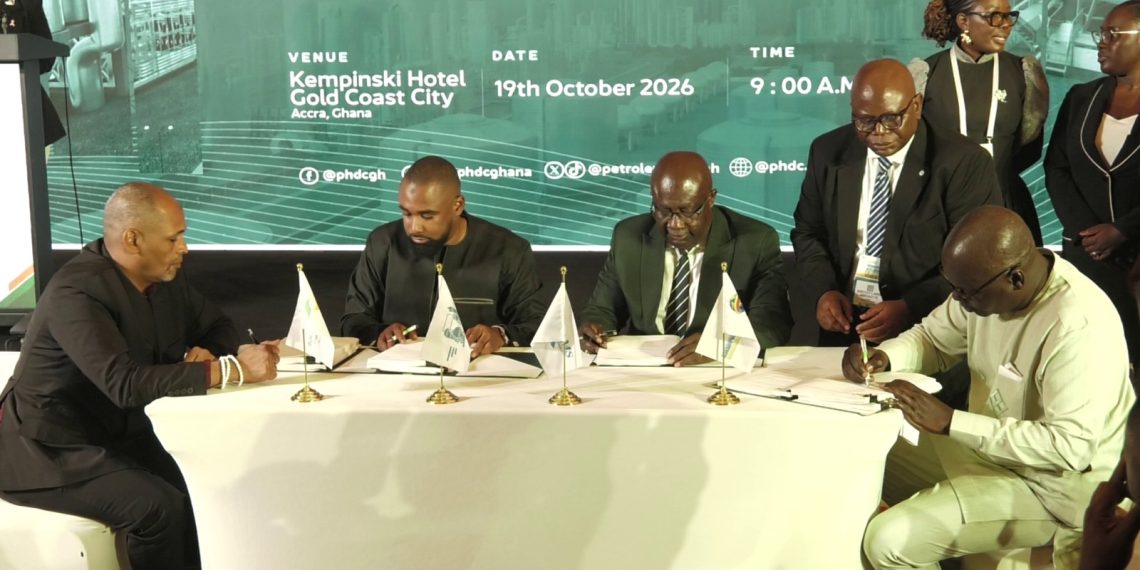
Ghana’s Petroleum Hub Development Corporation (PHDC) has signed a $28 billion Build-Operate partnership agreement with an international consortium led by Global Sphere for the development of Lot Two of the country’s flagship Petroleum Hub project, in what officials describe as one of the largest industrial investments ever mobilised in Ghana.
The agreement, executed at a ceremony in Accra on Monday, October 19, brings together investors and technical partners from the United Arab Emirates, South Korea, and Mali. Under the terms, Lot Two will comprise a refinery with a capacity of 300,000 barrels per stream day, two petrochemical plants, storage infrastructure with a stated capacity of four million cubic metres, and a multi-berth jetty .
PHDC Chief Executive Officer Dr Toni Aubynn said initial construction activities at the project site in Jomoro, in the Western Region, are scheduled to begin in the first quarter of 2027, subject to the completion of agreed preparatory requirements. The facilities are expected to be developed within five years .
“This commitment ranks among the largest industrial investment ever mobilized in Ghana and stands as a powerful vote of confidence in our country’s stability, leadership and long-term economic prospect,” Aubynn said .
Background: A $60 Billion Vision, Years in the Making
The Petroleum Hub project is Ghana’s most ambitious industrial undertaking, conceived to transform the country into a regional centre for refining, petrochemical production, storage, and logistics. Established under the Petroleum Hub Development Corporation Act, 2020 (Act 1053), the PHDC was created to lead the development of what is envisioned as West Africa’s first integrated petroleum and petrochemical hub .
The full programme is estimated at approximately $60 billion, with roughly 90 percent expected to come from private investors and 10 percent from government, directed at land acquisition, compensation, and initial infrastructure . Upon full completion, the hub is planned to host three refineries with a combined capacity of 900,000 barrels per stream day, five petrochemical complexes, approximately 10 million cubic metres of petroleum storage, LNG and gas-processing facilities, marine terminals, and an industrial city .
The project has faced significant hurdles, particularly around land. The original land requirement of 20,000 acres was reduced to 12,300 acres following a presidential directive in response to concerns from residents of Jomoro, a decision PHDC has insisted will not compromise the project’s integrity . Compensation for affected landowners has been estimated at approximately GH¢900 million .
Government Pledges to Clear Bottlenecks
Speaking at the signing ceremony, Energy and Green Transition Minister Dr John Abdulai Jinapor acknowledged that investor interest must be matched by government action to remove outstanding barriers. He pledged to lead inter-ministerial engagements with the Ministries of Finance and Lands and Natural Resources, as well as the Attorney-General’s Office, to resolve land acquisition, compensation, and financing issues .
“You have my full support. I will engage the Minister of Finance and the Attorney-General. I will also bring on board the Minister of Lands and Natural Resources so that, together, we can guide this project and provide the necessary backing,” Jinapor said .
The Minister framed the hub as indispensable to President John Dramani Mahama’s vision for the energy sector, noting that Ghana cannot increase oil production without adding value to its resources. “Today’s signing ceremony is not the culmination of the process; it is the beginning,” he said .
Boubacar Belco Bah, speaking on behalf of the consortium, affirmed the group’s commitment to fulfilling the agreement’s terms. “Ultimately, our success will be measured not by the agreement we sign today, but by the commitments we honour and the results we achieve together,” he said, adding that the consortium would prioritise rigorous project preparation, responsible risk allocation, and meaningful participation by Ghanaian contractors and professionals .
Economic Ambitions and the 24-Hour Economy
Aubynn linked the project directly to the government’s industrialisation and energy security agenda, arguing that a fully operational Petroleum Hub could serve as the anchor for Mahama’s flagship 24-hour economy initiative. “Experiences in Singapore, Malaysia and elsewhere suggest that there can be no better candidate for the 24-hour economy strategy than a fully functional Petroleum Hub,” he said .
Beyond the refinery and storage assets, Aubynn emphasised the project’s potential to create opportunities for Ghanaian engineers, technicians, artisans, entrepreneurs, contractors, and small businesses, as well as to drive skills development and technology transfer .
The signing marks a critical test for the PHDC, which has spent the past year navigating land disputes, compensation negotiations, and investor courtship. As Aubynn put it: “The true measure of our success will not be the agreement we sign, but the infrastructure we build, the investment we realize, the jobs we create, the industries we establish, and the lasting value we deliver to the people of Ghana” .