



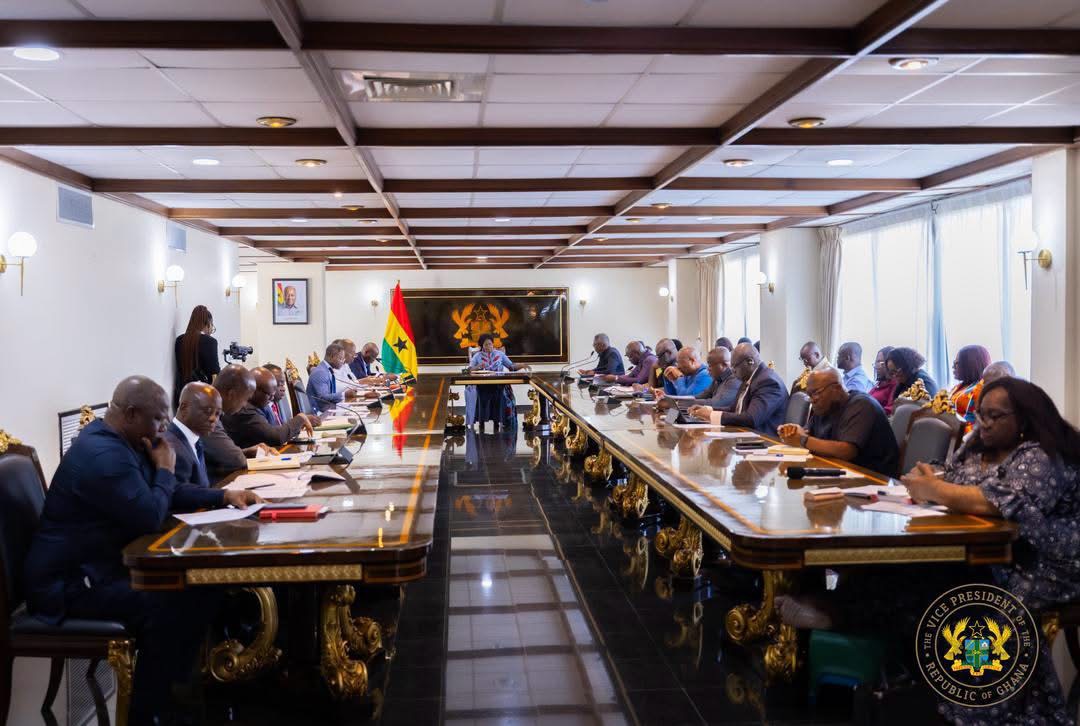
Vice President Professor Jane Naana Opoku-Agyemang has chaired a high-level meeting of the Inter-Ministerial Coordinating Committee (IMCC) on Decentralisation at the Peduase Lodge, as government intensifies efforts to deepen Ghana’s decentralisation agenda and strengthen local development.
The meeting, held earlier today, brought together sector ministers, institutional heads and key stakeholders mandated under the Local Governance Act, 2016 (Act 936) to steer the country’s decentralisation reforms . The Peduase Lodge, a historic presidential retreat in the Akuapim South Municipal District of the Eastern Region, has traditionally served as a venue for government strategy sessions .
The IMCC’s Renewed Mandate
The IMCC has been re-energised under the current administration as the highest national platform for inter-ministerial coordination of decentralisation . Established under Act 936, the Committee is designed to drive cross-sectoral collaboration and ensure compliance with decentralisation mandates across government institutions .
The Vice President has repeatedly stressed that a coherent and purposeful government stance is vital for attracting development partner support and ensuring that “funds follow functions” . She has described the IMCC’s reactivation as one of three pivotal interventions to reinvigorate the decentralisation drive, alongside increased direct transfers from the District Assemblies Common Fund to Metropolitan, Municipal and District Assemblies (MMDAs), and ongoing policy and legislative work to deepen functional devolution .
Key Priorities: Devolution of Critical Sectors
The IMCC has identified the decentralisation of the Education, Health and Road sectors as top priorities, with a target of achieving these reforms within the first year of the National Decentralisation Policy and Strategy (2026–2030) plan period .
In recent months, the Committee has held dedicated consultations with line ministries to operationalise devolution. In March 2026, the IMCC initiated discussions with the Ministry of Health to revive Ghana’s long-standing health sector devolution agenda . Dr. Gameli Kewuribe Hoedoafia, Executive Secretary of the IMCC, has argued that health and education remain the most critical services affecting citizens at the local level, and therefore, decision-making authority should be placed closer to the people .
Similarly, in May 2026, the IMCC engaged the Ministry of Roads and Highways to improve coordination of devolved road sector responsibilities within MMDAs . The National Decentralisation Policy 2026-2030 proposes that every district should have a roads department, a shift from the current arrangement of separate feeder roads and urban roads departments .
Institutional and Accountability Framework
The Vice President has emphasized that effective decentralisation must be anchored in stronger institutions, greater accountability and adequate resources . She has highlighted the government’s Position Paper on Constitutional Review recommendations as offering “an opportunity to pursue reforms that strengthen local governance and accountability” .
At the second National Dialogue on Decentralisation and Responsive Governance in August 2026, Prof. Opoku-Agyemang urged a decisive “reset” of Ghana’s local governance architecture to accelerate service delivery and development . She announced that sanitation performance would now be a key performance indicator for MMDCEs, and proposed the establishment of District Environment, Health and Sanitation Departments within assemblies .
The government is also working on legislative reforms to support devolution. A Legislative Review Committee, chaired by Prof. Kwamena Ahwoi, has been established to oversee reforms across sectors . The health sector review is currently a top priority, with a 12-member technical committee tasked with developing a draft bill to support devolution, with a target of completing and submitting it to Cabinet by December 2026 .
The Peduase Venue
The choice of Peduase Lodge for the IMCC meeting underscores the significance of the deliberations. The Lodge, built and first used by Ghana’s first President, Kwame Nkrumah, has been used extensively for government retreats and high-level strategic meetings .
Broader Decentralisation Vision
The IMCC’s work is part of the broader National Decentralisation Policy and Strategic Framework 2022–2030, which seeks to deepen decentralisation, strengthen local governance institutions, improve public service delivery and accelerate development at the local level .
Prof. Opoku-Agyemang has consistently emphasised that decentralisation must ultimately be judged by its impact on ordinary Ghanaians. “Our aim is a Ghana where local institutions have the confidence, the capacity and the resources to respond to local needs, and where communities are active partners in shaping development,” she has stated .
The Vice President has also urged citizens, development partners, civil society organisations, traditional authorities and academia to support the implementation of the decentralisation agenda through technical assistance, capacity development, financing, advocacy and active participation .


