



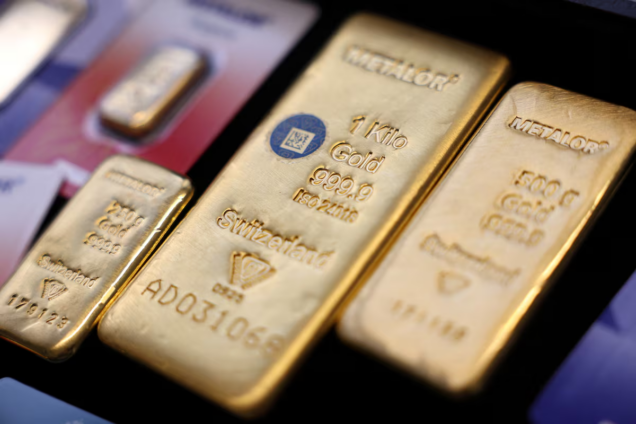
Gold prices edged lower on Monday, weighed down by robust U.S. employment data that reinforced expectations of an interest rate hike, while investors turned their attention to key inflation reports due later this week for clearer guidance on the Federal Reserve’s policy trajectory.
Spot gold was down 0.5% at $4,405.47 per ounce as of 0211 GMT, following a 1% decline on Friday. U.S. gold futures for December delivery also slipped 0.5% to $4,452.20.
Jobs Data Delivers Upside Surprise
Data released on Friday showed U.S. job growth accelerated sharply in August, with the economy adding 162,000 jobs—nearly three times the 56,000 that economists had anticipated . The unemployment rate held steady at 4.1%, suggesting an improvement in the labour market after recent struggles . July’s nonfarm payrolls were also revised upward from a decline of 23,000 to an increase of 21,000 .
The strong employment report pushed traders to increase their bets on a rate hike at the Federal Reserve’s September 15-16 meeting. Futures markets now price in a 58.4% probability of a quarter-point increase, up from approximately 50% before the data release .
“The jobs number delivered a clear upside surprise and put some pressure on the metal, but it wasn’t a complete slam dunk for a September rate hike,” said Tim Waterer, chief market analyst at KCM Trade. “The real missing piece of the puzzle arrives this week with U.S. CPI.”
Inflation Data to Determine Policy Path
The market’s focus now shifts to two critical inflation reports. The U.S. producer price index (PPI) is due on Thursday, followed by the consumer price index (CPI) on Friday .
Economists polled by Reuters expect headline CPI to rise 0.4% month-on-month in August, compared to a 0.2% increase in July, while core CPI is forecast to rise 0.2% with the year-over-year rate slipping to 2.4% from 2.5% .
“A strong inflation print would reinforce expectations of a Fed hike, lift yields further and weigh more heavily on gold,” Waterer said.
Deutsche Bank analysts echoed this sentiment, noting that these releases represent “the last set of inflation readings before the Fed’s next decision on September 16” .
Fed Governor Christopher Waller has indicated that the August CPI data will be a decisive factor in his vote, saying he would support holding rates steady if inflation continues to cool, but would consider a hike if the data surprises to the upside .
A Central Bank in a Bind
The Federal Reserve finds itself in a delicate position. The strong jobs report has reduced concerns about labour market softness, removing one excuse for holding rates steady . However, the administration of President Donald Trump has publicly pressured the Fed to cut rates, with Trump stating on Friday that he would stop trading with countries with which the United States has a deficit unless the Fed lowers rates .
Meanwhile, the 10-year Treasury yield has climbed to 4.78%, approaching the 5% threshold that investors view as potentially troublesome for equity valuations . Higher yields typically increase the opportunity cost of holding non-yielding bullion, weighing on gold prices.
Geopolitical Tensions Offer Some Support
Despite the pressure from rate expectations, gold has found some support from escalating geopolitical tensions. Over the weekend, U.S. forces struck three Iranian oil tankers, prompting a strong response from Tehran . A senior Iranian official has warned of a “painful response” if the country comes under further attack .
The escalating conflict raises concerns about the Strait of Hormuz, a critical chokepoint for global oil shipments. Iran has previously shut the strait, contributing to a global oil crisis and inflationary pressures . Citi analysts suggest that if the strait reopens, oil prices could fall, which might actually provide support for gold by easing inflation concerns and potentially allowing the Fed to pivot toward looser policy .
Outlook
While gold is typically viewed as an inflation hedge, higher interest rates tend to diminish the appeal of non-yielding bullion. The metal is currently caught between the pressures of a potentially hawkish Fed and the safe-haven demand driven by geopolitical instability.
“The gold market is currently in a dynamic balance between policy pressure and safe-haven support,” analysts at Zhongzhou Futures noted. “The strong nonfarm payrolls data reinforced rate hike risks, while escalating geopolitical conflicts could trigger safe-haven buying at any time” .
Citi maintains a relatively bullish outlook, setting a 0-3 month target of $4,800 per ounce and a 6-12 month target of $5,000, both above current spot prices .
Other Precious Metals
Among other metals, spot silver eased 0.2% at $66.03 per ounce, platinum lost 0.8% at $1,805.53, and palladium declined 0.7% to $1,396.08 .


