



The Trades Union Congress (TUC) has proposed sweeping reforms to Ghana’s Council of State, including limiting the number of members appointed by the President to no more than five.
The TUC said although the Council remains a useful organ of state, its effectiveness could be improved by reducing the dominance of presidential appointees in its composition.
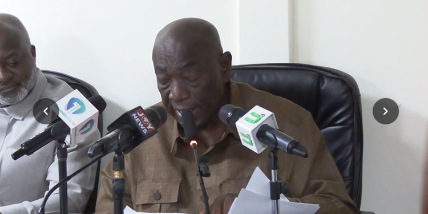
Speaking on the Union’s position on the review of the 1992 Constitution, TUC Secretary-General Joshua Ansah said the Council of State must be reformed to better meet the expectations of citizens.
“The Council of State remains a useful organ of state that must be reformed to be effective at meeting the expectations of citizens,” he said.
Mr Ansah argued that the overwhelming dominance of presidential appointees undermines the independence and effectiveness of the Council, and called for changes to its composition.
“The overwhelming dominance of presidential appointees on the Council is unhelpful,” the TUC stated, adding that the number of members appointed by the President “must not be more than five” .
Background: The Current Composition
The call forms part of the union’s broader position on proposed constitutional reforms, particularly Article 89(2) of the 1992 Constitution, which deals with the composition of the Council of State .
Under the current constitutional arrangement, the Council of State consists of persons appointed by the President in consultation with Parliament — including one person who has previously held the office of Chief Justice, one former Chief of Defence Staff, and one former Inspector-General of Police .
It also includes the President of the National House of Chiefs, one representative from each of Ghana’s 16 regions elected by an electoral college, and 11 other members appointed by the President .
The current 31-member Council of State was inaugurated by President John Dramani Mahama on February 18, 2025, under the chairmanship of Mr Edward Korbly Doe Adjaho, a former Speaker of Parliament .
The Council is made up of five institutional representatives nominated by the President, 10 other nominees of the President, and 16 elected regional representatives .
Position on DCE Elections
On the election of District Chief Executives (DCEs), the TUC supported the government’s proposal for all DCE elections to be held at the same time.
The Union, however, rejected a proposal that would allow an incumbent government to nominate five candidates, from whom three would be shortlisted for election.
Mr Ansah said district-level elections must be conducted with greater autonomy, without central government determining the candidates.
“Districts must be allowed to elect their leaders without central government determining who qualifies to contest,” Mr Ansah stressed .
The government had proposed that the President would nominate five persons for each District Chief Executive position, with at least two of the nominees being women. A vetting committee comprising representatives of the Ministry responsible for Local Government, the Public Services Commission and the Local Government Service would then assess the nominees and shortlist three candidates, including at least one woman, for election .
The TUC’s rejection of this arrangement reflects concerns that it would undermine local government independence and limit residents’ ability to freely choose their leaders .
District Assembly Representation
The TUC also backed changes to the composition of District Assemblies to provide broader representation for traditional authorities, women, businesses, persons with disabilities, the youth and civil society organisations .
The union believes that these groups should have stronger representation in local governance structures to ensure that decision-making reflects the diversity of Ghanaian communities.
Broader Constitutional Reform Context
The TUC’s proposals come amid ongoing national discussions on constitutional reforms following the work of the Constitutional Review Committee (CRC).
The government, in its White Paper on the CRC recommendations presented on July 30, 2026, endorsed the direct election of all Metropolitan, Municipal and District Chief Executives, replacing the current presidential appointment system .
However, the government modified the CRC’s proposed implementation framework and rejected a phased approach that would have tied the right to elect a DCE to a district’s fiscal capacity.
Attorney-General and Minister for Justice, Dr Dominic Ayine, said the government took the position that “all District Chief Executives should be elected” because creating a distinction between voting and non-voting districts “carries significant political costs and may be perceived as discriminatory against citizens” .
The government has proposed holding the necessary constitutional referendum alongside the 2027 District Assembly elections to reduce the cost of organising separate electoral exercises .
TUC to Submit Detailed Response
Speaking at a press briefing in Accra on September 9, 2026, Mr Ansah presented the labour movement’s formal position on the CRC recommendations, saying the organisation had carefully examined the proposals and would submit a detailed response to support the ongoing constitutional reform process .
The TUC’s proposals add to a growing chorus of voices calling for reforms to Ghana’s governance structures, with various stakeholders offering differing perspectives on how best to strengthen democratic accountability and citizen participation in governance.


