



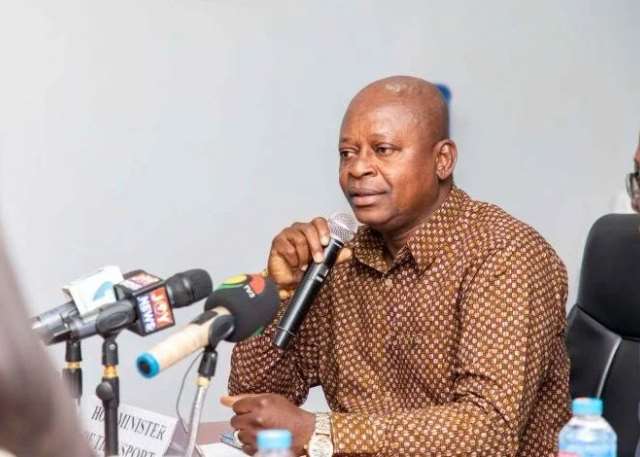
The government has initiated moves to confiscate and auction containers that have remained at Ghana’s ports for more than six months, as part of urgent measures to decongest the country’s major ports amid an unprecedented surge in container volumes.
Transport Minister Joseph Bukari Nikpe has directed the Ghana Ports and Harbours Authority (GPHA) to compile a list of containers that have overstayed at the ports for possible confiscation and auction .
“It is for us as a government to ensure that containers that are overstayed in the port are evacuated,” Nikpe said in an interview with Bernard Avle on Channel One TV’s The Point of View on Wednesday, September 9, 2026 .
He said GPHA had been instructed to identify the containers and hand the list to the Ghana Revenue Authority (GRA), which has the statutory responsibility to confiscate them.
“We had involved the Ghana Revenue Authority to confiscate such containers and then get them gazetted and auctioned to the people in a way to decongest the port,” he said .
Shipping Lines Asked to Remove Empty Containers
The Minister also disclosed that government had asked shipping lines to remove containers belonging to them that had remained at the port for more than six months.
According to him, the shipping lines are now making arrangements to bring in more vessels to take away their empty containers.
“The shipping lines are also making calls to bring in more ships to help them take their empty containers because they wouldn’t want to sit down and have them confiscated,” he said .
“I’m told that they have accelerated calls and are getting in more of the ships to help take the empty containers that have been left in the port for some time” .
Nearly 100% Surge in Container Volumes
The Minister attributed the congestion to a dramatic increase in container volumes, which he described as unprecedented in the past 20 years .
“But the truth of the matter is that the container volumes have increased almost to 100 per cent, which has never been recorded in the past 20 years at the port,” he said .
The surge has created significant operational challenges at the Meridian Port Services (MPS) Terminal at Tema, raising concerns over delays in cargo clearance and Ghana’s competitiveness as a regional trade hub .
Industry players have also cited persistent system outages at the MPS terminal as a major challenge, saying the technical disruptions have affected cargo-handling efficiency, forcing some containers to be redirected to off-dock terminals and further worsening congestion .
Government Engages Port Officials
Mr Nikpe said he had visited the port on Friday, September 4, 2026, to engage port officials on measures to address the congestion.
“I visited the port on Friday to get in touch with the port officials for us to take a decisive decision as to how to decongest the port. And I must say that it was a very fruitful meeting,” he said .
He explained that the surge in imports, coupled with insufficient export and transit cargo, had put additional pressure on available terminal space. According to him, shipping lines are occupying a significant portion of the available space at Terminal 3 and facilities operated by the GPHA .
Immediate and Long-Term Interventions
As part of immediate measures, Mr Nikpe said government was working with the Railway Development Authority to use available space at one of its terminals to temporarily evacuate some containers from the port .
He also disclosed that the GPHA had been instructed to urgently acquire two additional cranes to improve the loading and offloading of cargo.
“I also instructed the Ghana Ports and Harbours Authority for them to acquire two cranes that will be able to load and offload quickly so that all the ships or all the shipping lines coming in with cargo would not have any issue in terms of delay that would have caused them to pay demurrage any longer,” he said.
“So they are going to do an emergency acquisition of two cranes that will augment already what they have on the ground that will facilitate the loading and offloading of cargo, and it is believed that we will be able to decongest the port.”
Beyond the immediate interventions, the Minister said government was pursuing long-term measures to expand port infrastructure to accommodate rising container traffic. Both the GPHA and MPS are expected to expand their facilities and construct additional berths to increase handling capacity .
Mr Nikpe also identified inadequate road infrastructure leading into and out of the ports as another major contributor to congestion. He said government, in collaboration with MPS and the GPHA, was working to expand the Tema and harbour routes to improve traffic flow around the ports .
Legal Framework for Confiscation
Under Ghana’s Customs Act 2015 (Act 891), goods imported into the country are expected to be cleared within seven days after being discharged. Where goods are not cleared within the stipulated period, they are deemed to be deposited in the State Warehouse for a period of not more than fourteen days .
After twenty-one days, the goods are put on the Uncleared Cargo List (UCL) and are due for forfeiture. The process of forfeiture starts immediately the goods go on the UCL or after the expiry of any extension period .
When forfeited cargoes are confiscated, examination and valuation is done for about a three-month period, after which goods are enlisted and gazetted for public auction .
Broader Port Congestion Challenges
The clinker crisis is part of a broader congestion problem at Tema Port. A Ghana Shippers Authority assessment report published on September 3, 2026, found that about 70 percent of containers at Tema’s Terminal 3 undergo full physical inspections — seven times the rate recommended by the World Customs Organization.
Terminal 3, which opened in 2019 after a $1.5 billion investment, can handle 3 million TEUs annually and accommodate vessels carrying up to 24,000 TEUs. It has already handled 2.5 million TEUs in 2026 before the peak season.
The terminal faces significant challenges on the land side, including a single congested access road, no rail connection to the hinterland, and underused inland container depots.
Demurrage Costs Mounting
The congestion has also led to significant demurrage costs for importers. The Chamber of Cement Manufacturers, Ghana (COCMAG) has reported that vessel waiting times for clinker ships have surged from an average of seven days in January 2026 to between 30 and over 40 days in August.
The delays are estimated to have cost the industry between US50 million in demurrage charges during the first eight months of 2026, with individual vessels incurring costs ranging from US1 million.
COCMAG introduced a temporary GH¢12 per bag clinker demurrage surcharge in September 2026 — comprising GH¢10 before tax and GH¢2 in applicable taxes and levies — to offset these exceptional costs.
Mr Nikpe said the combined measures were intended to free up terminal space, improve cargo-handling efficiency and ensure the ports could cope with the sharp rise in container volumes.


