



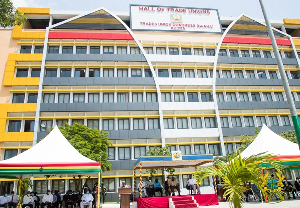
The Trades Union Congress (TUC) has drawn a firm line in the sand, categorically rejecting a World Bank-backed plan to hand over the operations of the Electricity Company of Ghana (ECG) and the Northern Electricity Distribution Company (NEDCo) to private entities.
In a hard-hitting statement released on Tuesday, the union accused the Bretton Woods institution of attempting to “sneakily” privatise the country’s power distribution sector, and vowed to use “all legal means available” to block the proposal.
The TUC’s rebuke is a direct response to recent comments by the World Bank’s Country Director, Dr. Adrian Alter, who had downplayed the plan, asserting that the proposed private sector participation (PSP) involved “only revenue collection.”
A “Disingenuous” Proposal
The union rejected this characterisation as misleading. According to the TUC, the model put forward by the Transaction Advisor—appointed at the behest of the World Bank and the International Monetary Fund (IMF)—is far more expansive.
The union outlined that the proposal would allow private operators to take full responsibility for electricity distribution, from the Bulk Supply Points to the final consumer. While ECG and NEDCo would retain ownership of the physical assets, private firms would lease and operate the networks, managing billing, customer service, network maintenance, and loss reduction.
“The World Bank is aware of this model. It is shocking for the Bank to say otherwise. And it is even more disingenuous for the Bank to claim that ECG is not going to be privatised,” the statement read.
Questioning the World Bank’s Logic
The TUC also challenged the economic rationale for the plan, pointing to international data that shows countries like Egypt, Tunisia, Algeria, and Ghana have higher rural electricity access rates than Nigeria and Uganda, where private distribution is more established.
Furthermore, the union criticised the World Bank for focusing on distribution losses while ignoring the controversial Independent Power Producer (IPP) model. The TUC argues that the IPP model has inflated generation costs and increased Ghana’s foreign exchange exposure. “The Bank will have us believe that the IPP model of procuring generation is the only game in town and that Ghana cannot do without it. This is a lie,” the statement said.
Sovereignty and Historical Precedent
Drawing on painful historical parallels, the TUC invoked the spectre of the Structural Adjustment Programmes (SAPs) of the 1980s and 90s. The union recalled that similar World Bank-supported reforms led to the privatisation of over 100 state-owned enterprises and significant job losses.
“We did not vote for the World Bank to run our country and, for that matter, our energy distribution sector,” the union declared, insisting that PSP, in this context, is a synonym for privatisation.
Parliamentary Support
The TUC’s position has found some resonance in Parliament. Collins Adomako-Mensah, Member of Parliament for Afigya Kwabre North, acknowledged that organised labour has “legitimate reasons for caution” given Ghana’s complex history with private energy collaborations.
While his party supports private participation to improve efficiency, he stressed that any new arrangement must be “properly designed” to avoid repeating past mistakes. “The TUC’s position… is a call for careful examination, rather than outright opposition,” he noted.
A Sector in Crisis
The standoff comes at a critical juncture for Ghana’s energy sector. The government is actively seeking to mobilise US4.4 billion pipeline aimed at expanding electricity access to 99% of the population by 2030.
As of publication time, neither the World Bank nor the Ministry of Energy had issued a formal public response to the TUC’s latest statements.


