



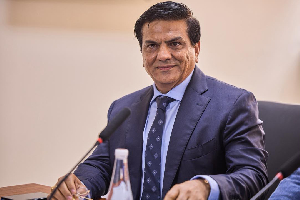
The Chairman of B5 Plus Limited, Mukesh Thakwani, has urged the government to ban the importation of goods that Ghanaian manufacturers are capable of producing locally, arguing that such a move would bolster domestic industries, create jobs, and ease pressure on the country’s foreign exchange reserves .
Speaking during a media engagement with the Ghana Revenue Authority (GRA), Thakwani said Ghana’s manufacturing capacity remains significantly underutilised while competing imported products continue to flood the market . He cited capacity utilisation of below 50% in some segments of the manufacturing sector, stressing that local producers have the capacity to scale up production to meet domestic demand and export to the sub-region .
“So we are not only producing the goods for Ghana but also for the West African market,” he stated .
A Call for Policy Review
Thakwani urged the government to review the continued importation of products that can be manufactured locally, raising particular concern about exemptions granted to some imported goods that directly compete with locally produced items . He also called for a review of the tax treatment of certain imports, arguing that local manufacturers require a more supportive policy environment to expand production .
The B5 Plus Chairman argued that increasing local production would help Ghana retain more foreign exchange while creating additional employment opportunities across the value chain .
Background: An Industrial Agenda
The call comes against the backdrop of the government’s broader industrialisation and import substitution agenda. The Vice-President, Prof. Naana Jane Opoku-Agyemang, has stated that the government’s economic reset agenda prioritises local manufacturing under the Ghana Framework for Industrialisation, Revitalisation, Support, and Transformation .
President John Dramani Mahama has also reiterated a commitment to eliminating raw ore exports within five years, supporting downstream processing, and promoting mineral-based industrial clusters . The government has likewise announced plans to potentially ban poultry imports by 2028, contingent on achieving internal production security .
A Leading Voice for Local Manufacturing
Thakwani has been a vocal advocate for Ghana’s industrialisation agenda. Speaking at the 10th Ghana CEO Summit earlier this year, he urged Ghana to move from import dependence to production-led growth, stating: “For too long, Africa has exported opportunity and imported value. Ghana must stop exporting potential and start exporting finished value” .
He also disclosed that B5 Plus is expanding its operations, including a 20-megawatt rooftop solar installation, which would be among the largest private-sector industrial solar projects in Africa once completed .
Impact of B5 Plus
B5 Plus is a significant player in Ghana’s manufacturing sector, particularly in iron and steel production. The company operates a steel ball mill and section mill plant at Larkpleku in the Ningo-Prampram area, commissioned by President Mahama in February 2026 . The plant is expected to support Ghana’s infrastructure programme and the government’s “Big Push” agenda by supplying critical materials for roads, railways, and housing projects .
The company’s significance was underscored recently when it presented a GH¢400 million tax cheque to the Ghana Revenue Authority . At the presentation, the Commissioner of the GRA’s Domestic Tax Revenue Division, Dr. Martin Kolbil Yamborigya, commended B5 Plus for its tax compliance and urged other businesses to follow its example .
Government’s Stance on Import Substitution
The Trade Minister, Elizabeth Ofosu-Adjare, has previously reaffirmed the government’s commitment to import substitution and quality made-in-Ghana goods, noting that “import substitution is a crucial part of our strategy because it makes our cedi story stronger and allows us to better assure the quality of products consumed locally” .
The government has also intensified inspections at local companies through the Food and Drugs Authority (FDA) and the Ghana Standards Authority (GSA) to ensure compliance with quality standards .
As of publication time, no official response from the Ministry of Trade, Agribusiness, and Industry to Thakwani’s latest proposal has been made public.


