


President Donald Trump returned from Beijing this week with a notably conciliatory message toward Chinese President Xi Jinping, declaring the U.S.-China relationship “going to be better than ever before” and hailing “fantastic trade deals,” even as core disputes over trade, technology, and Taiwan remain unresolved.
The visit marked a sharp contrast from Trump’s long-standing portrayal of China as America’s foremost economic adversary. During his 2016 campaign and throughout his political career, Trump repeatedly accused Beijing of “raping” the U.S. economy through unfair trade practices, intellectual property theft, and currency manipulation.
That rhetoric carried into his second term. Trump surrounded himself with prominent China critics, including Secretary of State Marco Rubio, Vice President JD Vance, and senior economic adviser Peter Navarro. Early in 2025, the administration escalated tariffs on Chinese goods from 10% to as high as 145% on “Liberation Day,” prompting Beijing to retaliate with 125% tariffs and restrictions on rare earth exports.
Friendly optics, limited breakthroughs
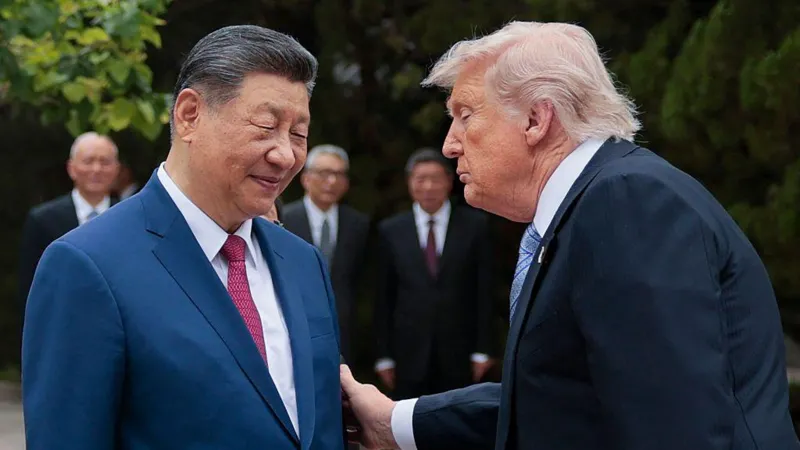
In Beijing, the tone shifted dramatically. Trump was greeted with a red-carpet ceremony at the Great Hall of the People, complete with flag-waving children and a military band playing the U.S. national anthem. He described the meeting with Xi as an “honour” and emphasized friendship.
While no comprehensive new trade agreement was announced, U.S. companies secured tangible wins: chipmaker Nvidia reportedly received approval to sell semiconductors to 10 Chinese firms, Boeing landed an order for 200 aircraft, and Citigroup was cleared to operate a securities business in China.
However, tensions persisted. Just days before the summit, the U.S. State Department sanctioned three Chinese companies for supplying satellite imagery to Iran for strikes on American forces in the Middle East. On Taiwan — the self-governing island Beijing claims as its territory — Trump offered few details on a delayed $14 billion U.S. arms package long sought by both Democrats and Republican hawks.
“I made no commitment either way,” Trump told reporters aboard Air Force One. He said he would make a determination “over the next fairly short period.”
The Chinese readout of the meeting placed heavy emphasis on Taiwan, warning that failure to handle the issue properly could lead to “clashes and even conflicts.” The White House summary made no mention of the topic.
Mixed reactions from China critics
The softer U.S. approach drew a pointed response from longtime Trump ally and former strategist Steve Bannon.
“I am shocked, given how much people wanted to make this into a positive spirit, he [Xi] started with a threat,” Bannon told Politico. “It was so brazen and so blatant.”
Despite such concerns, prominent China hawks in Congress and within Trump’s circle have remained largely quiet following the summit.
China policy experts say the muted reaction is unsurprising. David Firestein, president and CEO of the George H.W. Bush Foundation for U.S.-China Relations, noted that fundamental disagreements between the two powers — on market access, subsidies, intellectual property, and Taiwan — are unlikely to disappear regardless of summit outcomes.
“We still have the same problems today… None of those problems have been solved after eight years of having these tariffs on the books,” Firestein told the BBC.
David Sacks of the Council on Foreign Relations observed that the administration’s direction appears more top-down than in Trump’s first term. “When Trump opines, people follow. And the base follows,” added Stephen Orlins of the National Committee on U.S.-China Relations.
Taiwan remains a flashpoint
Pressure continues on the administration to approve the $14 billion arms sale to Taiwan ahead of Xi’s planned visit to the White House in September. Bipartisan groups of senators have urged formal notification to China, and congressional hearings are expected to keep the issue alive.
Analysts warn that proceeding with a major arms package could complicate Xi’s September trip, leaving Trump with a difficult balancing act between maintaining strategic deterrence in the Indo-Pacific and preserving the improved diplomatic atmosphere he has sought with Beijing.
As the dust settles on the Beijing visit, Trump’s shift in tone appears to reflect a pragmatic assessment that previous hardline measures yielded limited results on long-standing economic grievances. How his base and Republican hawks ultimately judge that recalibration will likely shape U.S.-China policy for the remainder of his term.
Trump’s Beijing Summit: Softer tone on China leaves MAGA hawks largely silent

Try our mobile app
Never miss an update. Read anytime, anywhere with our mobile app.


- Advertisment -