



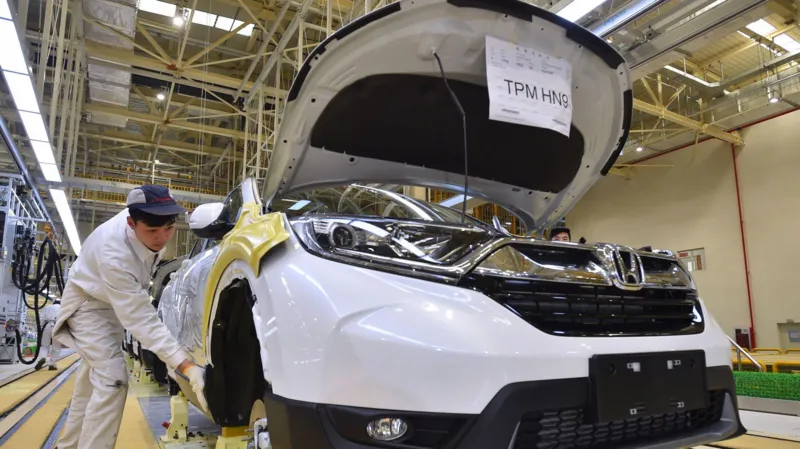
Honda Records Japanese automaker Honda has reported its first annual operating loss in seven decades, citing a costly miscalculation in consumer demand for electric vehicles.
For the financial year ending March 2026, Honda posted an operating loss of ¥423 billion ($2.68 billion). The company acknowledged that its heavy investments in EV development have not paid off, as global demand for battery-powered cars remains weaker than forecast.
In response, Honda is scaling back several key EV targets. The company said it will abandon its goal for EVs to account for 20% of new car sales by 2030, as well as its previous commitment to sell only EVs by 2040. To cut costs, Honda plans to source certain parts from China, where prices are lower.
The automaker attributed part of its financial troubles to recent U.S. policy changes. President Donald Trump’s administration eliminated tax credits of up to $7,500 for new EV buyers in September 2025 and imposed tariffs on imported cars and auto parts — later reduced from 25% to 15% — which further squeezed profit margins.
Honda, first listed on the Tokyo Stock Exchange in 1957 and now Japan’s second-largest automaker, has struggled to adapt to volatile swings in EV demand. Analysts point to the company’s size and legacy manufacturing footprint as key obstacles.
Going forward, Honda said it will refocus on its profitable motorcycle division, financial services, and hybrid vehicle production. North America, Japan, and India remain “priority markets,” though the company has suspended plans to build EVs and batteries in Canada.
Chief Executive Toshihiro Mibe confirmed the revised strategy, while warning that EV-related losses could reach ¥512 billion in the next fiscal year ending March 2027.
“It’s a bleak milestone for Honda but not a surprising one,” said Danni Hewson, head of financial analysis at AJ Bell. “Like many legacy automakers, it gambled on motorists making a quick move to EVs — and lost as the world shifted.”
Hewson added that while recent petrol price increases — driven by the US-Israel conflict with Iran — have temporarily boosted EV demand, large-scale manufacturers like Honda are struggling to adapt quickly. “Things could get tougher with more twists and turns on the horizon.”


