


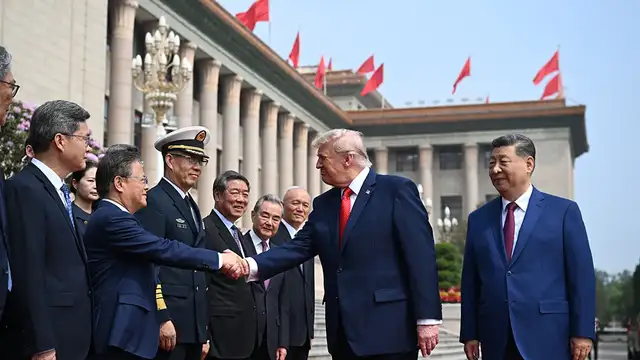
President Donald Trump arrived in China on Thursday for his first visit since 2017, holding bilateral talks with Chinese President Xi Jinping in a high-stakes summit aimed at stabilizing relations between the world’s two largest economies while addressing deep-seated disputes over trade, technology, Taiwan, and the ongoing Iran crisis.
Trump and Xi began their meetings at the Great Hall of the People, following a formal welcome ceremony that included a review of an honor guard. The two-day summit includes a tour of the Temple of Heaven and a state banquet. Topics under discussion include tariffs, artificial intelligence, agriculture, energy agreements, and the establishment of new U.S.–China boards for trade and investment.
White House officials framed the visit as an opportunity to secure economic wins and rebalance the bilateral relationship. White House spokeswoman Anna Kelly said Trump’s objective is to “deliver more good deals on behalf of our country” while protecting U.S. national security.
Chinese officials welcomed the engagement. Embassy spokesperson Liu Pengyu stated that “heads-of-state diplomacy plays an irreplaceable role” and expressed Beijing’s readiness to expand cooperation and manage differences “in the spirit of equality, respect and mutual benefit.”
Analysts note differing priorities. Trump is seeking visible momentum and headline agreements ahead of the 2026 midterms, while Xi is viewed as pursuing a longer-term strategy of strategic patience to stabilize ties and buy time for China’s economy, which continues to face weak domestic demand, deflationary pressures, and industrial overcapacity.
A recent report by the U.S.–China Economic and Security Review Commission highlighted Beijing’s state-led industrial policies, warning of a “two-speed” economy and a potential “China Shock 2.0,” in which excess capacity and growing trade surpluses disrupt global markets and increase dependence on Chinese supply chains in critical sectors such as batteries, pharmaceuticals, semiconductors, and AI.
The summit occurs against the backdrop of instability in the Middle East. With energy prices rising due to tensions near the Strait of Hormuz, the Trump administration has pressed China — one of Iran’s largest oil customers — to play a more active role. Reports indicate Xi has expressed interest in purchasing U.S. oil amid the crisis.
Progress is anticipated in agriculture, with the White House pushing for increased Chinese purchases of U.S. farm products, including soybeans, corn, sorghum, wheat, beef, and poultry. A delegation of U.S. business leaders, including executives from Cargill, is accompanying the president.
Technology restrictions and Taiwan remain sensitive issues. Beijing opposes U.S. arms sales and support for the island, while Washington maintains export controls on advanced semiconductors and AI technology destined for China.
Human rights advocates are urging the administration to address China’s treatment of religious groups. Trump has pledged to raise the case of imprisoned pastor Ezra Jin, following appeals from his daughter.
Despite the rivalry, neither side appears eager for direct confrontation. The meetings provide symbolic value through high-level engagement, even if major breakthroughs are considered unlikely in the short term.
The summit comes as both nations navigate complex global challenges, with the U.S. seeking to assert dominance in key areas and China aiming to preserve stability while advancing its long-term strategic goals.
Trump, Xi hold high-stakes Summit in Beijing amid trade, Iran, and Taiwan tensions

Try our mobile app
Never miss an update. Read anytime, anywhere with our mobile app.


- Advertisment -