



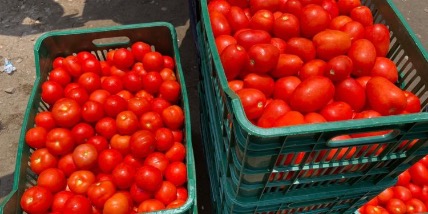
Fresh tomato prices surged by 158.3% year-on-year in August 2026, making the commodity the biggest price mover recorded by the Ghana Statistical Service (GSS) during the month, even as overall food inflation moderated marginally .
The sharp increase means tomatoes accounted for about 21.4% of the total contribution to inflation in August, according to the GSS data . The price surge came despite a slight decline in overall food inflation, which fell to 3.0% in August from 3.1% in July .
Presenting the August Consumer Price Index, Government Statistician Dr Alhassan Iddrisu said the significant rise in fresh tomato prices highlighted the varying price experiences of consumers across different commodities .
“Fresh Tomatoes more than doubled in price (+158.3%) while Lime fell 33.7%: the overall Y-on-Y inflation of 5.0% hides very different experiences at the market,” he noted .
Ginger, Other Commodities Also Record Sharp Increases
GSS data show that fresh tomatoes recorded the highest year-on-year price increase among the commodities tracked in August, followed by ginger, whose price rose by 128.3% . Shrimps recorded a 67.1% increase, mango prices rose by 57.7%, while fresh coconut and fresh green pepper increased by 38.0% and 30.5%, respectively .
The sharp rise in tomato and ginger prices comes amid an annual supply deficit of approximately 1.1 million metric tonnes of tomatoes, according to researchers at the Council for Scientific and Industrial Research (CSIR) . Ghana’s combined tomato imports—both fresh and processed—exceed US$230 million annually, yet still fill only about 40% of the country’s tomato shortfall .
More than 60% of fresh tomato imports enter Ghana during the dry season between November and April, when local supply falls sharply, leaving the country vulnerable to supply disruptions .
Price Declines for Other Food Items
The data also showed significant price declines for several other commodities. Lime recorded the biggest drop, falling by 33.7%, while maize prices declined by 31.3% . Cocoyam leaves, sweet apples, fried fish and pawpaw also recorded notable price reductions .
Despite the mixed movements, the GSS reported that food prices generally fell by 2.5% month-on-month in August .
Overall Inflation Rises Despite Food Moderation
Overall year-on-year inflation increased to 5.0% in August from 4.6% in July, marking the second consecutive monthly rise, though remaining substantially below the 11.5% recorded in August 2025 . Non-food inflation was the main driver, rising to 6.8%, compared with food inflation of 3.0% .
The GSS said non-food items accounted for 70.9% of total inflation, while food contributed 29.1% . Services remained a major source of price pressure, recording inflation of 8.6%, compared with 3.8% for goods .
According to the GSS, locally produced goods and services accounted for 86.2% of total inflation, while imported items recorded inflation of 2.2% . At the regional level, the Central Region recorded the highest inflation rate at 11.1%, more than twice the national average, while Bono East recorded the lowest at 3.3% .
Dr Iddrisu explained that inflation measures the rate at which prices change rather than the absolute price level of individual goods. “Inflation measures how fast prices in general are rising or falling, not how high they already are,” he added .
Government Initiatives Underway
The government has announced several initiatives aimed at addressing Ghana’s tomato deficit. In April 2026, the Ministry of Food and Agriculture entered into a strategic partnership with FarmMate Limited to boost domestic tomato production under a public-private initiative . The programme targets the production of 400,000 tonnes of fresh tomatoes annually and aims to reduce Ghana’s reliance on imports .
Additionally, Maphlix Farms has committed to supplying 3,000 tonnes of tomatoes to the domestic market as part of measures to stabilise supply following recent import constraints from neighbouring countries .
The CSIR has also released two open-pollinated tomato varieties, CRI-Kwabena Kwabena and CRI-Copia, with shelf lives of approximately 18 and 21 days respectively, as researchers push for stronger domestic seed systems to reduce dependence on imports .


