



Ghana risks losing its competitive edge in regional transit trade to Côte d’Ivoire and Togo unless urgent action is taken to improve the country’s deteriorating road network, the World Bank has warned in its 10th Ghana Economic Update.
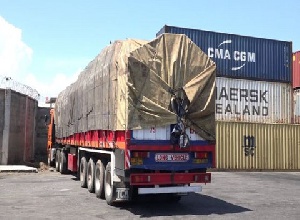
The report reveals that transporting a 40-foot container from Tema to Ouagadougou in Burkina Faso can take anywhere from four days to two weeks, with costs ranging between US3,500, largely due to poor road conditions and persistent checkpoint delays along the route .
The warning comes despite significant investments in Ghana’s port infrastructure. The US$1.5 billion Terminal 3 expansion at Tema Port increased container-handling capacity from 800,000 to 3.7 million TEUs, while customs reforms have reduced container turnaround time to approximately three days .
The Corridor Challenge
According to the World Bank assessment, the primary constraint lies not at the port itself but along the 818-kilometre Tema-Paga corridor—Ghana’s main road link to Burkina Faso and landlocked Sahelian markets .
The report indicates that as of 2017, approximately 35 percent of Ghana’s transit routes, representing 2,606 kilometres of road network, were in fair to poor condition. Even with significant investment since then, the damage continues to be exacerbated by overloaded trucks which further accelerate road deterioration .
“It is not just an infrastructure story—it is a growth story, a competitiveness story, a jobs story,” said Dr Robert Taliercio O’Brien, World Bank Division Director for Ghana, Liberia and Sierra Leone .
Funding Shortfall Compounds Challenges
The World Bank estimates that Ghana’s trunk roads require approximately US$685 million annually for maintenance . However, in 2024, the Road Fund covered only 37 percent of maintenance needs, compared with a target of 65 percent .
The broader picture is even more concerning. Only 27 percent of Ghana’s 94,200-kilometre road network is paved, with more than half in fair-to-poor condition . Feeder roads face particular challenges, affecting agricultural productivity and rural livelihoods .
The economic cost is staggering. Road safety incidents alone are estimated to cost Ghana about 2.1 percent of GDP annually—roughly US$4.55 billion, more than the entire national education budget .
Rail infrastructure has also declined precipitously, with the operational rail network falling from 947 kilometres in 1960 to just 160 kilometres in 2020, while population access to rail services dropped from nearly 30 percent to less than one percent over the same period .
Transit Trade at Risk
Ghana competes directly with Côte d’Ivoire’s Abidjan and Togo’s Lomé ports for transit trade to Burkina Faso and Mali. Transit cargo through Tema grew significantly from 116,000 metric tonnes in 2001 to more than 1.4 million tonnes in 2020 . However, the World Bank warns that without improved road infrastructure and reliable maintenance funding, Ghana risks losing more of this growing regional transit trade to its neighbours .
The challenge is compounded by the fact that transport costs in Ghana remain among the highest in the region, constraining the country’s ability to serve as a competitive logistics hub .
Government Response
In response to the crisis, the government has unveiled an ambitious transport and trade strategy that places rail infrastructure at the centre of its ambition to become a key logistics gateway for the Sahel region .
Finance Minister Dr Cassiel Ato Forson has proposed developing a 1,012-kilometre railway corridor linking Takoradi Port to Hamile in the Upper West Region. Under the plan, cargo destined for landlocked Sahelian countries would be transported directly by rail, reducing pressure on deteriorating roads and strengthening Ghana’s position in regional transit trade .
“My problem here is these vehicles that are overloading and destroying the roads. We will ensure that overloading and destroying this investment that we are making becomes a thing of the past, and it will come with very punitive measures,” Dr Forson warned .
The government also announced that the World Bank-funded Ghana Market Access and Connectivity Project, which received parliamentary approval, involves US$500 million to rehabilitate approximately 1,050 kilometres of feeder roads through performance-based maintenance contracts .
The initiative is expected to reduce travel times on paved corridors by as much as 40 percent, lower transport costs and post-harvest losses, and create approximately 25,000 direct and indirect jobs, including at least 7,500 for women .
A Call for Reform
The World Bank has called for reforms in Ghana’s transport sector, identifying six priority pillars for transformation: operationalising the Road Maintenance Trust Fund, developing a unified national transport strategy, revitalising freight-led rail services along western and eastern corridors, improving road safety, adopting climate-resilient infrastructure standards, and extending the digital single window to streamline logistics .
Mr Samuel Danquah Arkhurst, Coordinating Director (Technical) at the Ministry of Finance, acknowledged the government’s recognition that infrastructure investment would not deliver its full benefits without proper maintenance.
“A road that is not maintained is a road on a countdown to despair, so sustainable road maintenance financing is a reform we are taking seriously,” he said .
As Ghana seeks to maintain its position as a preferred transit hub in West Africa, the World Bank’s warning underscores the urgent need to bridge the gap between port efficiency and the land transport infrastructure that connects Ghana to its regional markets.


