



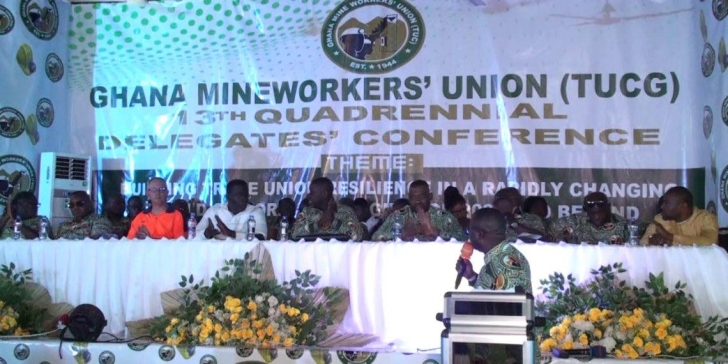
Tensions are mounting between the Ghana Mineworkers’ Union and the government over a new policy requiring mining companies to transfer key operations to locally owned contractors, with the union warning of possible strikes and protests.
The directive, enforced through the Minerals Commission, mandates that surface mining activities be undertaken by wholly Ghanaian-owned firms, while underground operations must involve companies with at least 50 per cent local ownership. The policy is part of broader reforms aimed at increasing local participation in the mining value chain.
But the Mineworkers’ Union says the policy risks eroding hard-won labour standards. General Secretary Abdul Moomin Gbana told Reuters that local contractors often offer lower wages and reduced job security compared to multinational operators, warning that workers could resort to industrial action if their concerns are ignored.
Mr Gbana also argued that the union was not consulted before the regulation was introduced, describing the process as one that sidelines labour interests.
Under the policy, global mining firms operating in Ghana – including Newmont Corporation, Zijin Mining and AngloGold Ashanti – are expected to transfer activities such as blasting, hauling and dumping to local contractors by December 2026 or face sanctions.
Wage gap fears
Central to the union’s concerns is a widening wage gap between contractor employees and workers directly employed by mining firms. Industry sources say contract workers can earn up to 50 per cent less in basic pay, with irregular statutory payments, including pension and provident fund contributions, also reported.
Mr Gbana warned that even if employment levels are maintained, the shift could lead to a steady decline in wages and benefits, undermining worker welfare across the sector.
The union’s resistance follows an earlier unsuccessful attempt between 2017 and 2018 to halt a shift towards contract mining by Gold Fields – a move that opened the door for wider adoption of contractor-led operations.
Industry and regulatory responses
Some industry executives have also raised concerns, arguing that the directive may conflict with existing mining laws that allow leaseholders to determine their operational structures. Critics say the policy could discourage investment if not properly aligned with the legal framework.
Meanwhile, at least one local contractor, Rocksure, has defended its record, stating that it complies fully with contractual and statutory obligations.
The Minerals Commission has acknowledged the concerns and signalled plans to strengthen oversight. Chief Executive Isaac Tandoh said tighter regulation would help prevent underpricing practices that drive down wages and operational standards. He added that the Commission is considering clearer pricing benchmarks and support mechanisms, including partnerships and technical guidance for local firms.
The standoff highlights growing tension between the government’s localisation agenda and labour concerns, as Ghana seeks to balance economic empowerment with the protection of worker rights in one of its most critical sectors.


