



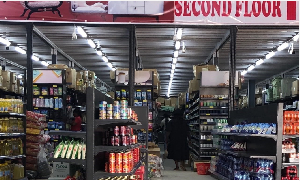
Traders in Sunyani, the capital of the Bono Region, have expressed growing concern over the rapid expansion of shopping malls in the city, warning that the trend is threatening the survival of indigenous businesses. The traders, predominantly women operating small and medium-sized retail outlets, said the significantly lower prices offered by the malls were eroding their market share and making it increasingly difficult for them to compete.
A market survey conducted by the Ghana News Agency observed a proliferation of shopping malls across the city, including several Chinese-owned retail outlets, intensifying competition for local traders. Scores of shoppers were seen patronising major malls including the newly opened Makro Mall along the Sunyani-Abesim Highway, Red Star Mall at the Sunyani Victory Park, and Lemon Mall near the Sunyani-Penkwasi Traffic Light. These malls stock a wide range of products, including cooking utensils, electrical gadgets and appliances, clothing, mattresses, furniture, and interior décor items.
Price Disparities Eroding Local Trade
The price gap between the malls and local shops has become a central grievance for traders. Madam Mercy Amoah, a clothes dealer, cited a dining table set that sold for approximately GH¢1,500 on the local market but was being offered for GH¢1,000 at one of the malls. Similarly, cooking utensils priced at about GH¢1,300 in local shops were being sold for roughly GH¢800 at a mall.
“I personally visited one of the malls, which had just opened along the Sunyani-Abesim Highway, for window shopping, and I noticed that their prices were too low for us to compete with,” she said. She noted that such price disparities were making it increasingly difficult for small retailers to retain customers and remain viable.
Madam Theresah Asantewaa, a shop owner operating within the Sunyani Central Business District, called on the government to introduce measures that would create a level playing field for indigenous retailers to compete effectively with the malls, particularly the Chinese-owned outlets. “Some goods are being sold at considerably lower prices at the malls than on the local market,” she said, adding that local retailers were being pushed out of business.
A Nationwide Pattern of Concern
The Sunyani traders’ concerns mirror a broader national debate over the growing dominance of foreign-owned retail outlets in Ghana. The Ghana Union of Traders Association has repeatedly warned that foreign businesses now control a substantial portion of the country’s retail market, with GUTA President Dr Joseph Obeng stating in September 2025 that foreign businesses dominate about 70% of Ghana’s market, leaving local traders with just 30%.
Prof Abdullah Mumuni, Head of the Economics Department at the University of Professional Studies, Accra, has warned that the surge in shopping malls – particularly foreign-owned ones – could threaten local manufacturing if government fails to demand they source a quota of their products locally. He noted that foreign-owned malls in Ghana import most of their products, rendering local manufacturers uncompetitive due to the high unit cost of domestic production. “Our prices generally are not competitive. It’s not because of quality, but generally the price level. Our unit cost locally is normally high,” Prof Mumuni said, citing crippling expenses for electricity, taxes, water, rent and transportation.
Legal Protections and Enforcement Gaps
Under the Ghana Investment Promotion Authority Act, 2026 (Act 1117), informal retail activities – including trading in open markets, small shops and kiosks – are reserved exclusively for Ghanaian citizens. The law makes it a criminal offence for any person or enterprise to let or sublet a market stall or store to a foreigner for trading purposes. A person convicted of the offence may face a fine of between 2,000 and 4,000 penalty units. Non-citizens or non-wholly Ghanaian-owned enterprises that engage in reserved activities face administrative penalties of between 5,000 and 10,000 penalty units, with further monthly penalties for continued violations.
While Ghana remains open to foreign investment in the formal retail sector, including malls and supermarkets, foreign investors must operate in accordance with the country’s investment laws. In August 2026, the Ghana Investment Promotion to modern Authority and GUTA agreed on a set of measures to strengthen protection of Ghanaian-owned informal retail businesses, including stronger monitoring and enforcement, public education on investment regulations, and a direct reporting mechanism for suspected breaches. The discussions also focused on the growing practice of “fronting,” where Ghanaian individuals or businesses are allegedly used to conceal foreign ownership or control of enterprises operating in sectors reserved for citizens.
GUTA President Clement Boateng said the association was not opposed to legitimate foreign investment but insisted that businesses operating in Ghana must comply with the law. “If you satisfy the law, we have no issue with you,” he said, while calling for action against foreign operators who breach the regulations and compete in areas reserved for Ghanaian traders.
Government Interventions in Sunyani
The concerns in Sunyani come amid ongoing effortsise the city’s trading infrastructure. In October 2025, the Member of Parliament for Sunyani East, Mr Mubarak, lobbied for a $50 million investment to facelift the Sunyani Daily Market, aimed at opening up the Central Business District for thriving trade and commerce. In April 2026, the Bono Regional Minister, Hon. Joseph Addae Akwaboa, led a sod-cutting ceremony for a 24-hour economy market in the Sunyani Municipality, designed to provide hundreds of trading spaces and create employment opportunities.
However, market women in Sunyani have also raised concerns about their treatment during market rehabilitation projects. In 2024, over 54 traders known as the Nana Bosoma Market Container Traders Association sued the Sunyani Municipal Assembly over their ejection from their trading location without compensation, after they had already invested significant amounts in constructing their containers. The President of the Sunyani Market Women Association has also called on metropolitan assemblies to utilise their Internally Generated Funds for development purposes, expressing frustration that market women and traders pay market tolls without seeing corresponding improvements at the marketplace.
A Broader Economic Dilemma
The tension in Sunyani reflects a wider policy dilemma facing Ghana: balancing the benefits of foreign investment and formalised retail with the need to protect the livelihoods of thousands of informal traders who form the backbone of local economies. While shopping malls offer consumers greater product variety, lower prices and a more organised shopping experience, they also introduce competitive pressures that many indigenous retailers are ill-equipped to withstand.
The IMANI Africa policy think tank has argued that Ghana’s protectionist stance on retail is increasingly misaligned with modern commerce, noting that a growing middle class and a young, tech-savvy population are reshaping consumption patterns. “Shopping malls and organized retail spaces are expanding, not only because they provide goods, but because they deliver an experience valued by consumers,” IMANI noted, adding that more competition would mean greater product variety and downward pressure on prices, ultimately enhancing consumer choice.
For the traders of Sunyani, however, the immediate concern is survival. As mall after mall springs up across the Bono Regional capital, local retailers are appealing for measures that would ensure indigenous businesses remain competitive in an increasingly crowded marketplace.


