



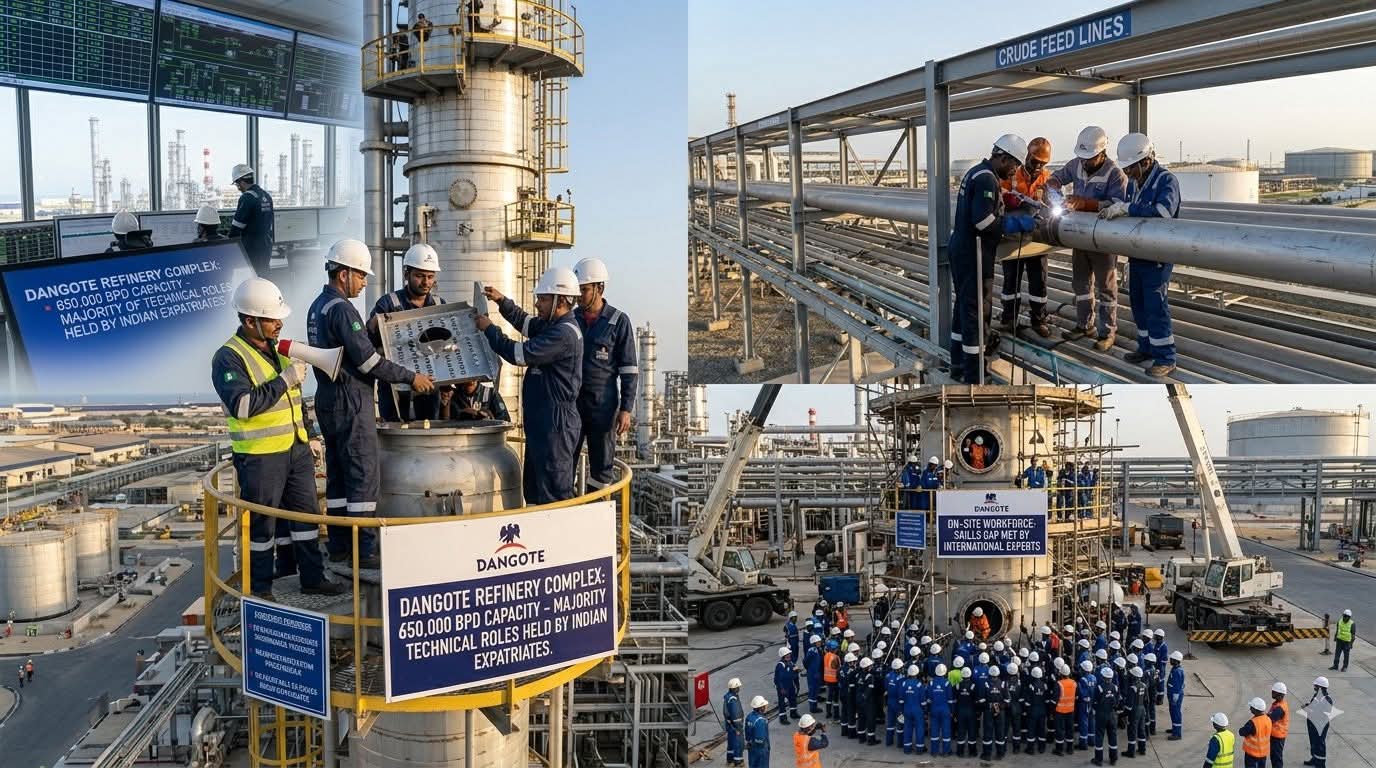
A firestorm of controversy over the hiring of 11,000 Indian technicians at Africa’s largest oil refinery has exposed a painful truth about the continent’s skills crisis, experts say.
The Dangote Refinery, a $19 billion megaproject in Nigeria’s Lekki Free Zone, turned to India for skilled labor after reportedly failing to find even 100 qualified local technicians. The revelation has triggered outrage—but development specialists warn the real scandal lies closer to home.
“It isn’t India that is humiliating us; it is our inability to produce skills that match our ambitions,” said Dr. Chris Kpodar, a development expert with the World Economic Forum, in a widely circulated analysis.
A Continent’s Technical Blind Spot
Nigeria, Africa’s most populous nation with 235 million people and the continent’s largest economy, could not supply the technical workforce for its flagship industrial project. The pattern, however, is not unique to Abuja.
Across Africa:
· Foreign teams repair power plants
· International contractors calibrate mines
· Overseas engineers configure data centers
· Expatriate crews pave major highways
“While Africa organizes summits, national dialogues, and endless conferences, India organizes classrooms,” Kpodar wrote. “While we politicize technical education, India professionalizes it.”
The Education Divide
Technical schools across the continent operate with machinery from the 1980s, teachers who haven’t been retrained in decades, and curricula that remain frozen in time. Workshop facilities have become “dusty museums,” according to the analysis.
Cultural attitudes compound the problem. African parents continue dreaming of lawyers, doctors, and politicians for their children—not industrial mechanics, electromechanical technicians, or process engineers.
“Technical students are still considered ‘less brilliant’ than those in general education,” Kpodar noted. “Even though the modern world depends entirely on them.”
Wealth Without Skills
The Dangote case proves that natural resources and billionaire backing cannot compensate for weak human capital, experts argue. Africa possesses oil, bauxite, gold, cobalt, and lithium—but lacks the workers to transform them.
“Africa is a continent where you can build a port in 18 months—using foreign labor. But where it takes 25 years to modernize a technical high school,” Kpodar said.
The Path Forward
Dr. Kpodar calls for a “mental revolution” that transforms every technical school into a talent factory. Real development, he argues, begins when African nations no longer need foreign expertise for basic industrial operations.
“No magic. No slogans. No hollow ‘Vision 2030,'” he wrote. “Development requires qualified welders and certified electronic technicians. That is where the fight begins.”
As the Dangote Refinery prepares to commence operations, the 11,000 Indian technicians will soon be at work. The question echoing across the continent: How many will be Nigerian in five years?


