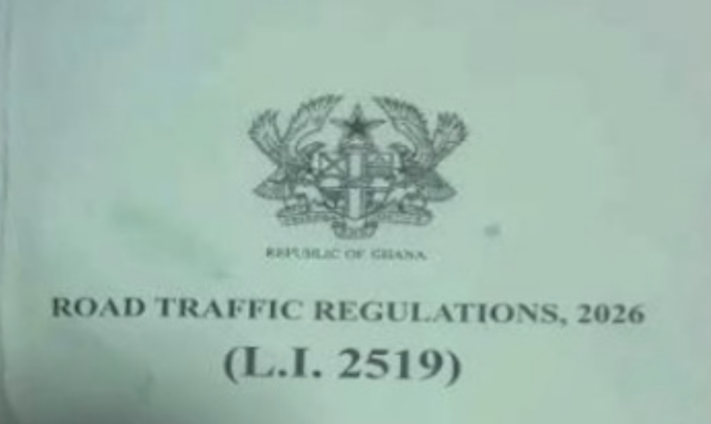
The Ghana Police Service has urged transport operators, vehicle owners, drivers, industry stakeholders and the general public to familiarise themselves with the new Road Traffic Regulations, 2026, to ensure effective compliance and road safety .
The regulations, which replace the Road Traffic Regulations, 2012, are expected to provide a framework for addressing emerging developments in Ghana’s transport sector, including vehicle construction standards, ownership, registration, licensing and use .
📋 The Call for Public Awareness
Assistant Commissioner of Police (ACP) Alexander Kweku Obeng, Director of the Motor Traffic and Transport Department (MTTD), made the call during an interview with the Ghana News Agency (GNA), urging the public to obtain copies of the document for study and adherence .
“Every road user needs to understand the regulations to become aware of their rights and responsibilities,” ACP Obeng said, adding emphatically that “we should all look out for it, get a copy, and make it our second Bible” .
He noted that the changing nature of transportation in Ghana requires corresponding changes in regulation and enforcement, particularly given developments including the growing use of electric vehicles (EVs), the emerging commercial motorcycle sector, and the increasing use of technology in traffic enforcement .
🚗 Context: A New Legal Framework for Road Safety
The new regulations come at a critical juncture for road safety in Ghana. The World Health Organization (WHO) has reported that road deaths in Ghana increased by 65% between 2016 and 2021 to a reported annual toll of nearly 3,000 . With nearly 26 road deaths per 100,000 population, Ghana’s fatality rate is far higher than the WHO African Regional average of 19 per 100,000 and the global average of 15 deaths per 100,000 .
The new law and associated safety standards, adopted by Parliament in December 2025 and enforced from early 2026, bring Ghana “largely into line with WHO road safety legal recommendations” .
Among the key provisions of the new regime are :
· Reduced Blood Alcohol Limit: Ghana has lowered the legal blood alcohol concentration limit for drivers from 0.08 to 0.05 grams per decilitre, meeting most WHO legal recommendations.
· Mandatory Child Safety Restraints: The new law requires child car seats appropriate to the age, height, weight and physical vulnerabilities of infants and young children. WHO notes that child safety restraints can reduce deaths in crashes by up to 71% among younger infants.
· Stricter Motorcycle Helmet Standards: All motorcycle helmets sold in Ghana must now meet strict safety certifications. Counterfeit or substandard “cap helmets” are now illegal, as motorcycle riders account for about a third of all road deaths in Ghana. WHO says high-quality helmets reduce the risk of death by more than six times in a crash.
💻 Digital Enforcement: A New Era of Traffic Policing
ACP Obeng said the Police are modernising road traffic enforcement by using technology to improve compliance and promote safety .
He explained that motorists will increasingly encounter police officers using electronic devices to enforce traffic regulations, while systems are being developed to enable offenders to receive traffic tickets electronically and make payments without necessarily appearing in court .
“With the new technology, you may not necessarily need to appear in court but get a ticket on your phone instead,” he said . “You will be required to pay fines like we do with water and electricity bills,” he added .
The Minister of Transport, Mr Joseph Bukari Nikpe, has stated that Parliament is expected to pass the Legislative Instrument (LI) to operationalise the automated traffic law enforcement system . The Ministry is working to establish a robust legal framework to address road indiscipline, including drunk driving, speeding, careless driving and other offences that continue to contribute to road crashes in the country .
The automated enforcement system, known as Traffitech-GH, will deploy a combination of fixed and mobile speed cameras, as well as portable devices, to monitor traffic violations across highways and urban roads . Motorists will receive notifications through text messages containing details of the violation, the amount of the fine and a link that will allow them to view video evidence of the offence . Offenders will have 14 days to pay fines electronically through the Ghana.gov platform using mobile money, rather than paying any individual police officer .
🏍️ Implications for Commercial Motorcycle Riders
The new regulatory framework also formalises the operations of commercial motorcycle riders, which had previously operated in a legal grey area . This formalisation is expected to bring the sector under proper regulatory oversight, with implications for licensing, safety standards and enforcement.
🤝 Call for Public Understanding and Cooperation
The MTTD Director urged transport operators, vehicle owners, driving school proprietors, driving instructors, police officers, road safety advocates and the media to take an active interest in the new regulations . He said stakeholders should not merely obtain copies of the document but study, analyse and explain its provisions to road users to ensure that the regulations were widely understood .
ACP Obeng called for greater cooperation between law enforcement agencies and road users to ensure that the new regulatory regime achieved its objective of improving road safety and discipline .
He said the Police would continue to strengthen enforcement while encouraging motorists and other road users to understand and comply with the law. The success of the new regulatory framework, he said, would ultimately depend on Ghanaians’ willingness to understand their obligations and cooperate with authorities to create safer roads .
🏁 Conclusion
As Ghana rolls out its most comprehensive road safety reform in over a decade, the message from the Police is clear: knowledge of the law is the first step to compliance. With new provisions on child safety, alcohol limits, motorcycle standards and technology-driven enforcement, road users are urged to treat the new regulations as essential reading for anyone who uses Ghana’s roads.