



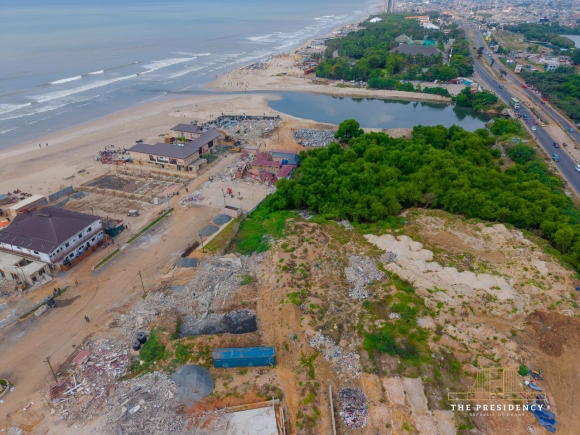
The Greater Accra Regional Security Council (REGSEC) on Sunday began demolishing beachfront nightclubs, eateries and other hospitality facilities at Laboma Beach in the La Dadekotopon Municipality, citing their location within the buffer zone of the Kpeshie Lagoon.
The demolition, led by the 48 Engineer Regiment of the Ghana Armed Forces, followed the expiration of a 21-day notice issued to operators to vacate the area.
Among the structures destroyed was the popular Pink Flamingo Lounge, a well-known destination along the Laboma beachfront. Several other establishments were also affected, including ULA Beach Club, Trophy, Bliss Escape, Amsterdam Kitchen, Si Beach Resort and Alora Beach Resort.
Background: The 21-Day Ultimatum
The enforcement action traces back to an August 7, 2026 directive from REGSEC, which gave operators 21 days to remove structures encroaching on the Kpeshie Lagoon buffer zone. The directive formed part of broader government measures to address flooding and restore natural drainage channels in the Greater Accra Region.
Greater Accra Regional Minister Linda Ocloo had warned at the time that some developers proceeded with construction despite receiving early warnings. “Some of these buildings, we asked the owners to stop at the foundation stage, but they went ahead,” Ocloo said. “I am not even sure the encroachers have the necessary permits.”
The Kpeshie Lagoon and its surrounding areas have come under increasing pressure from development, with environmental concerns mounting over the impact of structures built within protected zones.
Rooted in the June 29 Floods
Sunday’s demolition is part of the broader mandate of the Post-Flood Mitigating Task Force, established by the government following devastating floods across the country in June and July 2026.
According to data presented to Parliament by the Interior Minister, Ghana recorded its highest monthly rainfall since records began in 1995, with 593.2mm in June 2026. On June 29 alone, 169.2mm of rain fell — the fourth-highest daily figure on record. The floods killed at least 12 people, left seven missing, displaced more than 7,700 households and affected nearly 39,000 people.
Minister Ocloo said risk assessments showed that illegal land reclamation and construction in the Kpeshie Lagoon catchment had directly worsened flood risks in surrounding communities, particularly Tse Addo. “Everybody knows Laboma. It used to be mangrove wetlands. They cleared the trees, filled the land, and sold it to developers who put up hotels and other facilities,” she said.
How the Encroachment Happened
Investigations reveal that illegal development in the Kpeshie Lagoon buffer zone has been ongoing for years. According to official accounts, encroachers dumped boulders into the water and covered them with sand to create artificial land, on which commercial facilities were then built.
The Lands Commission has made clear that the area was never rezoned for residential or recreational use, and its legal status remains that of a lagoon. The Hydrological Services Department is expected to conduct a full assessment of the encroachment to determine the dredging and demolition needed to restore the lagoon’s water-holding capacity.
Economic and Employment Fallout
The demolition has triggered strong reactions from affected businesses and workers. Local residents estimate that about 600 people may lose their jobs as a result of the operation. One affected operator said he had just secured a loan to start his business and now faces an uncertain future with no way to repay it.
Minister Ocloo had warned before the operation that anyone resisting enforcement would be arrested, and that the government would recover demolition costs from property owners. The Commanding Officer of the 48 Engineer Regiment, Lieutenant Colonel Frank Osei Amponsah, said authorities ensured people and property were safely evacuated before demolition, and that the exercise was carried out lawfully after advance notice.
A Wider Crackdown
The Laboma Beach demolition is not an isolated action. The Ghana Armed Forces are simultaneously clearing waterways at multiple locations across Accra, including Oyarifa, East Legon and the Lafa Retention Basin. At the Lafa Basin in Mallam, military engineers are using heavy equipment to excavate years of accumulated solid waste and silt to restore the area’s natural water retention capacity.
Analysts say the Laboma demolition sends a clear signal: with climate change driving increasingly frequent extreme rainfall, the Ghanaian government is tightening control over wetlands and waterway buffer zones. As the Daily Graphic put it in a recent editorial: “A buffer zone is not empty land waiting to be developed. It is infrastructure — space that allows the lagoon to breathe and floods to be absorbed.”


