



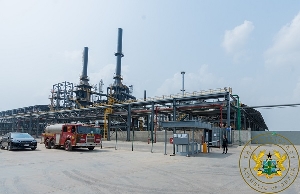
The National Petroleum Authority (NPA) has issued a firm directive ordering Sentuo Oil Refinery Limited to immediately halt what it describes as unfair and discriminatory arrangements in the marketing of petroleum products, warning that the refinery’s operating licence could be at risk if it fails to comply .
In a notice dated August 18, 2026, the regulator said it had observed with “grave concern” that licensed Bulk Import, Distribution and Export Companies (BIDECs) seeking to procure petroleum products from Sentuo were, in several instances, effectively compelled to transact through a particular intermediary .
The Intermediary Arrangement Under Scrutiny
The intermediary at the centre of the complaints is Mohamed Raii, a Lebanese national identified by industry sources as operating in connection with Sentuo . According to the allegations, Raii sources substantial volumes of bulk petroleum products from the refinery and subsequently resells them independently on terms he determines, effectively creating an intermediary layer between the refinery and downstream distributors .
Industry sources have also fingered AXSOR as a distribution point through which petroleum products supplied from the refinery are allegedly channelled by Raii . Some downstream operators have expressed concern that this arrangement gives the intermediary considerable control over access to refinery products and the terms on which those products reach licensed buyers .
Additionally, there are unverified allegations that Raii has sought to project himself as highly connected, claiming access to senior government officials and asserting that National Security and the police are at his beck and call .
Non-Delivery and Financial Fallout
The Authority said it had also received reports that the intermediary had repeatedly failed to honour its contractual obligations to licensed petroleum service providers, resulting in non-delivery of products, locked-up funds, and disruptions to legitimate downstream petroleum trading activities .
The NPA noted that the situation could also have implications for financial institutions and their transactions with affected Bulk Distribution Companies, particularly where significant amounts of money remain tied up in disputed transactions .
Legal Basis for the Directive
The NPA cited Section 24 of the National Petroleum Authority Act, 2005 (Act 691), which provides for the sale of refinery products without discrimination to bulk customers and licensed petroleum marketers . It also referred to Section 40 of the Act, which requires fair and equitable commercial practices and the monitoring of relationships among petroleum service providers to support the enforcement of existing contracts .
“The Authority finds this practice unacceptable,” the NPA stated, adding that the arrangement was inconsistent with the standards of fair, transparent and non-discriminatory commercial conduct expected of a licensed refinery .
Warning of Licence Revocation
More significantly, the regulator warned that Sentuo’s refinery licence could be at risk if the concerns are not satisfactorily addressed. The Authority cited Section 18 of Act 691, under which the Board may suspend, revoke or refuse to renew a licence for non-compliance with the Act, regulations or conditions of the licence .
“In view of the seriousness and recurrence of these concerns, the Authority is presently considering whether Sentuo remains fit to continue operating under its refinery licence,” the notice stated .
Sentuo has been given seven working days from the date of the notice to respond. The company is required to confirm that the practice complained of has ceased, outline measures implemented to ensure direct, fair and non-discriminatory access to its products, and show cause why proceedings should not be initiated for the suspension or revocation of its refinery licence under Sections 18 and 19 of Act 691 .
The Authority warned that failure to provide a satisfactory response and immediately regularise the situation would leave it with “no alternative but to consider the appropriate regulatory action available” .
CBOD Raises Wider Sector Concerns
The NPA action comes against the backdrop of a wider warning from the Chamber of Bulk Oil Distributors (CBOD) over practices among Petroleum Service Providers (PSPs) resulting in the non-delivery of contractual and prepaid petroleum products . The Chamber said the cases involve BIDECs, refineries, Oil Marketing Companies (OMCs) and intermediaries, with funds being locked up and normal business activities disrupted .
The Chamber warned that such developments could trigger supply disruptions, expose businesses to significant financial risks, and undermine confidence in the downstream petroleum market .
About Sentuo Oil Refinery
Sentuo Oil Refinery Limited (SORL) is Ghana’s first large-scale privately owned crude oil refinery and the country’s largest active refining facility as of 2026 . The refinery was conceived within the framework of China’s Belt and Road Initiative and developed to position Ghana as a regional benchmark for petrochemical production in West Africa .
Phase 1 operations commenced on August 29, 2023, with a formal commissioning ceremony presided over by then-President Nana Akufo-Addo on January 26, 2024 . The company is a wholly owned subsidiary of Sentuo Group Limited, a private joint-stock enterprise headquartered in China .
The refinery has faced regulatory challenges before. In February 2024, the NPA suspended the approval for Sentuo to sell some finished petroleum products due to quality concerns, after investigations revealed that the refinery had sold petrol with vapour pressure slightly higher than what was originally approved .
Currently, Sentuo is contributing approximately 20% of the diesel consumed in Ghana, with ongoing expansion projects expected to enable the facility to meet about 70% of Ghana’s domestic demand for refined petroleum products upon completion . However, Ghana remains structurally dependent on imported petroleum products, with domestic refining accounting for a mere 13% of national demand in 2025, compelling a 37% spike in imports .
Implications for the Downstream Sector
The NPA’s insistence on direct, fair and transparent access to refinery products could have wider implications for how petroleum products are allocated, sold and distributed to licensed operators in Ghana’s downstream petroleum market .
The notice was signed by NPA Chief Executive Godwin Kudzo Tameklo and copied to the Minister for Energy and Green Transition, the CBOD, the Chamber of Oil Marketing Companies, and relevant NPA departments .


