



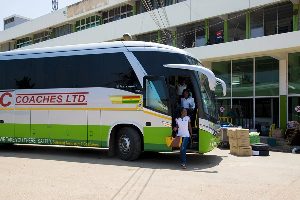
Intercity STC Coaches Limited has recorded a significant improvement in its financial performance, reducing its net loss by an impressive 92.60% in 2025 despite a decline in revenue, according to the 2025 State Ownership Report published by the State Interests and Governance Authority (SIGA) .
A Sharp Reduction in Losses
The company’s net loss fell dramatically from GH¢69.98 million in 2024 to GH¢5.18 million in 2025, representing a remarkable turnaround within a single year . The improvement was mirrored across other key financial indicators:
· Operating loss narrowed sharply from GH¢45.13 million in 2024 to GH¢4.27 million in 2025
· Loss before tax declined from GH¢70.08 million to GH¢4.73 million over the same period
The SIGA report attributed the improvement mainly to the company’s efforts to reduce costs, as well as the impact of changes in foreign exchange gains and losses recorded during the two financial years .
Cost-Cutting Outpaced Revenue Decline
The significant reduction in losses came despite a decline in revenue. The company’s total expenditure fell by 18.70%, from GH¢198.71 million in 2024 to GH¢161.49 million in 2025 . This substantial cost reduction helped offset the impact of lower revenue generation.
However, the revenue picture was less encouraging:
· Operating revenue declined by 11.77%, from GH¢178.03 million in 2024 to GH¢157.08 million in 2025
· Total revenue, including other income, fell by 30.79%, from GH¢227.43 million to GH¢157.39 million
Revenue Decline: Contributing Factors
The SIGA report attributed the decline in operating revenue primarily to three factors:
· The limited number of buses available for operations
· Differences in fares
· Increased competition in the transport sector
Operational Challenges Continue
The company’s fleet challenges have been well documented. Transport Minister Joseph Bukari-Nikpe previously revealed that Intercity STC “cannot boast of 60 buses that are effective and can run any distance without trouble on the way” . The situation has been compounded by the fact that a significant proportion of buses operating under the STC brand are privately owned rather than government property .
Former Deputy Managing Director Nuru Hamidan also disclosed that the company inherited a “nearly crippled” operation, with major assets having been sold off or leased out under questionable terms, and no audited financial statements produced since 2021 .
Government’s Revitalisation Efforts
The government has acknowledged the company’s distress and announced plans to modernise its fleet. In September 2025, the Transport Ministry outlined plans to procure 350 Toyota Hiace buses, 100 coastal buses, and 50 trucks for Metro Mass Transit and Intercity STC . The introduction of electronic buses for operations was also mooted as part of the modernisation agenda .
More broadly, SIGA has engaged STC management to explore solutions to challenges in the public transport sector and identify new revenue opportunities .
Outlook
The figures point to a marked improvement in the company’s financial performance. However, as the SIGA report itself notes, STC will need to improve bus availability, strengthen its operations and increase revenue to sustain the gains recorded during the year . The continued reliance on cost containment, alongside efforts to address its operational fleet and competitiveness, will remain critical to sustaining the recovery .


