



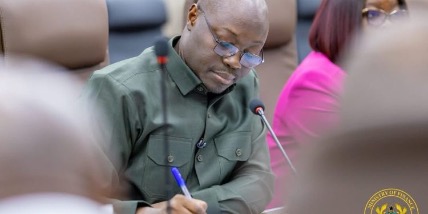
Finance Minister Dr Cassiel Ato Forson has announced that the government’s New Economy programme will boost local production, reduce Ghana’s dependence on imports and create more jobs by directing investment towards productive sectors of the economy. Speaking during a meeting with the leadership of the Association of Ghana Industries (AGI) and leading captains of industry, he stated that “our mission is to produce more of what we consume and create more jobs here at home.”
Dr Forson said every imported product must challenge the country to build the capacity to produce it locally. “Every import is an opportunity to ask: why can’t we make it in Ghana?” he said, stressing that the government’s objective was to build an economy in which increased domestic production translates into jobs and stronger economic activity.
He described the New Economy as a decisive shift towards a productive, job-creating and prosperous nation. “That is the promise of the New Economy: Ghana producing. Ghanaians working. Prosperity growing!”
New Economy Programme
The programme, to be rolled out in the 2027 Budget, is expected to deploy about US$1.6 billion, equivalent to approximately one per cent of Gross Domestic Product (GDP), to develop strategic areas of the economy and create opportunities for the private sector to expand and generate jobs.
It forms part of the government’s broader strategy to channel resources into productive sectors capable of driving sustainable economic growth while generating returns that can support the repayment of investments over time. The programme, which has been approved by Cabinet, follows the country’s successful completion of the International Monetary Fund (IMF) Extended Credit Facility (ECF) $3 billion bailout programme implemented over the past three years.
The finance minister explained that the programme would also operate under a new Policy Coordination Instrument (PCI) arrangement with the IMF, which would focus on reforms and technical support rather than financial assistance.
Agriculture, Mining and Energy Targeted
Dr Forson said priority areas under the framework would include commercial agriculture, mining value addition, energy and transport infrastructure.
He explained that the government was shifting its focus towards sectors with strong growth potential and the capacity to generate significant economic activity and employment. The energy sector is expected to be a key component of the programme, with planned investments in gas-to-power and gas-to-fertiliser projects aimed at strengthening energy security and supporting industrial development.
In the transport sector, Dr Forson cited the Western Railway Line and other strategic infrastructure projects as areas that could receive support under the framework.
He, however, noted that the final blueprint was still being developed, with details of additional projects expected to be announced when the programme is formally launched.
From Stability to Development
The New Economy programme marks a deliberate shift in the government’s economic strategy from macroeconomic stabilisation to production, job creation and wealth generation. Presenting the 2026 Mid-Year Fiscal Policy Review in July, Dr Forson said: “Stabilisation was never the destination. It was the price of entry. Ghana has paid that price. What comes next is the work that changes lives at scale—the work of transformation.”
Ghana’s economy has shown significant improvement over the past year. The IMF projects real GDP growth of about 4.8 per cent in 2026, underpinned by firmer exports, easing inflation and a gradual recovery in domestic confidence. Headline inflation eased to 3.8 per cent in January 2026, the lowest level in three decades, down from 23.5 per cent a year earlier. The country’s public debt-to-GDP ratio fell from 61.8 per cent at the end of 2024 to 45 per cent by June 2026, bringing Ghana into compliance with its statutory debt ceiling.
Finance Minister Dr Forson has been a firm advocate for fiscal discipline throughout the recovery period, warning that the government will not abandon prudent management for political convenience. Under his stewardship, Ghana’s economy exceeded $100 billion in value for the first time, and the country completed its IMF programme with what the World Bank described as a remarkable turnaround.
Industry Reaction and Broader Policy Context
The engagement with AGI leadership forms part of broader consultations on the New Economy framework. The Association of Ghana Industries, the country’s leading advocacy body for industrial and manufacturing businesses, has long argued that Ghana must take advantage of the global economic shift to pursue a full-scale industrialisation agenda anchored on manufacturing-led growth.
AGI CEO Seth Twum-Akwaboah has noted that Ghanaian manufacturers have the capacity to produce quality goods and compete globally, but persistent challenges—including high production costs and inadequate infrastructure—continue to limit the growth of local industries. “There’s so much export potential. But I can say that we haven’t been able to harness the potential fully because our value chains are still not working that well. Our cost of production is relatively high,” he said.
The New Economy programme aligns with other government initiatives aimed at promoting local production, including a policy linking rice import permits to domestic production, an amendment to the Public Procurement Act to prioritise locally manufactured products, and a five-year plan to increase local pharmaceutical manufacturing to 70 per cent of medicines consumed.
At a press conference announcing the end of the IMF programme, Dr Forson emphasised the urgency of job creation, noting that the country produces an average of 500,000 graduates who enter the job market every year. “The public sector employing people is not sustainable, it will create more fiscal difficulties. We need to create the environment necessary to attract the private sector to create jobs,” he stated.
What Happens Next
The full details of the New Economy programme are expected to be presented in the 2027 Budget Statement to Parliament in November. President John Dramani Mahama has said the programme will involve a US$10 billion investment in key sectors of the economy.
Dr Forson has urged banks to increase lending to productive sectors as part of the programme, as the government takes steps to reduce its dependence on domestic borrowing.
The coming months will determine whether the New Economy can deliver on its promise of transforming Ghana from an import-dependent economy into a production-driven one—creating sustainable jobs for its growing youthful population and building the industrial base that successive governments have long promised but struggled to deliver.


