



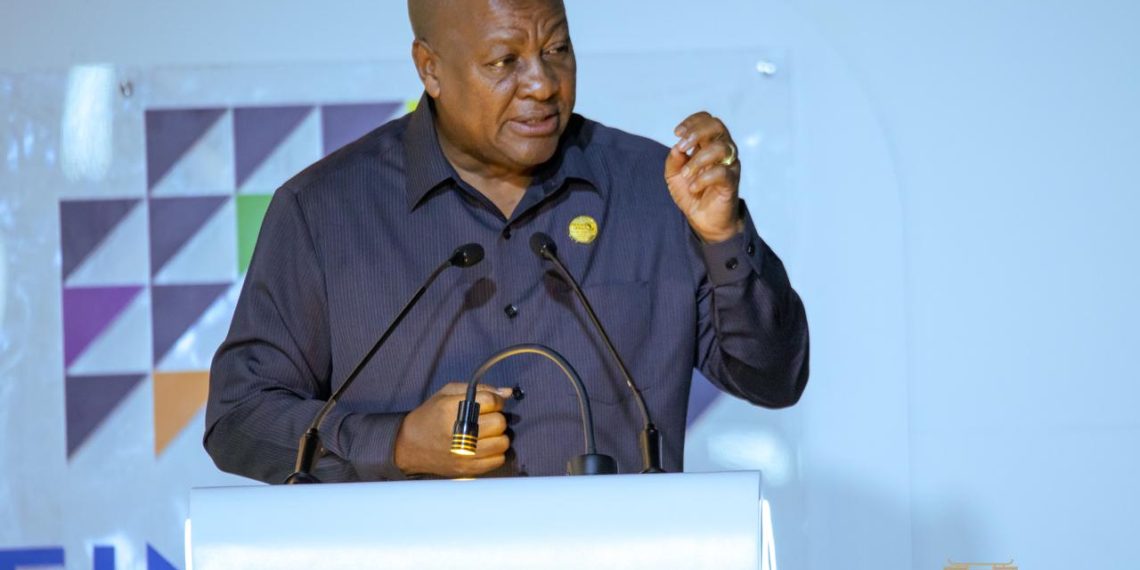
President John Dramani Mahama has announced the Health Investment and National Gateway, known as H-Enabler, a platform aimed at streamlining regulation, clinical validation and commercialisation for health innovators and investors across Africa.
The platform was announced during President Mahama’s keynote address at the Alamein Africa Forum in Egypt, where he spoke on investing in health manufacturing and regional value chains.
President Mahama said H-Enabler had been developed in collaboration with the African Medicines Agency, Institut Pasteur and Afrochampions to help address regulatory and financial barriers that constrain investment in Africa’s health sector.
A Data-Driven Solution to Regulatory Fragmentation
He said the platform would serve as a data-driven system that brings together regulatory processes, clinical validation and commercialisation into a unified framework for innovators and investors.
According to President Mahama, reducing regulatory friction was necessary to create a stronger continental ecosystem for pharmaceutical manufacturing and health investment.
He said the initiative formed part of broader efforts to strengthen Africa’s capacity to produce medicines and vaccines locally and reduce the continent’s dependence on imports.
President Mahama said Africa currently imports more than 70 per cent of its pharmaceuticals and nearly 99 per cent of its vaccines, resulting in significant financial resources leaving the continent to procure essential health products.
He said H-Enabler would help create a more predictable environment for investors and manufacturers while supporting the development of regional health value chains.
The Accra Reset Presidential Council
The President also said that through the Accra Reset Presidential Council, Ghana was deploying dedicated task forces and reform interlock observatories to track capital flows, monitor policy commitments and address non-tariff barriers affecting regional value chains.
The Accra Reset Presidential Council is a Ghana-led initiative aimed at driving structural reforms and coordinating African responses to global challenges, particularly in areas such as health, trade, finance and industrial development.
He called for greater participation by private capital, industrial developers, commercial banks and sovereign funds in Africa’s health manufacturing sector.
Call for Faster Operationalisation of African Medicines Agency
President Mahama further challenged African regulators to accelerate the operationalisation of the African Medicines Agency (AMA), saying a harmonised regulatory system could enable a single drug approval to facilitate access across the continent.
The African Medicines Agency, established by the African Union in 2019 and headquartered in Rwanda, is intended to serve as a continental regulator that harmonises medical product regulation across member states. Once fully operational, it is expected to reduce duplication in drug approvals, speed up access to essential medicines and strengthen regulatory capacity across the continent.
However, the agency has faced delays in becoming fully functional, with only a limited number of countries having ratified the treaty establishing it. President Mahama’s call adds momentum to efforts to accelerate its operationalisation.
He said stronger regulatory coordination, combined with investment in local manufacturing, would be critical to achieving greater health sovereignty and ensuring that African countries could respond more effectively to future health emergencies.
Background: Africa’s Health Manufacturing Deficit
Africa’s reliance on imported pharmaceuticals and vaccines has been a long-standing concern, highlighted starkly during the COVID-19 pandemic when the continent found itself at the back of the queue for vaccines and essential medical supplies.
The African Union has set a target of producing 60 per cent of the continent’s vaccines locally by 2040, under its Partnership for African Vaccine Manufacturing. Several countries, including South Africa, Senegal, Rwanda and Ghana, have begun investing in vaccine and pharmaceutical manufacturing capacity.
Ghana has positioned itself as a potential hub for health manufacturing in West Africa, with initiatives aimed at attracting investment in local production of medicines, vaccines and medical devices.
The H-Enabler platform is expected to complement these efforts by providing innovators and investors with a clearer pathway from research and development to regulatory approval and commercialisation.
What H-Enabler Aims to Achieve
By bringing together regulatory processes, clinical validation and commercialisation into a single framework, H-Enabler seeks to:
· Reduce the time and cost of bringing new health products to market in Africa
· Provide investors with greater predictability and transparency
· Support local innovators in navigating complex regulatory environments
· Facilitate collaboration between governments, regulators, research institutions and the private sector
· Strengthen regional value chains for pharmaceuticals and health products
The platform’s development partners — the African Medicines Agency, Institut Pasteur and Afrochampions — bring complementary expertise. The AMA provides regulatory oversight and harmonisation, Institut Pasteur contributes scientific research and clinical validation capacity, and Afrochampions mobilises private sector investment and advocacy across the continent.
A Vision for Health Sovereignty
President Mahama’s announcement reflects a growing consensus among African leaders that health security is inseparable from economic sovereignty. The COVID-19 pandemic exposed the continent’s vulnerability to supply chain disruptions and vaccine nationalism, prompting renewed calls for local production and self-reliance.
By positioning H-Enabler as a tool for streamlining investment and regulation, Ghana is seeking to play a leadership role in Africa’s health manufacturing transformation.
The success of the platform will depend on sustained political commitment, adequate financing, effective coordination among partner institutions and the active participation of the private sector. But for now, the announcement signals a clear direction: Africa must produce more of what it consumes, and it must do so on its own terms.
As President Mahama concluded, stronger regulatory coordination and investment in local manufacturing are not just economic imperatives — they are essential to ensuring that African countries can respond effectively to future health emergencies and secure the health of their people.


