



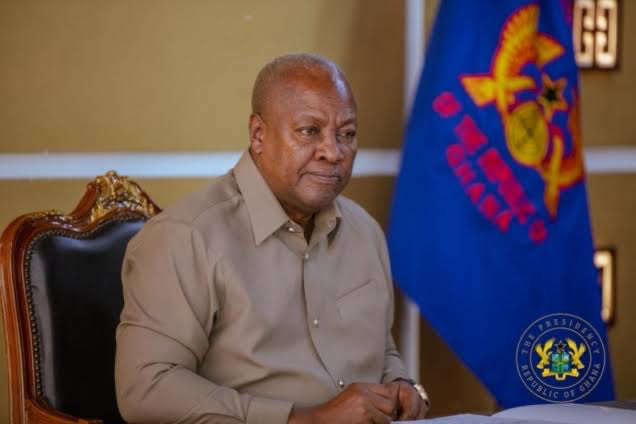
President John Dramani Mahama has dissolved the governing boards of nine state institutions with immediate effect, in a move that signals a significant restructuring of Ghana’s state-owned enterprise sector.
The directive, announced on Wednesday, September 2, 2026, affects major entities across key sectors including petroleum, banking, mining, infrastructure and sports. The affected institutions are:
· Prestea Sankofa Gold Limited
· Bulk Oil Storage and Transportation Company Limited (BOST)
· Volta Aluminium Company Limited (VALCO)
· Consolidated Bank Ghana Limited (CBG)
· Ghana Post Company Limited
· Road Maintenance Trust Fund
· TDC Ghana Limited
· Ghana National Petroleum Corporation (GNPC)
· National Sports Authority (NSA)
Official Directives and Interim Arrangements
A statement issued by the Spokesperson to the President and Minister for Government Communications, Felix Kwakye Ofosu, confirmed the dissolution but did not assign a specific reason for the decision.
The relevant sector Ministers have been directed “to take all necessary steps, in accordance with the applicable laws and governing instruments, to give effect to the dissolution of these Boards”. The affected boards are expected to be reconstituted in due course.
Until new boards are appointed, management teams of the affected institutions will continue to oversee their day-to-day operations under the supervision of their respective sector ministries. However, management has been instructed not to take major policy, financial or contractual decisions requiring board approval without prior authorisation from the appropriate authority. This interim arrangement was previously introduced following the dissolution of boards appointed by the former administration.
Context: The SIGA 2025 Report and SOE Performance Scrutiny
The latest dissolution comes at a critical juncture, following the recent release of the 2025 State Ownership Report by the State Interest Governance Authority (SIGA). The report, published on August 30, 2026, highlighted a significant financial turnaround for Ghana’s state-owned enterprises.
Key findings from the SIGA report include:
· SOEs recorded a consolidated net profit after tax of GH¢19.8 billion in 2025, reversing the GH¢2.3 billion net loss posted in 2024.
· Total SOE revenue increased by 28.1% from GH¢137.64 billion to GH¢176.43 billion.
· The turnaround was driven by growth in agriculture, manufacturing and infrastructure sub-sectors, improved foreign-exchange earnings, and a 42.5% reduction in finance costs.
However, the report also highlighted persistent challenges. Five SOEs – including the Electricity Company of Ghana, Ghana Cylinder Manufacturing Company Limited and Graphic Communications Group Company – recorded losses in every financial year between 2021 and 2025. Six entities maintained negative equity throughout the same period.
Debate Over SOE Performance Figures
The SIGA report’s headline figures have not escaped scrutiny. Vice President of IMANI Africa, Bright Simons, publicly disputed the reported GH¢19.8 billion profit, arguing that the apparent improvement was largely influenced by currency revaluations.
Simons stated that “state-owned businesses’ underlying profitability declined in 2025,” and when currency effects are removed, “net profit fell 17.1 percent, operating profit fell 22.7 percent, and the operating margin narrowed by three and a half percentage points between 2024 and 2025”. This debate adds a layer of complexity to the scrutiny of SOE performance, suggesting that operational improvements may be less pronounced than the headline figures indicate.
The National Sports Authority: A Case in Point
The dissolution of the National Sports Authority board deserves particular attention due to its recent history and current challenges. The 15-member NSA Governing Board was chaired by Dr. Fred Awaah and had been inaugurated in December 2025 following Cabinet approval under Section 4 of the Sports Act, 2016 (Act 934).
The board’s tenure was marked by controversy surrounding Ghana’s sports infrastructure. In August 2026, Dr. Awaah publicly described the condition of the Accra Sports Stadium as a potential safety hazard, stating that the facility’s structural condition was serious enough that, if the NSA had the authority, it would have opted to pull down the building and rebuild it. The dissolution comes at a significant time for the authority, which is also preparing for Ghana’s hosting of the 2027 Africa U-20 Cup of Nations.
Historical Precedents and Legal Framework
This latest directive follows President Mahama’s earlier blanket directive dissolving statutory boards, corporations, commissions and councils appointed by the previous administration, in accordance with the Presidential (Transition) Act, 2012 (Act 845).
Under that directive, individuals appointed to boards by former President Nana Addo Dankwa Akufo-Addo or a former Minister of State ceased to hold office on January 7, 2025 – the date of President Mahama’s swearing-in. The Presidency clarified that the cessation of board membership did not affect independent constitutional creations.
The governance framework has faced criticism from some quarters. Energy expert and former Power Minister Dr. Kwabena Donkor has argued that Section 14 of the Presidential Transition Act creates prolonged leadership vacuums in critical SOEs during political transitions. He noted that the provision mandates that presidential appointees cease office upon a new administration’s inauguration, potentially leaving entities without governing bodies for extended periods, which can “paralyse strategic decision-making, CEO appointments, and restrict acting officers to limited operational functions”.
What This Means for Ghana’s State Institutions
The dissolution of these nine boards represents a significant moment in President Mahama’s governance agenda. The affected institutions occupy critical positions in Ghana’s economy – from petroleum (GNPC, BOST) and aluminium production (VALCO) to banking (CBG), mining (Prestea Sankofa Gold) and postal services (Ghana Post).
While the Presidency has not provided explicit reasons for the dissolution, the timing and context suggest a desire to reconstitute boards with fresh mandates aligned with the administration’s vision. The SIGA report had identified corporate governance as a key factor in SOE performance, with its Director-General noting that “performance or non-performance; compliance or non-compliance, all emanate from the ability of the boards to manage the entities in line with the President’s vision”.
The reconstitution of the boards is expected to pave the way for new appointments in accordance with the respective laws and governing instruments of the institutions. President Mahama has expressed gratitude to outgoing board members for their service to the nation.
As the boards are reconstituted, stakeholders will be watching closely to see how the new governing structures address the performance challenges highlighted by SIGA, the infrastructure concerns at the NSA, and the broader push for improved governance and financial accountability across Ghana’s state-owned enterprise sector.


