



Artificial Intelligence (AI) is now a primary driver of cybercrime across Africa, enabling 55% of all reported incidents and contributing to a dramatic surge in financial losses that have more than doubled to $484 million since 2024, according to the 2026 African Cyber Threat Assessment by INTERPOL.
The Industrialisation of Cybercrime
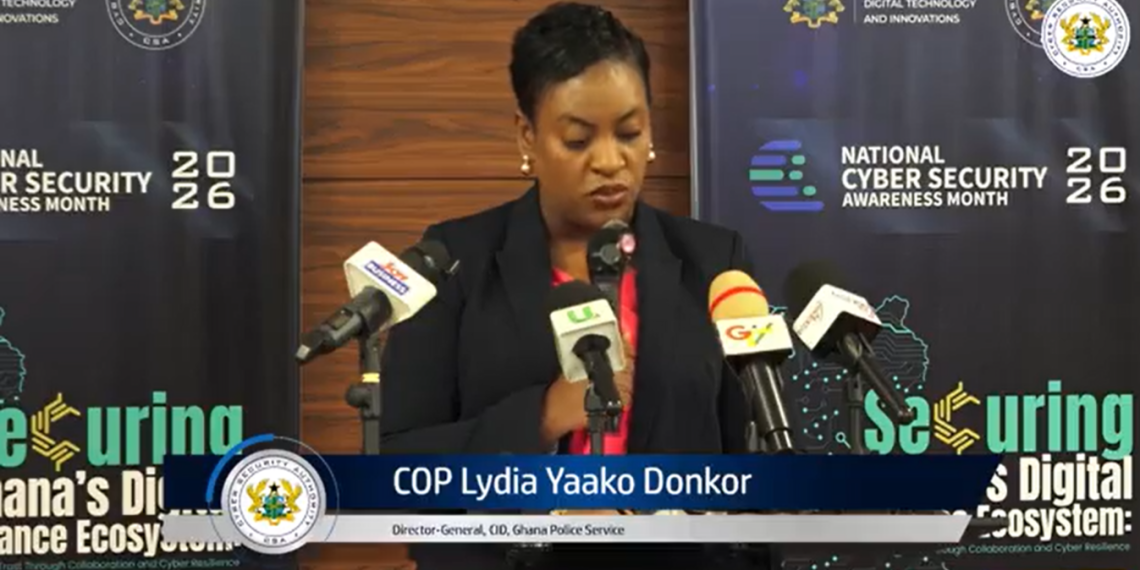
The Director-General of the Criminal Investigation Department (CID), COP Lydia Yaako Donkor, disclosed these figures during the launch of the 2026 National Cyber Security Awareness Month for the Ghana Police Service on Tuesday, September 1, 2026. She warned that cybercrime has evolved from isolated incidents into a highly organised, borderless criminal ecosystem.
“Cybercrime is no longer merely isolated offending. It is increasingly an industrialised, borderless criminal ecosystem,” COP Donkor stated.
AI as an Enabler
The report, based on survey data from 36 African member countries, highlights how criminals are leveraging generative AI to expand their operations. These tools allow for the creation of convincing phishing messages, voice cloning, synthetic images and videos, and automated personalised deception.
“AI is automating every stage of a cyberattack—from reconnaissance and phishing to extortion and evasion,” said Neal Jetton, Director of INTERPOL’s Cybercrime Directorate.
Beyond text, criminals are creating “synthetic identities” by combining real personal data with fabricated details to bypass biometric security systems, enabling them to open bank accounts and secure mobile loans under false names.
Ghana’s Growing Digital Threat
COP Donkor emphasised that Ghana’s rapid digital transformation—through mobile money, internet banking, and online commerce—has created new opportunities for criminals. Deputy Minister for Communication, Digital Technology and Innovations, Mohammed Adams Sukparu, echoed this concern, noting that reports to the Cyber Security Authority (CSA) indicate a surge in fraudulent investment platforms.
In a specific case, a platform operating under the name CWPC Digital Marketing allegedly manipulated unsuspecting Ghanaians into fraudulent schemes, resulting in reported losses of approximately GH¢1.14 million from 174 reports between July 1 and 31, 2026. Additionally, Ghanaians lost over GH¢3.4 million to online investment scams in the first six months of 2026, with fraudsters using names like Darazz to appear credible.
Law Enforcement Response
The CID has expanded its use of technology in criminal investigations, with digital evidence now playing a critical role in cases involving fraud, extortion, kidnapping, and organised crime. COP Donkor asserted that the Police Service has decentralised cybercrime investigators and specialists across commands to improve response capabilities.
Recent operations demonstrate growing capacity. A coordinated INTERPOL operation led to the arrest of 68 suspects, the seizure of 835 devices, and the tracing of more than US$450,000 in losses. In a separate joint CSA-CID operation near Tema, 39 suspects were arrested in connection with a suspected cyber-fraud hub.
A Call for Collaboration
The launch set the tone for the 2026 National Cyber Security Awareness Month, themed “Securing Ghana’s Digital Finance Ecosystem: Building Trust Through Collaboration and Cyber Resilience.”
Mr. Sukparu stressed that no single institution can tackle the growing cyber threat alone, calling for a coordinated response involving government, financial institutions, academia, and citizens. COP Donkor urged victims and institutions to report incidents early, framing the response as a “golden-hour culture” where time is critical in tracing illicit funds.
“We must develop a culture of prevention and preparedness,” Mr. Sukparu added, encouraging institutions to adopt proactive approaches rather than reacting after incidents occur.
As Africa and Ghana continue their digital transformation, the fight against cybercrime remains a shared responsibility. COP Donkor’s warning resonated clearly: “Anonymity does not mean immunity.”


