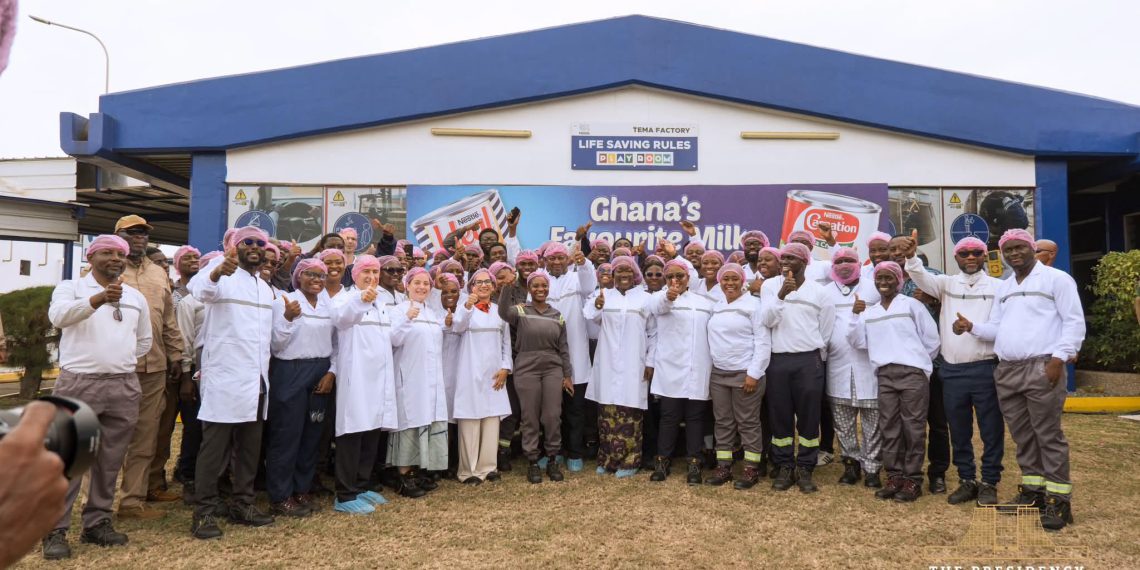
President John Dramani Mahama on Thursday commissioned Nestlé Ghana’s expanded evaporated milk production line at its Tema factory, a GH¢59 million modernisation project expected to boost production capacity, improve efficiency and supply both Ghanaian and regional markets.
The ceremony, held on Thursday, October 8, 2026, underscored the government’s push to create a stable economic environment capable of attracting private investment and strengthening local manufacturing.
The expanded line replaces equipment that had operated for more than three decades and is expected to significantly raise Nestlé Ghana’s evaporated milk output. It forms part of the company’s long-running investment programme at its Tema factory, which has produced brands such as Ideal Milk, Milo, Carnation, Cerelac and Nescafé 3-in-1 since the facility was established in 1971.
Speaking at the event, President Mahama said predictable fiscal policies, controlled inflation, stable foreign exchange rates and reliable energy supply are essential to giving businesses the confidence to invest and expand.
“Capital goes where it is safe, but it stays and expands where there is stability and supporting infrastructure,” he said.
The President assured corporate investors that his government would continue implementing policies to maintain macroeconomic stability and improve key infrastructure to support industrial growth.
He linked the Nestlé expansion to his administration’s 24-hour economy agenda, arguing that round-the-clock industrial operations are central to job creation and economic transformation.
“When we talk about the 24-hour economy initiative, this is what we are talking about — a factory that never sleeps,” President Mahama said.
Government figures released at the ceremony indicated that the expanded facility supports about 1,200 full-time workers and another 1,300 third-party workers. President Mahama also noted that 94.4 per cent of Nestlé Ghana’s employees are Ghanaian, describing it as evidence that the company is creating opportunities for Ghanaians as it grows.
Managing Director of Nestlé Ghana, Salome Azevedo, reaffirmed the company’s long-term commitment to Ghana, describing the expansion as a demonstration of its confidence in the country’s manufacturing sector and economic prospects.
“This milestone is more than the completion of a major investment; it is a strong expression of Nestlé’s confidence in Ghana, our enduring commitment to local manufacturing, and our conviction that Ghana will continue to play a leading role in the future of Central and West Africa,” she said.
The GH¢59 million evaporated milk line builds on Nestlé’s earlier investment of GH¢175.4 million in a cereal production line at the same Tema site. The company has also announced plans to invest an additional GH¢138 million to double its Milo production capacity and install another evaporated milk production line.
Those investments are expected to further strengthen Ghana’s position as a regional manufacturing hub while supporting local production and the supply of products to markets across West Africa.
The commissioning comes amid a broader government industrialisation drive, including the Big Push infrastructure programme and plans for a Tema Integrated Industrial Park. Officials say such projects are intended to create jobs, boost exports and reduce the country’s reliance on imports.
Minister for Trade, Agribusiness and Industry Elizabeth Ofosu-Adjare said the Nestlé investment signals growing confidence in the Ghanaian economy. She noted that manufacturing recorded the highest number of new investment projects in 2025 among major sectors, surpassing mining, oil and gas, and general trade.
President Mahama urged Nestlé Ghana to continue expanding production, deepen its relationships with local farmers and suppliers, and create more opportunities for young people.
“This investment by a major multinational company does not only underscore the confidence that Nestlé and its shareholders have in the Ghanaian economy, but it is also a signal to the global business community that the Ghanaian economy is recovering,” he said.
With the expanded line now operational, Nestlé Ghana says it is better positioned to meet growing demand for evaporated milk in Ghana and neighbouring markets, while the government insists it will keep working to create the conditions for more investments of this kind.