



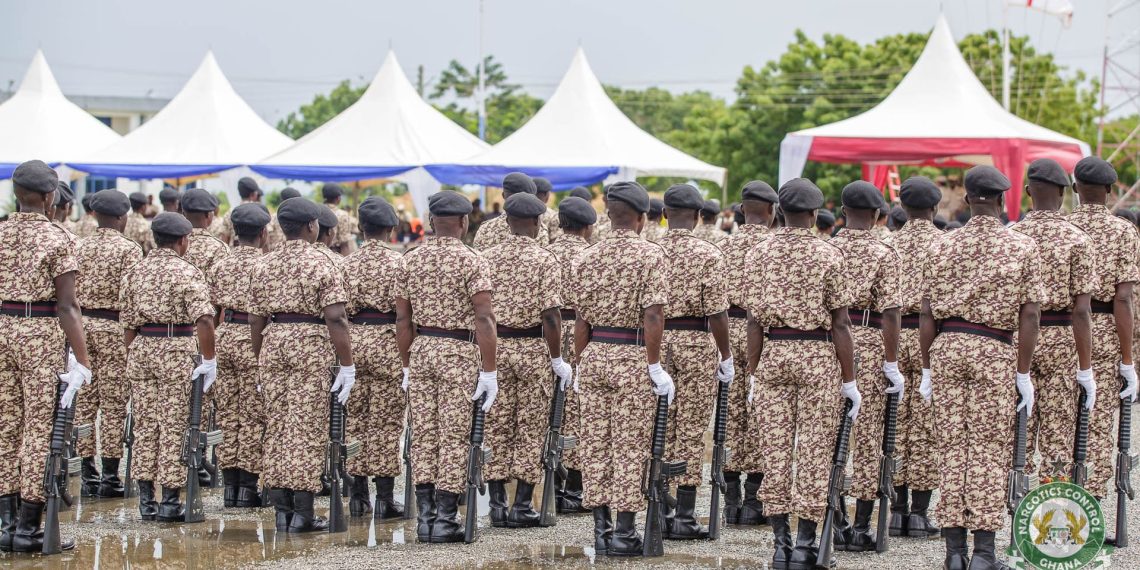
President John Dramani Mahama has approved the recruitment of 1,200 additional staff for the Narcotics Control Commission (NACOC), the Majority in Parliament announced on Thursday, marking the latest phase of a rapid expansion aimed at confronting Ghana’s escalating role in global drug trafficking.
The recruitment will complement the 495 officers trained by NACOC in 2025—the largest graduating cohort in the Commission’s history—and address a longstanding staffing deficit that has left the agency unable to cover large swaths of the country.
Addressing journalists in Accra, Majority Leader and Member of Parliament for Builsa North, James Agalga, said the approval was part of a sustained government effort to rebuild NACOC’s operational capacity after years of neglect.
“This government has more than doubled NACOC’s staff, training 495 new officers in 2025 alone, the largest number of officers to ever graduate from NACOC. This isn’t just a number. It’s the difference between an agency that can respond and an agency that can be there in communities at borders along the path traffickers go to exploit,” Agalga said.
“The government has approved the recruitment of another 1,200 staff for NACOC, a bold and consistent move that will go a long way to fill the deficit in the Commission’s staffing,” he added.
A Skeletal Force on a National Mission
The announcement comes amid heightened scrutiny of Ghana’s role as a transit hub for illicit narcotics. Before the current administration, NACOC operated with fewer than 1,500 personnel nationwide—a force Agalga described as wholly inadequate for securing a nation of over 30 million people with a long coastline, two major seaports, an international airport, and porous land borders.
“The public must come to a hard realisation that before this administration, the entire Narcotics Control Commission had less than 1,500 personnel throughout the country,” Agalga said. “It is not a national narcotics agency; it’s a skeletal crew called on to do a national mission”.
That shortfall had direct operational consequences. As of July 2026, NACOC was operating in only 66 of Ghana’s 261 districts due to shortages of personnel and equipment. The Commission’s workforce remains below 2,000, according to Peter Lanchene Toobu, Vice Chairman of Parliament’s Defence and Interior Committee.
From Board to Commission: NACOC’s Evolving Mandate
NACOC’s origins trace back to 1990, when the Narcotics Drugs (Control, Enforcement and Sanctions) Law, 1990 (PNDCL 236) established the Narcotics Control Board (NACOB) as the central coordinating body for dealing with rising drug abuse and trafficking. For three decades, the agency operated with limited enforcement powers, with narcotics enforcement largely handled as part of the Ghana Police Service.
That changed in 2020, when Parliament passed the Narcotics Control Commission Act, 2020 (Act 1019), transforming NACOB into NACOC with an expanded mandate and independent law enforcement powers. More recently, in July 2026, NACOC was granted full recognition as a security agency, empowering its officers to carry firearms, conduct intelligence operations, make arrests, and independently prosecute narcotics-related offences. The Director-General now holds the rank of a two-star General.
Expanding Footprint, Escalating Threat
The staffing boost follows a period of rapid operational expansion. NACOC’s district commands have grown from fewer than 10 to 77 nationwide, covering all 16 regions of the country, with approximately 27 operational vehicles received for field deployments. A 100-acre parcel of land has been secured at the Akwamu Traditional Area for a dedicated NACOC training school. The government has also provided mobile drug detection scanners and is collaborating with the Netherlands to replace non-operational body and baggage scanners at Kotoka International Airport.
These investments respond to a sharply deteriorating trafficking landscape. Between 2025 and April 2026, NACOC recorded 217 arrests and 165 prosecutions, seizing more than 8.5 tonnes of narcotic drugs and intercepting approximately 45.4 million tramadol tablets. Authorities also froze about GH¢6.9 million and US$440,000 in cash linked to suspected narcotics-related activities, and recovered 73 assets and approximately 19 kilograms of gold in money laundering cases.
The scale of the challenge is underscored by a string of major seizures. In March 2025, authorities intercepted approximately 3.3 tonnes of cocaine at Pedu Junction in Cape Coast, with an estimated street value exceeding US6.9 million.
According to the Global Initiative Against Transnational Organised Crime, as much as 30 percent of Europe’s cocaine could be transited through West Africa, with Ghana sitting “at the centre of that corridor,” NACOC Director-General Brigadier General Maxwell Obuba Mantey has warned.
Political Battle Over Ghana’s Drug Record
The recruitment announcement has become a flashpoint in an increasingly heated political debate. The opposition New Patriotic Party has accused the government of allowing Ghana to become a “cocaine coast,” pointing to recent international seizures involving consignments linked to the country. Agalga rejected the characterization, arguing the NDC government has done more to confront the menace than its predecessor, citing institutional upgrades, the establishment of a dedicated court for narcotics offences, and the restoration of NACOC to port inspection duties.
NACOC was removed from the joint container inspection regime in June 2018, a decision critics say weakened the agency’s ability to detect and prevent trafficking at Ghana’s ports. President Mahama has since directed that NACOC be restored to the inspection framework.
Interior Ministry Press Secretary Julius Kwame Anthony cited US State Department reports from 2023 and 2025 describing Ghana as “a major transit point for heroin and cocaine shipments to other countries in Africa, Europe, and the United States,” arguing that the country’s role as a trafficking hub predates the current administration.
Beyond Enforcement: A Public Health Gap
The government’s strategy has also focused on public education, with NACOC conducting 1,948 educational sessions nationwide targeting schools, faith-based organisations, communities, and workplaces. However, Interior Minister Muntaka Mohammed-Mubarak has identified rehabilitation and recovery services as a major gap, noting that Ghana currently does not have a state-owned rehabilitation centre.
NACOC’s Director-General has also raised alarm over drug use among security service applicants, revealing that over 6,000 candidates—about 7 percent—tested positive for substances including cannabis, cocaine, methamphetamine, and opioids during mandatory screening between 2025 and April 2026.
What’s Next
No timeline has been announced for the completion of the 1,200-person recruitment. The government has signalled plans to expand NACOC’s operations to all 261 districts within five to six years, and a comprehensive national drug prevalence survey—Ghana’s first—is expected to be completed by 2027 in partnership with UNODC.
For now, the Commission’s leadership is framing the expansion in stark terms. “To every trafficker, every syndicate, every network that thinks Ghana can serve as a safe operating base—the message is clear: Ghana is no haven for drug syndicates,” Brigadier General Mantey said.


