



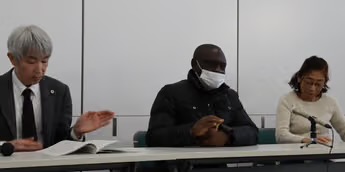
A Ghanaian man battling chronic kidney failure has lost his final legal battle for public assistance in Japan, after the Supreme Court upheld lower court rulings that his foreign nationality places him outside the country’s welfare system.
Siaw Johnson Kwaku, 36, a resident of Chiba City who requires dialysis three times a week, had argued that the city’s rejection of his application under the Public Assistance Act was unconstitutional. The Supreme Court’s Second Petty Bench, presided over by Justice Mamoru Miura, dismissed his appeal in a decision dated September 9, ruling that it did not constitute valid grounds for a final appeal. The decision leaves in place the earlier rulings of the Chiba District Court and the Tokyo High Court, both of which had sided with the municipality.
The court’s majority opinion did not engage with the constitutional question at the heart of Kwaku’s case, stating only that the appeal did not meet the criteria for review.
A Lone Dissent
Justice Miura, a former prosecutor, was the sole dissenter among the four justices. In a sharply worded minority opinion, he argued that excluding foreign nationals undergoing medical treatment from welfare eligibility is “unconstitutional and invalid” and “grossly inhumane”.
“If foreign nationals undergoing medical treatment who are unable to work cannot maintain a minimum standard of living in Japan, it is difficult for them to avoid danger to their survival,” Miura wrote. He said such individuals should be included among those eligible for protection under the law and that the high court ruling should have been overturned and the case sent back for further proceedings.
Miura also criticized the government for failing to legislate on the matter. “The failure to establish a legal framework and leaving it to the discretion of municipalities means the state is neglecting the survival and dignity of foreign nationals,” he said.
The Legal Barrier
Japan’s Public Assistance Act is rooted in Article 25 of the Constitution, which guarantees the right to a minimum standard of living. However, the law explicitly limits eligibility to Japanese nationals. In a 2014 ruling, the Supreme Court held that “foreign nationals do not have the right to receive benefits under the Public Assistance Act”.
The government nevertheless provides de facto welfare assistance on humanitarian grounds to certain categories of foreign residents, including permanent residents, long-term residents, their spouses, special permanent residents, and recognized refugees. In fiscal 2024, an average of 47,332 households headed by foreign nationals received such assistance each month.
Kwaku’s “Designated Activities” residence status — granted for medical treatment — does not fall within these categories.
A Life in Limbo
Kwaku came to Japan in 2016 to study Japanese at a language school. After graduating, he worked at a food products company making bread. In 2019, he developed chronic renal failure and began dialysis treatment. The following year, his residence status was changed to “Designated Activities” for medical treatment, which permitted him to remain in Japan but prohibited him from working.
In November 2021, Kwaku applied to Chiba City for public assistance. The city rejected his application the following month, stating that his residence status did not warrant the same treatment as Japanese nationals.
The Chiba District Court ruled against him in January 2024, finding that “whether to include foreign nationals among those eligible for protection is within the discretion of the legislature”. The Tokyo High Court upheld that ruling in August 2024.
Kwaku’s lawyer, Satoshi Oikawa, described the ruling as “bound by outdated thinking” and expressed disappointment that the court had not moved toward a more inclusive society.
A Growing Foreign Population, Limited Protections
The case underscores the widening gap between Japan’s rapidly expanding foreign population and its welfare protections. As of the end of 2025, Japan’s foreign resident population reached a record 4,125,395, up 9.5 percent from the previous year and surpassing 4 million for the first time. Foreign residents now account for approximately 3.35 percent of Japan’s total population.
African nationals remain a small fraction of that total. As of June 2024, there were 23,788 African residents in Japan, about 0.7 percent of the foreign population. Nigerians formed the largest African community with 4,126 residents, followed by Ghanaians at 2,996 and Egyptians at 2,299.
Ghana’s community in Japan has grown steadily since the early 1990s, when many arrived as laborers in factories, construction sites, and restaurants. Saitama Prefecture’s Soka City has become a notable hub, home to over 100 Ghanaian residents and a small cluster of Ghanaian-owned businesses and a mosque.
For Kwaku, however, the court’s decision leaves him in a precarious position. Unable to work under his residence status and without access to welfare, he faces an uncertain future in a country where his right to survive has been deemed a matter of legislative discretion, not constitutional guarantee.


