

The government plans to raise GH¢15.38 billion in net domestic financing between October and December 2026, as it moves to buy back bonds issued under the Domestic Debt Exchange Programme (DDEP) that mature in 2027, according to the fourth-quarter issuance calendar released by the Finance Ministry.
The borrowing target reflects projected domestic debt maturities and the remaining net domestic financing requirements under the 2026 Mid-Year Fiscal Policy Review Framework. The figure represents net financing, not total gross issuance.
Treasury Bills to Dominate Issuance
The government intends to raise the funds primarily through Treasury bills with maturities of 91, 182 and 364 days, to be issued weekly through primary auctions. Medium- to long-term securities will also be issued, subject to prevailing market conditions, to help establish benchmark bonds across the yield curve.
The calendar confirms plans for liability management operations involving buybacks of the 2027 DDEP bonds. However, the government did not specify the amount earmarked for the buyback exercise.
Sinking Fund Operationalisation
The planned buybacks, among other factors, have made the full operationalisation of the sinking fund necessary, the calendar stated. The fund is designed to set aside resources ahead of major debt repayments rather than relying entirely on refinancing when bonds mature.
As of July 22, 2026, the Cedi Sinking Fund held GH¢15.6 billion, with the government targeting GH¢30 billion by the end of the year to help cover DDEP principal repayments due in 2027 and 2028. Ghana faces GH¢58 billion in domestic debt maturities in 2027 and GH¢53 billion in 2028.
Background: The DDEP Burden
The DDEP was launched in December 2022 after Ghana lost access to international capital markets, seeking to swap outstanding medium- and long-term domestic bonds for lower-coupon, longer-maturity instruments. The restructuring reprofiled over 70 domestic bonds into approximately 16 benchmark bonds, but it postponed rather than eliminated the debt burden.
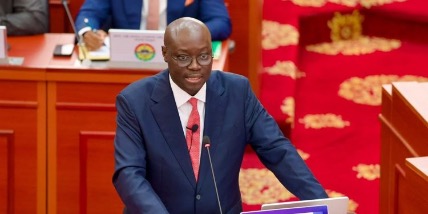
Finance Minister Dr. Cassiel Ato Forson has been candid about the programme’s limits. “The DDEP was not designed to solve Ghana’s debt problem,” he told Parliament. “It was designed to postpone it.”
Since 2025, the government has paid GH¢41.36 billion in DDEP coupons, including a GH¢10.82 billion settlement in August 2026 — the seventh such payment and the third made entirely in cash. Restrictions on new domestic bond issuance expired in March 2026, allowing the government to begin rebuilding the longer-term domestic market, though it has continued to rely heavily on short-term Treasury bills.
Fiscal Consolidation Context
The fourth-quarter borrowing plan comes amid notable fiscal improvement. Ghana’s public debt declined from 61.8 per cent of GDP at the end of 2024 to 45.0 per cent by June 2026, meeting the statutory debt ceiling years ahead of schedule. The primary balance recorded a surplus of 2.5 per cent of GDP in 2025, exceeding the 1.5 per cent target.
Borrowing costs have also fallen sharply. The 91-day Treasury bill yield dropped from 11.12 per cent at the start of 2026 to 4.60 per cent by October, while the 364-day rate eased from 12.93 per cent to 9.75 per cent.
The government says the issuance calendar is designed to improve transparency and help market participants make informed investment decisions.
“Government reaffirms its commitment to promoting transparency, predictability, market development and investor confidence in the domestic capital market,” the calendar stated.