



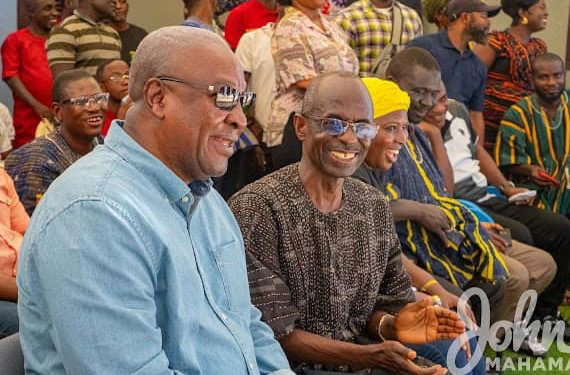
The National Chairman of the governing National Democratic Congress (NDC), Johnson Asiedu Nketiah, has called on the John Dramani Mahama-led administration to remain open to public scrutiny, transparency, and accountability as it works to fulfil its commitments to Ghanaians, declaring that the government “should expect scrutiny” and that ministers must answer legitimate questions about their stewardship.
Speaking as the guest of honour at the 4th Bono Regional Ghana Journalists Association (GJA) Awards in Sunyani on Saturday, September 20, 2026, Mr. Asiedu Nketiah — popularly known in political circles as “General Mosquito” — underscored that accountability is an essential component of democratic governance and should not be viewed as an obstacle or an attack on the government.
“This government should expect scrutiny. Ministers should answer legitimate questions. Public expenditure should be examined. The promises we made to Ghanaians should be checked against what we deliver,” he said. “That is part of governing in a democracy and a government that intends to perform should have no difficulty with it at all”.
A Call for Vigilant Regional Journalism
The NDC chairman, who hails from Seikwa in the Bono Region, made a particularly pointed appeal to journalists in his home region to closely monitor public projects and maintain detailed records of government investments. He noted that billions of cedis in public investments are currently underway in the Bono Region and urged the media to track them rigorously.
“There are billions of cedis of public investments underway in Bono today. I would encourage journalists in this region to keep the records,” he said. He urged journalists to establish the cost, contractor, timelines, and terms of major projects and to return later to assess whether they were completed and whether citizens received value for money.
“Five years from now, it should be possible for somebody to go into the archives of the media in Bono and reconstruct what happened to the major development commitments being made today,” he added.
According to him, journalism should not end with reporting government announcements but should also provide an accurate record against which public officials can be held accountable.
Journalists Must Remain Independent
Mr. Asiedu Nketiah further called for improved working conditions and greater institutional support for journalists, saying media organisations must have the resources to employ and retain competent professionals, investigate stories, and maintain strong regional newsrooms.
“We should equally be concerned about the conditions under which journalists work,” he said. He stressed that better conditions would help journalists perform their watchdog role effectively and build sustainable careers without becoming financially dependent on politicians, businesses, and institutions they cover.
“If we want high professional standards, the sustainability of serious journalism deserves attention as well,” he added.
He also urged politicians to provide journalists with the information required for accurate reporting and not to regard difficult questions as hostility.
The Political Context
Mr. Asiedu Nketiah’s remarks come at a politically sensitive moment for the Mahama administration, which marked its first year in office in January 2026. The government has faced sustained criticism from the opposition Minority in Parliament, which accused it in January of presiding over an “accountability charade” and a “relapse into patterns of deception,” particularly regarding its anti-corruption drive dubbed “Operation Recover the Loot”. The Minority alleged that accountability under the current administration has been “selective” and questioned the government’s commitment to transparency.
The NDC chairman has consistently defended the government’s record. In April 2026, he argued that prudent economic management had shielded Ghanaians from global shocks and stabilised the economy within the government’s first year. His call for scrutiny at the GJA Awards therefore represents a notable moment of a governing party chairman publicly embracing oversight — a stance that analysts suggest is aimed at reinforcing the government’s stated commitment to transparency while also setting a standard for media engagement.
Asiedu Nketiah: A Political Heavyweight
Johnson Asiedu Nketiah, born in 1956 in Seikwa in the Bono Region, is one of Ghana’s most enduring political figures. A trained teacher and former stockbroker, he began his political career in 1989 as a local assembly representative and became a member of the consultative assembly that drafted the 1992 Constitution.
He served as Member of Parliament for his constituency for 12 years and was Deputy Minister of Food and Agriculture under the Rawlings administration between 1997 and 2001. He holds the record as the longest-serving General Secretary of the NDC, having been elected to that position in December 2005, before being elevated to National Chairman in December 2022. He was also the star witness in the NDC’s 2020 election petition at the Supreme Court.
His presence at the Bono Regional GJA Awards thus carried additional symbolic weight, as he returned to the region of his birth to deliver a message that was, by his own admission, intended for the governing party he leads as much as for the journalists in attendance.
Awards Celebrate Journalistic Excellence
The 4th Bono Regional GJA Awards were held under the theme: “Ethics, Integrity and Impactful Journalism: Catalysts for Societal Transformation”. The guest speaker, Professor Elvis Asare-Bediako, Vice Chancellor of the University of Energy and Natural Resources (UENR), urged journalists to uphold the principles of ethics, integrity, and accuracy, describing journalism as “a form of leadership capable of influencing public thought, shaping civic behaviour and inspiring collective action”.
“In a world where misinformation spreads faster than truth, accuracy is the bedrock of trust, and trust is the foundation of transformation,” he said, urging journalists to resist sensationalism and prioritise public interest, fairness, and balance.
Lawrence Yeboah Gyan of Wisdom FM received the overall Bono Regional Best Journalist of the Year 2025 award for his work in children’s advocacy, health, and medical care. Precious Semevoh of Joy News was adjudged Best Journalist in Climate Change and Green Transition Reporting. A major highlight of the ceremony was a posthumous honour for the late Francis Owusu Ansah, a dedicated member of the Association, in recognition of his contribution to journalism.
The event was attended by notable figures including the NDC chairman and Minister Ahmed Ibrahim.
Media Freedom: Progress and Challenges
Mr. Asiedu Nketiah’s call for the government to embrace scrutiny comes against the backdrop of Ghana’s evolving media freedom landscape. In May 2026, Ghana rose to 39th place out of 180 countries in the Reporters Without Borders (RSF) World Press Freedom Index, its strongest performance in five years, up from 52nd in 2025.
However, structural challenges persist. The GJA has warned that police involvement in media-related matters risks undermining press freedom, and has renewed calls for reforms to laws such as the Electronic Communications Act, 2008 (Act 775). Media organisations also continue to struggle with financial sustainability, uneven advertising markets, and dependence on state advertising — factors that the GJA says contribute to low remuneration for journalists and, in some cases, the collapse of media outlets.
Mr. Asiedu Nketiah’s emphasis on improving journalists’ working conditions and ensuring their independence from political and commercial pressures thus addresses both the gains and the remaining vulnerabilities in Ghana’s media environment.
A Challenge for Both Government and Media
In the end, the NDC chairman’s message at the GJA Awards was twofold: the government must accept scrutiny as a democratic necessity, and journalists must have the resources and independence to conduct that scrutiny effectively. As Ghana’s political landscape continues to evolve ahead of future electoral cycles, the willingness of both the governing party and the media to uphold their respective responsibilities will serve as a critical test of the country’s democratic resilience.
“Journalism serves the citizens best when the facts are established properly and reported without regard to which political party finds them convenient,” Mr. Asiedu Nketiah said, in a pointed reminder to both the government and the fourth estate of the shared duty they bear in a functioning democracy.


