


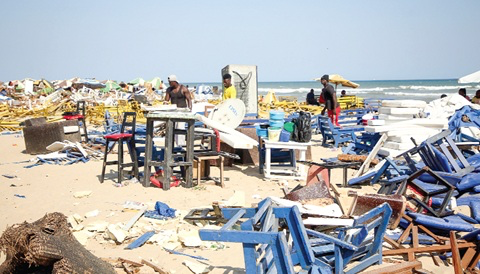
A committee is to be constituted by early next week to determine appropriate compensation for persons whose businesses and properties were affected by the recent demolition of facilities at La Pleasure Beach in Accra, the Member of Parliament for La Dadekotopon and Deputy Minister of Local Government, Chieftaincy and Religious Affairs, Naa Odoley Sowah, has announced.
The committee will bring together representatives of the Social Security and National Insurance Trust (SSNIT), the La Dadekotopon Municipal Assembly (LaDMA), traditional authorities, management of the affected beaches, and the Member of Parliament for the area.
Mrs. Sowah disclosed this when she appeared before the Committee on Local Government and Decentralisation in Parliament on Tuesday, October 6, 2026. She said data had already been gathered on persons displaced by the exercise and their circumstances would be assessed to determine the form of compensation to be provided.
Compensation Details Yet to Be Finalised
The Deputy Minister, however, stopped short of giving the exact nature and amount of compensation to be determined, saying that “the matter will be discussed by the committee before a decision will be reached.”
“We have gotten their data and the committee is going to look at what we are going to give to them as compensation. So those affected will be compensated and the decision for the type of compensation has not been finalised but as the MP I am following up deeply on that to ensure that everybody gets what they are supposed to get,” she said.
She said the committee would also consider the needs of persons who might have to be relocated as well as those who might require financial compensation. She explained that the exercise involving the La Pleasure facilities was separate from the demolition at Laboma, which she said would be dealt with under a different arrangement. “Laboma Beach demolishing is a different issue but subsequently Laboma concerns will come up,” she said.
Background: The October 2 Demolition
The demolition at La Pleasure Beach began in the early hours of Friday, October 2, 2026, involving personnel from the Ghana Armed Forces’ 48 Engineer Regiment and the Ghana Police Service. Security personnel arrived at about 4:00 a.m. and instructed residents, workers, and businesses operating within the area to vacate the premises. Several structures were completely demolished, while others were partially pulled down, and workers and residents were seen attempting to recover belongings from the rubble.
Popular entertainment spots including Pera Beach, Polo Beach Club, Vienna City Club, and Bliss Escape Restaurant were among the hardest hit. The demolition followed weeks of controversy over the ownership and control of the beachfront.
SSNIT’s Role and Rationale
The Social Security and National Insurance Trust (SSNIT) explained the reasons behind the demolition exercise. SSNIT sought intervention from the National Security Council Secretariat due to unlawful occupation and encroachment along the beachfront near Labadi Beach Hotel and La Palm Royal Beach Hotel. According to SSNIT, these hotels are part of its investment portfolio and are significant national assets. The Trust stated it has a fiduciary responsibility to protect these investments and ensure they generate sustainable returns for contributors under the Basic National Social Security Scheme.
However, Deputy Chief of Staff Stan Dogbe clarified that the demolition was not part of the government’s flood mitigation exercise, stating that Friday’s action along a section of the beachfront “was not a Flood Mitigation Action by the government task force.” He said the action was carried out under the supervision of National Security at the request of the Labadi Beach Hotel, whose management cited safety, tranquillity, and reputational concerns.
MP Confronts Military
The Member of Parliament for La Dadekotopon, Rita Naa Odoley Sowah, confronted military personnel at the site and questioned the circumstances surrounding the demolition. She said she had engaged relevant authorities over the planned exercise and was surprised that structures were being demolished despite what she described as assurances that the area would be spared.
“What is it, do you want to kill us, what has La done?” she questioned during the confrontation, alleging that some military personnel were firing shots and wielding guns at people at the scene. The MP also stated that government was not aware of the exercise, pointing fingers at the Board Chairman of the Labadi Beach Hotel as being behind the operation.
Laboma Demolition: A Different Exercise
Giving an account of the Laboma demolition, the Chief Executive of the La Dadekotopon Municipal Assembly, Mr. Alfredos Nii Anyetei, told the committee that the exercise was undertaken as part of measures to address flooding and restore an ecological site. He said the assembly was not consulted but was shown in a meeting the locations where the exercise would be undertaken. He also said he was not aware that the MP had been specifically informed before the exercise.
The Laboma Beach demolition, which began on September 13, 2026, was carried out by the Post-Flood Mitigation Task Force under the 48 Engineer Regiment of the Ghana Armed Forces. The exercise followed a directive by the Greater Accra Regional Security Council on August 6, 2026, after an inspection of the Laboma Beach enclave. Occupants within the affected area, formerly part of a protected lagoon buffer zone, were given 21 days to vacate before the demolition.
The Kpeshie Lagoon is considered a critical intervention point under the post-flood mitigation programme because years of illegal reclamation, sand filling, and uncontrolled development have reduced its natural capacity to retain floodwaters. Greater Accra Regional Minister Linda Ohenewaa Akweley Ocloo said the operation was conducted peacefully, following engagements with affected occupants and the expiration of the 21-day ultimatum.
Committee Chair Calls for Stronger Enforcement
The Chairperson of the Committee on Local Government and Decentralisation, Mrs. Queenstar Pokua Sawyerr, said the La Dadekotopon Municipal Assembly had the mandate and technical personnel to monitor development and protect waterways within their areas. She urged the assembly to strengthen its enforcement mechanisms to prevent people from re-filling areas that had been dredged or cleared to improve drainage.
She said although central government agencies could intervene in emergencies, assemblies should take responsibility for developments within their jurisdictions. Mrs. Sawyerr urged the MP and the assembly to ensure that the concerns of affected persons were properly addressed, assuring that “we will follow up on the outcome of the committee’s work.”
The Human Cost
The demolition has left hundreds of workers and business operators facing an uncertain future. Some affected vendors maintained that they were not given prior notice and were forcibly prevented from retrieving their belongings, while others considered the notice period inadequate. One worker, a single mother, said she and her colleagues had been given two weeks to vacate but had not believed the order would actually be enforced.
Ms. Beatrice Aku Tawiah, an operator at Labadi Beach under Princess Wala Company, said the sellers were not informed about the demolition. She said the company employed more than 70 workers and that the exercise had destroyed her property and caused significant financial losses. “I have lost over one million Ghana cedis in this place; my properties have been destroyed,” she said. “I even took a loan for this business and I don’t know how I can get the money to pay.”
Laboma Beach spokesman Nathaniel Nettey said more than 3,000 people worked within the enclave and could feel the impact, including staff and associated workers.
Historical Context: A Long-Running Land Dispute
The demolition at La Pleasure Beach is the latest chapter in a decades-long dispute over ownership and control of the beachfront. The beach’s troubles are rooted in a 2002 Memorandum of Understanding between the La Traditional Council, the allodial landowners, and the state-owned Ghana Tourism Development Company for the development and management of La Pleasure Beach.
The protracted conflict centres on Stanley Nunoo, who has maintained control of the beach’s operations and finances in defiance of a Court of Appeal order that restructured the management committee and mandated a peaceful handover of responsibilities. The dispute has left the youth of La without scholarships and the traditional landowners without their share of millions of cedis in revenue.
Management of La Pleasure Beach has dismissed assertions that it operated as squatters on the beachfront before the demolition, maintaining that the beach has been in existence since 1960—well before the Labadi Beach Hotel was established—and has consistently operated from the location in question over the years.
Political Reactions
The demolition has drawn reactions from across the political spectrum. Flagbearer of the New Patriotic Party, Dr. Mahamudu Bawumia, condemned the demolition and pledged to rebuild the economy of La Pleasure Beach, describing the area as economically and culturally significant to Ghana. In a statement issued on October 3, Dr. Bawumia outlined plans to rebuild the beach economy and issue leases to each business, redesigning the space to meet required standards while assisting operators to run their enterprises.
Ghanaian musician and businessman D-Black also expressed disappointment over the demolition, calling the situation unfortunate and expressing concern about the impact on beach club operators and workers who depend on these businesses for their livelihoods. “It’s unfortunate that this is happening,” he stated. “This is how people make money to take care of themselves.”
What’s Next
As the committee prepares to convene early next week, affected persons await clarity on the form and amount of compensation they will receive. The committee’s work will be closely watched as a test of the government’s commitment to addressing the economic and social consequences of the demolition on some of Accra’s most vulnerable workers and small business operators.