



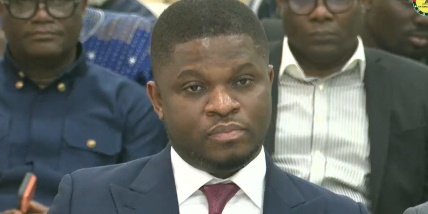
The Ghana Gold Board (GoldBod) has disclosed that it is yet to settle an estimated GH₵36 million in income tax obligations inherited from the Precious Minerals Marketing Company (PMMC), pending the outcome of a comprehensive tax audit by the Ghana Revenue Authority (GRA).
Chief Executive Officer of GoldBod, Sammy Gyamfi, told Parliament’s Public Accounts Committee (PAC) on Tuesday, October 13, 2026, that the GRA is conducting the audit to establish the board’s definitive tax liability for the period under review. He explained that PMMC’s financial statements for 2020 to 2024 had not been audited during those years, making it difficult for GoldBod to determine the outstanding tax obligations it inherited when it took over the company’s rights and responsibilities.
According to Mr Gyamfi, an audit conducted by the Auditor-General and reported in August 2025 identified both profit-making and loss-making years, requiring adjustments to account for losses carried forward. He also said GoldBod had about GH₵11.3 million in tax credits arising from its role as a buying agent for the Bank of Ghana, which needed to be factored into the calculation.
The Transition from PMMC to GoldBod
The GH₵36 million tax liability is a legacy issue stemming from the transition of the Precious Minerals Marketing Company (PMMC) into the Ghana Gold Board. The PMMC, established in 1963 as the Ghana Diamond Marketing Board, was a state-owned company with a rich history in the marketing of Ghana’s precious minerals. Under section 78 of the Ghana Gold Board Act, 2025 (Act 1140), GoldBod took over the rights, obligations, assets, liabilities and workforce of the PMMC.
The transition marked a strategic shift from a company limited by shares to a statutory corporation with strengthened legal backing as the national assayer, granting it the exclusive power to buy gold from both small-scale and large-scale miners, and the exclusive authority to export all gold from small-scale mining.
However, the transition also meant that GoldBod inherited liabilities accumulated by PMMC over several years, including the tax obligations now under review. PMMC’s financial statements for 2020 to 2024 had gone unaudited for five consecutive years, leaving a significant gap in the financial records that GoldBod had to reconstruct upon taking over.
The GRA Audit and Path to Settlement
GoldBod wrote to the GRA Commissioner-General on May 26, 2026, requesting a comprehensive tax audit to establish the exact amount payable. The GRA responded on June 16 and deployed a team to conduct the exercise.
“As I speak to you, they are conducting that audit. They’ve indicated to us that the report will be ready next month. Once the report is ready, we stand ready to clear all tax liabilities of the PMMC,” Mr Gyamfi assured the Committee.
The audit is expected to bring clarity to GoldBod’s tax position after years of uncertainty. The board’s proactive engagement with the GRA reflects a commitment to resolving the inherited liabilities transparently and putting the institution on a sound financial footing.
Strong Debt Recovery Performance
GoldBod’s appearance before the PAC also highlighted significant progress in recovering debts owed to its predecessor. Mr Gyamfi disclosed that the Board has recovered GH¢38.7 million out of GH¢55.9 million owed to PMMC by third parties, representing approximately 69.2% of the total outstanding debt.
The debts were uncovered during an audit of PMMC’s financial statements covering 2020 to 2024, after the company went five consecutive years without an audit. According to Mr Gyamfi, the audit showed that third parties owed PMMC GH¢55.88 million as of December 31, 2023. Management had since taken steps to recover the money, including issuing demand notices to the debtors. As of September 30, 2026, the Board had recovered GH¢38.71 million.
The remaining GH¢17.1 million is being pursued through legal action and other recovery measures. About GH¢7.5 million of the outstanding amount is tied up in court cases, while the remaining GH¢9.6 million is being pursued through demand notices, negotiations and other civil recovery processes. Mr Gyamfi expressed confidence that the Board would recover more of the outstanding funds before the end of the year. “We hope that by the end of this year we will have even increased what we have recovered so far,” he said.
A Financially Viable Institution
The tax liability and debt recovery issues come against the backdrop of GoldBod’s strong financial performance. According to the Board’s audited financial statements for the year ended December 31, 2025, GoldBod recorded an operational surplus of GH₵907 million and an overall surplus of more than GH₵5.4 billion.
Mr Gyamfi has consistently rejected claims by the Minority in Parliament that the institution incurred losses of about $1.7 billion. He explained that the operational surplus reflected revenue generated from the institution’s own operations less expenditure of approximately GH₵109 million. He has challenged critics to rely on the Auditor-General’s report, which, he says, made no adverse findings against the Gold Board for 2025.
“No taxpayers’ money was paid to us throughout 2025,” Mr Gyamfi stated, dismissing allegations of financial mismanagement.
A New Financing Architecture
GoldBod has also taken significant steps to strengthen its financial independence. In August 2026, the Board successfully raised US$75 million from commercial banks in Ghana, marking a milestone in its transition towards a market-based financing model. The transaction, executed on August 3, 2026, was completed within 48 hours and did not require the Bank of Ghana to act as an intermediary.
Under the previous arrangement, GoldBod inherited the role previously performed by PMMC, purchasing gold as an agent for the Bank of Ghana under the Domestic Gold Purchase Programme. The new structure enables GoldBod to finance its gold aggregation activities while simultaneously supporting the foreign exchange needs of businesses and strengthening the institution’s commercial independence.
Outlook
As GoldBod awaits the GRA audit report, the Board’s leadership has expressed confidence that the outstanding tax liability will be resolved once the audit is completed. The combination of strong debt recovery, a robust operational surplus, and a new market-based financing model positions the institution to settle inherited obligations while continuing its mandate to transform Ghana’s gold sector.
The GRA audit report is expected next month, and GoldBod has indicated it stands ready to clear all tax liabilities of the PMMC upon receipt.


