



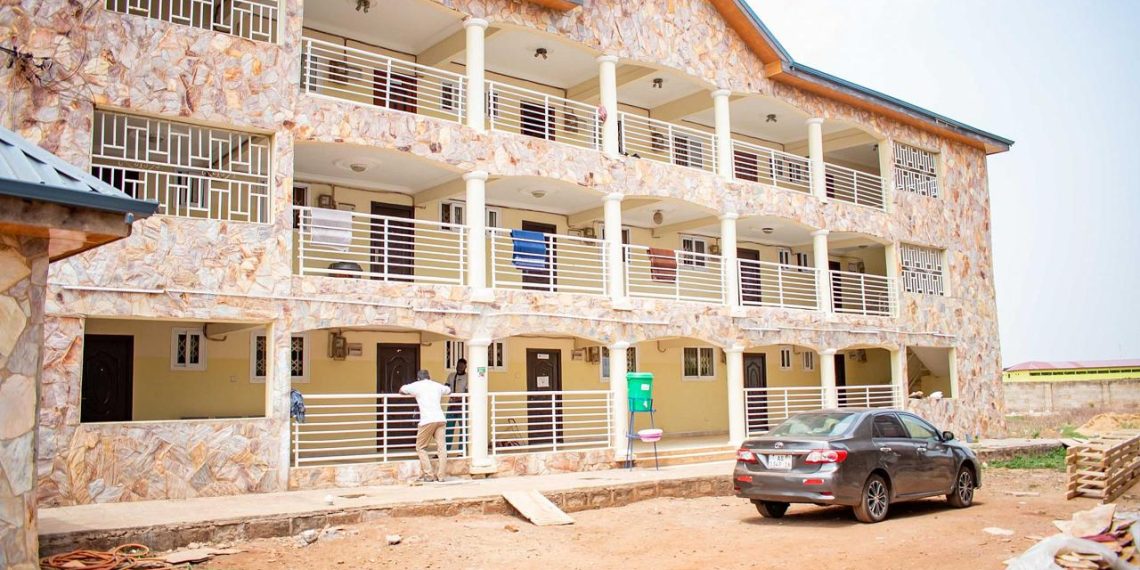
Ghana’s accommodation industry is facing a paradox. Across the country, roughly five million room-nights are available every month, yet the majority of them sit empty. Between March and June 2025, only about four out of every ten available rooms were occupied, according to new data from the Ghana Statistical Service (GSS) — a finding that signals deep structural problems in a sector often touted as a key driver of economic diversification and job creation.
The GSS’s 2025 Accommodation Unit Survey — the first nationwide panel study of commercial short-stay accommodation, covering 1,085 establishments selected from a national frame of 9,602 units across all 16 regions — captured monthly occupancy data from November 2024 through October 2025. The March-to-June window revealed that occupied room-nights declined from 2.14 million in March to 1.99 million in June, a roughly seven per cent drop in monthly totals. National room occupancy hovered perilously close to the 40 per cent mark throughout the period, rising slightly from 41.7 per cent in March to 41.9 per cent in April before falling to 39.7 per cent in May and recovering marginally to 40 per cent in June.
The survey’s findings suggest that the sector’s challenge is not a shortage of rooms but a shortage of demand — and a failure to convert existing capacity into revenue. “The data therefore point not simply to the availability of accommodation, but to the importance of generating and sustaining demand for the capacity already in place,” the report stated.
A Tale of Two Accommodation Markets
The aggregate figures conceal stark differences by establishment type. Hostels recorded room occupancy rates of between 92.9 per cent and 96.1 per cent — with standard hostels operating particularly close to full capacity at 96 to 99 per cent. Hotels, by contrast, recorded rates of just 32.4 per cent to 34.9 per cent, despite accounting for approximately 71 per cent of all available rooms in the country.
The pattern extends beyond occupancy numbers. In February 2025, one-star hotels recorded a room occupancy rate of just 28 per cent and bed occupancy of only 24 per cent, according to the Government Statistician, Dr Alhassan Iddrisu. The gap between the hostel segment and lower-tier hotels highlights a fundamental shift in how travellers are choosing to spend their money — favouring lower-cost options as household budgets tighten and the cost of formal hotel accommodation rises.
The GSS cautioned that the serviced apartment category, which recorded a sharp increase in occupancy from 47 per cent in March to 83.1 per cent in June, has limited representation in the survey, meaning those estimates should be interpreted carefully.
Regional Imbalances Expose Uneven Demand
National averages also mask significant regional disparities. The Central Region recorded 56.8 per cent occupancy in June, while the Western Region maintained rates above 50 per cent throughout the four-month period. Both regions benefit from a concentration of tourism assets — including the Cape Coast and Elmina castles, Kakum National Park, and beach resorts along the western coastline.
At the other end of the spectrum, the Eastern, Bono East and North East regions recorded occupancy rates below 25 per cent. Earlier GSS data covering November 2024 to February 2025 showed that the Savannah Region recorded the highest room occupancy rate of 63.7 per cent in January 2025, while the Eastern, Bono East and Volta regions recorded rates below 28 per cent throughout that period.
Greater Accra, which has the country’s largest concentration of hotel rooms, saw room occupancy hover between 41 and 48 per cent during the November 2024 to February 2025 period. The region also attracted the highest number of foreign guests, peaking at over 30,000 in January 2025, while the Central Region recorded particularly strong domestic demand with over 872,000 domestic guests in the same month.
The GSS said the disparities demonstrate that national averages could obscure important differences in local accommodation markets. The situation is further complicated by a growing shortage of accommodation in some regions even as others grapple with empty rooms. In the Volta Region, the capital Ho has faced a persistent shortage of hotel rooms during major events, with limited room availability cited as a significant barrier to the region’s tourism potential.
Revenue and Demand: A Fragile Recovery
Revenue performance was uneven during the March-to-June period. Revenue per available room (RevPAR) increased from GH¢425 in March to GH¢464 in April, before falling to GH¢399 in May and recovering to GH¢458 in June. The average daily rate (ADR) followed a similar pattern, rising from GH¢1,018 in March to GH¢1,145 in June, despite dipping to GH¢1,004 in May.
The earlier period from November 2024 to February 2025 had already shown weakness. National RevPAR declined from GH¢603 in November 2024 to GH¢490 in January 2025 before increasing to GH¢524 in February. Greater Accra recorded the highest RevPAR throughout, although it also experienced a decline from GH¢1,165 in November to GH¢852 in January.
Domestic guests accounted for the overwhelming majority of recorded visitors, with monthly numbers ranging from approximately 1.78 million to 1.86 million during the March-to-June period. Foreign guest numbers ranged from about 23,000 to 30,000 per month, though international visitors generally stayed longer — averaging three to nine nights compared with one to two nights for domestic guests.
The figures underscore the critical importance of domestic tourism to accommodation businesses. Ghana’s tourism sector generated an estimated $4.34 billion in receipts in 2025, with international arrivals reaching 1,306,962, up from 1,288,804 the previous year. Domestic tourism visits grew from 1.68 million in 2024 to 1.79 million in 2025, a seven per cent increase. The number of licensed tourism enterprises also expanded from 6,702 in 2024 to 7,109 in 2025, a 6.1 per cent rise, with travel trade enterprises recording the strongest growth at 18.6 per cent.
Yet even as visitor numbers rise, the accommodation sector struggles to convert that growth into occupancy. The GSS notes that visitor numbers alone do not fully capture economic value. Longer stays create more opportunities for spending on accommodation, transport, food, entertainment and other services — a dynamic that favours international visitors but one that the domestic market, with its shorter average stays, does not fully replicate.
Cost Pressures Squeeze Operators
The occupancy challenge is compounded by rising operational costs. The Ghana Hotels Association has warned that high taxes and utility tariffs are driving up the cost of accommodation and squeezing already-thin margins. Association president Victor Opoku Minta explained that taxes alone account for about 20 per cent of the price of a hotel room. “If you take a GH¢100 hotel bill, roughly GH¢20 goes to taxes. The remaining GH¢80 has to cover electricity, water, staff salaries, maintenance and several other expenses required to keep the facility running,” he said.
The cost of energy is a particular concern. According to industry players, energy costs represent about 20 per cent of hotel revenue in Ghana, compared with six per cent in Côte d’Ivoire and eight per cent in Burkina Faso. Roughly 80 per cent of the items hotel operators use — from meat to bedsheets — are imported, further inflating costs and making Ghanaian hotels less competitive with regional peers.
Electricity and water tariffs rose in May 2025, with electricity up 14.75 per cent and water up 4.02 per cent. Hoteliers have also raised concerns about multiple taxes, including the COVID-19 Levy, VAT, NHIL and GETFund levies, and have warned that higher utility tariffs were expected from January amid a tax review.
The association has called on the government to review how hotels are classified under utility tariffs, arguing that supportive policies could ease the cost burden on operators and reduce accommodation rates for consumers.
The Airbnb Question and Regulatory Gaps
Adding to the competitive pressure is the rapid growth of short-term rental platforms such as Airbnb. The Ghana Hotels Association has warned that the growth of Airbnb without proper regulation could undermine the traditional hotel industry. Association president Dr Edward Ackah-Nyamike insists the issue is not competition but an uneven regulatory and tax environment. “What we have not been happy about is the regulation of that sector in terms of taxes, in terms of levies, in terms of the regulatory fees that we pay that they don’t pay, and so they end up providing services at cheaper rates,” he said.
Hotels are subject to VAT, NHIL, GETFund levy, COVID-19 levy, FDA, fire service and EPA requirements, while many Airbnb operators are not — a disparity that hoteliers argue distorts the market and places traditional accommodation providers at a disadvantage. The association has acknowledged that short-term rentals sometimes help the industry during peak periods when hotels are fully booked, but maintains that the regulatory gap remains the core issue.
A Call for Evidence-Based Investment
The GSS has urged accommodation operators experiencing persistently low occupancy to assess demand, location, pricing, service quality and market positioning before committing resources to additional rooms. Investors and financial institutions have been advised to examine location-specific demand, property type, occupancy and revenue performance when evaluating new projects.
“Invest where the evidence supports demand, not simply where capacity is scarce,” the report stated.
The survey’s findings are particularly significant given the broader economic context. While Ghana’s tourism sector has shown resilience — with international arrivals exceeding 1.3 million in 2025 and revenue reaching $4.34 billion — the accommodation industry continues to face structural challenges that predate the current reporting period. An academic study on barriers within the Ghanaian tourism and hospitality industry identified shortages of skilled labour, inadequate investment, poor infrastructure and maintenance, high seasonality and insufficient management expertise as persistent obstacles, particularly in the Central and Western regions.
More broadly, the sector faces persistent high costs of travel influenced by taxes and regulatory fees, infrastructure limitations including poor roads and inadequate conference facilities, fluctuating foreign exchange rates affecting pricing and investor confidence, and fragmented destination marketing with limited global visibility. The Social Security and National Insurance Trust (SSNIT) has been seeking strategic investors for three of its hotels — La Palm Royal Beach Hotel, Elmina Beach Resort and Busua Beach Resort — which continue to face financial challenges.
The GSS’s survey represents the most comprehensive effort to date to provide granular data on the accommodation sector. The nationwide longitudinal survey, conducted monthly from November 2024 to October 2025, drew a nationally representative sample from both registered and unregistered establishments. The training of 153 field officers across the country for the survey underscores the scale of the data collection effort.
Looking Ahead
Government Statistician Dr Alhassan Idrissu said the survey would support better-informed decisions across the tourism and hospitality industry. “Good tourism decisions begin with good tourism data,” he said.
The GSS said regular collection of accommodation statistics would help policymakers and businesses monitor demand, identify viable investment opportunities and improve the use of existing facilities. The report’s authors caution that the findings cover only a portion of the planned 12-month survey and should be treated as an emerging baseline rather than evidence of a long-term trend.
For operators, the message is clear: the era of building capacity on the assumption that guests will follow is over. The data suggests that the future of Ghana’s accommodation sector lies not in constructing more rooms, but in understanding where demand exists, what travellers are willing to pay for, and how to compete in an increasingly crowded and cost-sensitive market.


