



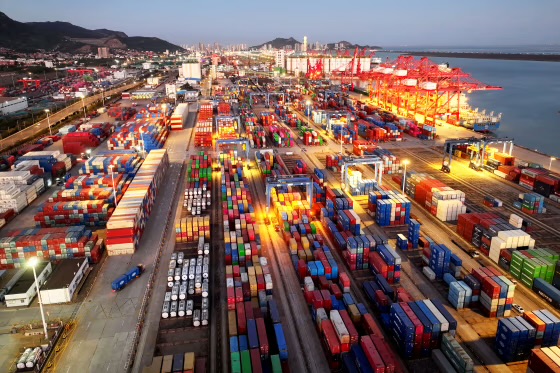
China’s trade surplus widened more sharply than forecast in September, driven by a powerful rebound in exports of semiconductors, electric vehicles and other high-tech goods. The figures keep the world’s second-largest economy on course to eclipse last year’s record annual surplus and are likely to sharpen trade frictions with the United States and Europe.
Customs data released Wednesday showed exports jumped 36.3 percent from a year earlier, accelerating from August’s 25 percent gain and easily clearing economists’ expectations of roughly 25.5 percent growth. It was the strongest monthly export performance since February’s 39.6 percent surge. Imports also remained firm, rising 31 percent against forecasts of 24.5 percent and August’s 28.2 percent increase.
The result: a September trade surplus of $133.53 billion. That included a 20-month high surplus of $34.01 billion with the United States and a $34.8 billion surplus with the European Union. Cumulative surplus for the first nine months of the year reached $938.11 billion. China first crossed the $1 trillion threshold in November of last year and finished 2025 with a record $1.189 trillion surplus. Barring a sharp slowdown in the final quarter — which analysts currently view as unlikely — Beijing is on track to hit the trillion-dollar mark earlier this year.
“Key trade ties look set to remain stable through year-end, which should keep this year’s key growth engine humming,” said Lynn Song, chief Greater China economist at ING.
Wang Jun, a vice minister of customs, told a briefing that external uncertainties, including geopolitical conflicts, could still affect trade flows. He expressed confidence, however, that “there is foundation and support for continued growth in exports and imports in the fourth quarter.”
Tech and green products lead the charge
The export boom has been powered by global demand for semiconductors and green-technology products. Semiconductor shipments rose 108.1 percent in value terms in the first nine months of the year. Automobile exports expanded more than 50 percent in both value and volume, reflecting China’s dominance in electric and hybrid vehicles.
Analysts attribute much of the semiconductor strength to the ongoing global build-out of artificial-intelligence infrastructure, which continues to fuel demand for Chinese-made chips, servers and related components. The Canton Fair, China’s largest trade exhibition, opens Thursday and is expected to give manufacturers another platform to lock in orders from foreign buyers.
The export strength has provided a crucial buffer for Chinese policymakers. Domestic demand and private investment remain subdued, and the property sector continues to weigh on the economy after years of decline. Factory-gate prices rose at their fastest pace in more than four years in September, while consumer inflation edged higher but still undershot expectations — underscoring an uneven recovery. The solid trade numbers suggest Beijing can continue to rely on relatively moderate stimulus to pursue its official growth target of 4.5 to 5 percent this year.
Trade tensions simmer
The widening surplus is already intensifying scrutiny overseas. A recent agreement with the European Union to limit Chinese hybrid-vehicle exports to the bloc is expected to curb auto shipments over time, though the detailed measures are not due until December. Exporters may accelerate shipments in the intervening weeks to beat any new restrictions.
“The widening trade surplus with Europe could spur broader E.U. restrictions beyond last week’s narrow deal, though we expect the resulting economic fallout for China to be small,” said Nguyen Hoang Nam, China economist at Capital Economics.
In the United States, a September summit in Washington between President Xi Jinping and President Donald Trump produced an extension of their tariff truce and a modest reciprocal cut in tariffs covering $30 billion of goods on each side. Still, both Washington and Brussels continue to criticize China’s industrial policies and what they describe as an undervalued currency that subsidizes exports. China’s central bank last week issued a lengthy rebuttal, insisting it has never pursued competitive depreciation and rejecting claims that the yuan is kept artificially weak.
September commodity imports told a more mixed story: crude oil volumes fell 21.5 percent year-on-year and soybean imports dropped 7.7 percent, reflecting both softer domestic demand and shifts in sourcing.
The yuan held steady against the dollar on the strong trade numbers, while Chinese stocks declined. For policymakers in Beijing, the message from September’s data is clear: exports remain the brightest spot in an otherwise patchy recovery. How long major trading partners will tolerate the resulting imbalances is the open question heading into the final months of the year.


