



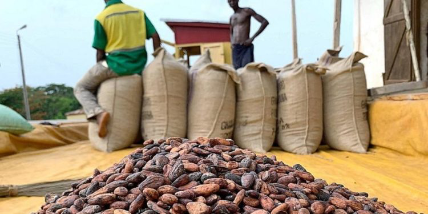
Ghana’s cocoa production is expected to fall by at least 16 per cent in the 2026/2027 season, the Ghana Cocoa Board (COCOBOD) has announced, citing adverse weather, the crop’s natural fruit-bearing cycle and disease outbreaks.
The projection for the 12-month season beginning in September comes amid mounting concerns from farmers in the Western and Western North regions, who have reported sharply reduced pod counts this season.
Multiple factors behind decline
Responding to questions from Reuters, COCOBOD attributed the expected decline to the likelihood of El Niño conditions, excessive rainfall in May and June this year, and the physiological bearing pattern of the cocoa tree, which tends to alternate between higher- and lower-yield years.
The regulator said a low cherelle load — the number of small pods that survive to maturity — in the Western and Western North regions was consistent with these factors.
The outlook in those two regions, which together account for more than half of Ghana’s output, has been aggravated by the combined effects of swollen shoot disease, ageing cocoa farms and an increase in illegal gold mining, known locally as galamsey.
Galamsey destroys over 100,000 acres
Illegal mining has emerged as the single biggest threat to Ghana’s cocoa industry, with more than 100,000 acres of high-yield cocoa plantations already destroyed in key producing regions such as Ashanti, Western and Central, according to COCOBOD’s Cocoa Health and Extension Division.
Mr Samuel Asuman, Regional Manager of the Western South Cocoa Health and Extension Division, warned recently that the industry could collapse if urgent interventions were not made.
He expressed concern that the increasing loss of farmland and declining yields had resulted in significant national output deficits, limiting foreign exchange earnings and crippling COCOBOD’s capacity to settle operational debts or fund farmer welfare programmes.
Farmers count losses
Farmers across the Western and Western North regions have reported heavier rains than usual linked to a strengthening El Niño weather pattern. The wet conditions have fuelled black pod disease, a fungal infection that can sharply reduce yields.
Kwame Alex, one of Ghana’s largest growers, said heavy rain had left his farms in poor condition. He expects his harvest to drop from 35 bags to 10 bags in the next season.
“I did everything required to maintain the farm, but the weather worked against us,” Alex said.
Harvests are also falling because farmland is being cleared to make way for mining and rubber plantations, permanently removing trees from production.
COCOBOD rolls out interventions
COCOBOD said it has taken action to limit losses, including rehabilitating infected farms in the Western North Region, expanding insecticide and fungicide spraying, and reintroducing a nationwide free fertiliser distribution scheme for the 2026/27 crop year.
The regulator is also pushing for new legislation to protect farmers, including stricter punishment for clearing farms, a requirement to replant three acres for every acre destroyed, and higher compensation for impacted farmers.
West African output under pressure
West Africa’s cocoa outlook has previously been revised lower, and output in Ivory Coast, the world’s biggest cocoa producer, is expected to fall by more than 10 per cent next season.
Pod counters and exporters in Ivory Coast project the main crop — running from September to February — at 1.35 to 1.45 million metric tonnes, down from an estimated 1.6 million tonnes this season.
Similar weather conditions in Ghana and Ivory Coast during the 2023/24 El Niño contributed to a tripling of global cocoa prices.
Ghana’s cocoa production has been on a downward trajectory since peaking at 1.04 million tonnes in the 2020/2021 season, falling to roughly 430,000 tonnes in 2023/24 — the lowest output in over two decades. The country has since recovered to an estimated 700,000 tonnes in 2024/2025.


