



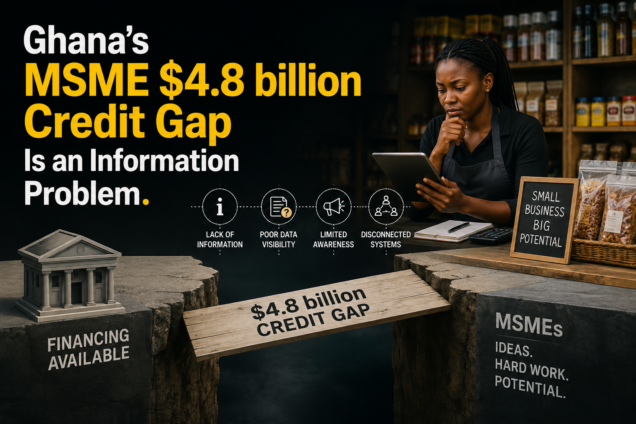
The Bank of Ghana (BoG) has officially quantified a long-felt market reality: Ghana’s small and medium-sized enterprises (SMEs) face a financing gap of approximately $4.8 billion annually, one of the most severe on the continent despite the country’s comparatively advanced financial system . During the Distinguished Digital Finance Lecture at National ICT Week, Second Deputy Governor Matilda Asante-Asiedu issued a call to action, proposing that access to credit on fair terms should become the new benchmark for measuring financial inclusion in Ghana .
A Shift from Payment Rails to Credit Rails
Mrs. Asante-Asiedu’s central proposition is that Ghana has spent fifteen years building world-class retail payment infrastructure, with interoperability that reaches into markets and farms no branch network ever served. However, she stressed, “We have built extraordinary payment rails, but we have not yet built equally extraordinary credit rails” .
She highlighted the scale of Ghana’s digital ecosystem: mobile money platforms processed 954 million transactions valued at approximately GH¢493 billion in June 2026 alone, with 84.6 million registered accounts . Yet, the disconnect between transaction data and access to credit remains the country’s “single largest unrealized opportunity” .
The Credit Data is Already There
The key insight is that the gap is not a shortage of capital but a shortage of assessment. Institutions already hold substantial transaction history, including cash flow, merchant activity, frequency of transactions, income patterns and growth trajectories. As the regulator has signalled, failing to convert this data into credit assessment has moved from a commercial choice to a supervisory concern .
“That is not background information; it is a credit record. We have simply not built the habit of reading it as such,” Mrs. Asante-Asiedu said . The operational implication for financial service providers is immediate: they should be asking why the five-year cash-flow record of a customer they already serve is not sufficient to lend to them.
Collateral Dependence and Open Banking
The reliance on traditional collateral such as land and buildings is excluding viable businesses . According to the National Insurance Commission’s own assessment, roughly 95% of SMEs are constrained by their inability to pledge physical assets, despite having strong cash flows and real receivables .
To address this, the BoG is advancing its Open Banking and Open Finance frameworks . However, the success of these reforms will not be judged by the number of APIs published, but by whether they result in more credit being extended to businesses . The measure of success should be how much credit reaches businesses through the use of transaction data .
The Assessment Problem
The gap is often described as a shortage of money, but it is more accurately a shortage of information . Lenders cannot see enough of a small business to price its risk, so they substitute collateral for information.
MSME assessment is genuinely more difficult than consumer or corporate lending, as a poultry farmer, fabric trader and haulage operator share a size band but almost nothing else. Cash flow is inherently lumpy due to planting cycles, shipment timing and school term peaks. A critical flaw in many existing models is that a model can only learn from the loans already made, meaning digital underwriting without reject inference can actually reinforce the existing collateral bias.
A Five-Point Action Plan for Industry
The following steps are proposed for industry to close the gap:
· Start With What You Already Hold: Institutions can build a cash-flow early-warning capability on their own internal transaction data today, before any open banking API goes live. Waiting for infrastructure to be handed over is the least defensible reason for inaction.
· Fund A Learning Tranche: To understand the excluded market segment, institutions need data on the population they decline. A deliberately funded, controlled volume of lending outside current policy, supported by guarantee or first-loss capital from a Development Finance Institution, is the only unbiased source of performance data on the excluded segment.
· Build Monitoring Before Volume: Rather than relying solely on an origination scorecard, behavioural early warning on live transaction flows is a superior signal. A borrower whose receipts drop below their trailing baseline or whose counterparty count is shrinking is visibly deteriorating before a payment is missed.
· Make Declines Explainable: Requirement for reason codes at decision time is critical. A decline framed as “recorded receipts over six months are below the level required for this amount” becomes coaching rather than exclusion.
· Regulate by Risk, Not by License Category: Cross-regulator coordination is essential. An SME finance product can now cross the boundaries of banking, insurance and securities. Regulators must work together to ensure that innovation is regulated according to the risks involved .
The Role of the Wider Ecosystem
The call for coordination requires a concrete response from each regulator. The Bank of Ghana should continue to publish its Open Banking implementation timetable and begin reporting the SME financing gap as a tracked supervisory statistic . The National Insurance Commission should advance the SME credit insurance mechanism already under discussion with the BoG and the 24-Hour Economy Authority, which serves as the most direct substitute for land and building collateral .
The Securities and Exchange Commission must build the funding side, including securitisation of MSME receivables and workable crowdfunding frameworks. The National Pensions Regulatory Authority oversees the Tier 2 and Tier 3 schemes where patient local currency capital actually resides. Credit Bureaus should improve MSME coverage and identity linkage anchored on the Ghana Card, as unlinked identity remains one of the largest sources of avoidable exclusion .
The Measure of Success
Mrs. Asante-Asiedu has proposed a measure of success that the regulator itself can be judged against. If the SME financing gap is the explicit test, the question in two or three years will not be how many directives were issued, but whether the number has moved. The ultimate goal is to ensure that the same phone that lets a market trader send money in three seconds also allows her to borrow against the business she has spent a decade building, and to choose between competing offers rather than accept whatever her existing provider proposes .


