



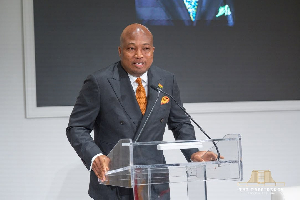
Ghana will stop exporting raw materials entirely by 2030, Foreign Affairs Minister Samuel Okudzeto Ablakwa has declared, outlining an ambitious push to industrialize the economy and retain more of the wealth generated by its natural resources.
“By 2030, we will no longer export any raw material, not one,” Ablakwa said at the “Ruptures and Ramparts” event on the sidelines of the United Nations General Assembly. “Whether it’s cocoa, whether it’s gold, whether it’s bauxite, whatever. We are going to add value. We are going to industrialize and make sure that we have resource sovereignty.”
The minister said the policy is intended to break with a decades-old model in which Ghana ships unprocessed commodities abroad while most profits and jobs are created elsewhere. He pointed to gold as an example: after many decades of exploration, Ghana’s current interest is only 10 percent, while 90 percent is extracted and the wealth is created elsewhere. Ghana’s share from oil and gas, discovered almost two decades ago, is only about 15 percent, he added.
Ablakwa said the government has adopted a new negotiating framework for resource contracts, especially leases approaching renegotiation. “We have a new framework where we are negotiating hard and smart. We have said that all the leases that are coming up for renegotiation will not follow the same old template,” he said.
The 2030 target builds on earlier measures. In January 2026, Cabinet approved restrictions on exports of non-ferrous scrap metals and raw natural rubber to protect domestic industries and ensure adequate local supply. Separately, the Tree Crops Development Authority issued a directive effective May 2025 requiring exporters of unprocessed rubber, cashew and shea to obtain written permits before clearance. President John Dramani Mahama has also announced plans to end exports of raw mineral ores by 2030.
Internationally, Ghana is pursuing partnerships to support the industrialization agenda. Ablakwa discussed collaboration with the Russian Academy of Sciences during a visit to Moscow, meeting Professor Irina Olegovna Abramova, director of the Institute for African Studies. The partnership is expected to support research and capacity-building as Ghana moves toward domestic processing and manufacturing.
Ablakwa placed the policy in a wider geopolitical context, arguing that Africa’s role in global supply chains for critical minerals has strengthened the continent’s bargaining power. “For us in Africa, because of all of this new AI dispensation and the critical minerals required to drive that, you can’t have this discussion without Africa,” he said. He urged African countries to avoid being drawn into great-power rivalries and instead pursue partnerships based on their own interests.
He also cited domestic resilience, pointing to Ghana’s recent decision to reject a health financing package worth less than $200 million over conditions attached to it, including access to health and pathogen data and the privacy of Ghanaian citizens. “We refused. But we found the resources within,” he said.
Ablakwa said advances in technology, including artificial intelligence and generative tools, have made it possible for countries like Ghana to build internal capacity. “Now technology is available… you can buy them off the shelves and you can create your own internal capacity and make sure that your natural resources benefit the people,” he said.
He acknowledged that the shifting global order is less predictable than the post-Cold War era. “We miss the old order where you could trust people more and have more friends and be a bit more loyal and you can be invited to Delhi or Washington and trust the coffee you are served,” he said. “But this new dispensation offers, particularly Africa — the most endowed continent — a new paradigm. And smart leaders must take advantage and create new wealth for Africans.”
Ghana is preparing to assume the chairmanship of the African Union and intends to deepen cooperation with groups including BRICS and CARICOM, Ablakwa added.


