


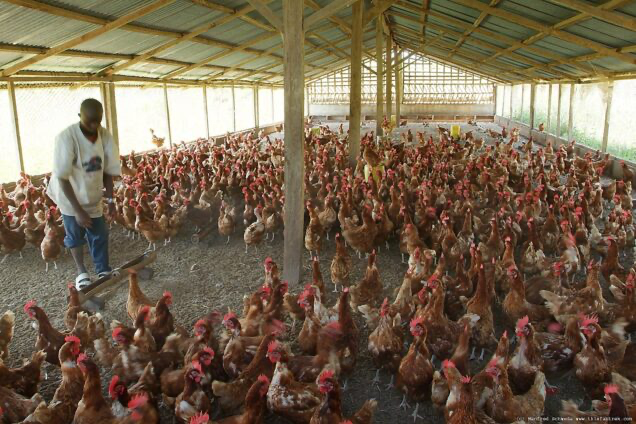
Consumers in Ghana should brace for higher poultry prices this festive season, with the Greater Accra Poultry Farmers Association projecting an increase of at least 15 percent ahead of Christmas.
The association’s Chief Executive, Mohammed Ali, said the anticipated hike is driven by the escalating cost of maize, soya, and other feed ingredients, compounded by higher freight charges on imported production inputs .
Speaking to Joy Business during an outreach to schools in Dansoman to mark World Egg Day, Ali indicated that the price adjustment is unavoidable. “Maybe not less than 15 percent; we must see some price change,” he said .
Structural Pressure on Feed Costs
The warning underscores a persistent vulnerability in Ghana’s poultry sector: heavy reliance on imported feed components. According to industry data, feed constitutes approximately 65 to 70 percent of total poultry production costs, with maize accounting for about 60 percent of that feed component and soya roughly 30 percent .
While local maize production has seen some fluctuations, the soya used in poultry feed is largely imported because locally produced varieties contain higher fat content, exposing farmers directly to international price volatility and shipping costs .
Ali argued that the solution lies in boosting domestic production of these key inputs. “When we are able to have an abundance locally, the feed price will surely come down. But without them, we can’t do anything about poultry feed,” he added .
Retail Disparity in Egg Market
Beyond the festive price warning, the association is renewing calls for intervention in the egg market, where a significant gap persists between farm-gate and retail prices.
Ali disclosed that farm-gate prices currently range between GH¢40 and GH¢45 per crate, yet some traders allegedly add as much as GH¢20 before selling to consumers. He insisted that retail prices should not exceed GH¢50 per crate .
“We don’t expect an egg to go beyond 50 cedis. Take or leave,” he stressed, urging the Ministry of Trade and Agribusiness to introduce measures that would discipline the market and prevent practices that keep retail prices artificially high .
This concern is not new. Earlier in January 2026, the association highlighted similar disparities, noting that while farm-gate prices had dropped, consumers were still paying between GH¢70 and GH¢75 in retail outlets .
Nutrition Education and Policy Advocacy
The price warnings came during the association’s World Egg Day commemoration, where it distributed over 100,000 eggs to five clusters of schools in the Dansoman enclave. Ali emphasized the nutritional value of eggs for children, particularly those aged zero to eight, and expressed hope that early education would foster healthy eating habits .
On the policy front, Ali called for the expansion of the government’s Nkokor Nkitinkiti initiative, a flagship poultry revitalization program launched in late 2025 aimed at reducing Ghana’s dependence on imported poultry. He argued that targeting larger-scale farmers with support would yield a more significant impact on production volumes, market supply, and ultimately, prices .
The association’s warnings come amid broader concerns about Ghana’s poultry import bill, which government officials have estimated at between $300 million and $400 million annually—a drain on foreign exchange that the Nkokor Nkitinkiti program seeks to address .
Background Notes:
· World Egg Day is observed internationally on the second Friday of October to promote the nutritional benefits of eggs.
· Nkokor Nkitinkiti (meaning “backyard poultry” in Akan) is a government initiative under the Feed Ghana Programme, designed to distribute poultry birds to households and commercial farmers to boost local production and food security .
· Ghana’s poultry sector has faced chronic challenges, including high feed costs, competition from imported frozen chicken, and periodic market gluts that squeeze farmer margins .