



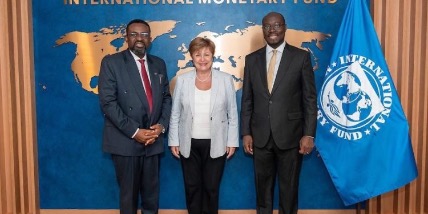
Ghana is heading to the IMF-World Bank annual meetings in Bangkok, Thailand, seeking to reassure international investors about its economic outlook and demonstrate its commitment to reforms following the end of its US$3 billion bailout programme.
The October 12–18 meetings mark Ghana’s first participation since the country transitioned from the IMF’s Extended Credit Facility (ECF) to a non-financing Policy Coordination Instrument (PCI) arrangement with the Fund.
A Three-Year Journey from Crisis to Stability
The ECF programme, launched in May 2023, was designed to restore macroeconomic stability after Ghana’s 2022 economic crisis. In July 2026, the IMF Executive Board approved the sixth and final review, unlocking a final disbursement of about US3 billion.
Finance Minister Dr Cassiel Ato Forson described the programme’s conclusion as a milestone, stating that the reforms had “delivered tangible results: inflation has reduced significantly, the cedi has strengthened markedly, public debt as a share of Gross Domestic Product (GDP) has declined sharply, and economic growth has rebounded strongly”.
Minister of State for Government Communications Felix Kwakye Ofosu added that gross international reserves had reached an all-time high of approximately US$14.5 billion by February 2026 — almost six months of import cover — and that Ghana’s sovereign credit ratings had improved from “restricted default” to “B” with a positive outlook, representing five distinct rating levels of upgrades.
Inflation, which had exceeded 50 per cent in December 2022, plunged to a historic 3.8 per cent in January 2026 — the lowest level since the CPI rebasing in 2021. It declined further to 3.2 per cent by March 2026, though it has since risen modestly to about 5 per cent. Real GDP growth rose to 6 per cent in 2025, up from 5.8 per cent in 2024. The cedi appreciated by more than 40 per cent against the US dollar in 2025, with gains continuing into 2026.
Debt Restructuring and Fiscal Consolidation
Ghana has made significant progress in restructuring its public debt. In July 2026, the government completed the exchange of US$253 million in Saderea Notes, marking the final chapter of the comprehensive sovereign restructuring of bonded debt that began in October 2024. The transaction received 100 per cent approval from holders of the outstanding notes.
Ghana also made early Eurobond repayments totalling US2.1 billion since the resumption of payments. The Ministry of Finance reported that public debt had reduced by GHS82.1 billion, with the debt-to-GDP ratio declining to 45.1 per cent by June 2026.
S&P Global Ratings affirmed Ghana’s ‘B-/B’ rating with a stable outlook, noting that interest payments are forecast to average a high 20 per cent of government revenue over the next four years — well below the historical peak of almost 48 per cent in 2021. The reduction is underpinned by debt restructuring effects, cedi appreciation in 2025, and lower local currency financing costs.
The Shift to a Non-Financing Arrangement
The transition to the PCI changes the focus from direct financial support to policy monitoring, reform implementation, and maintaining confidence in the economy. The PCI does not provide financial bailout but will offer continuous capacity development, a confidence boost to the market, and deliver a catalytic effect for fresh financing to Ghana, according to Finance Minister Forson.
IMF African Department Division Chief Ruben Atoyan noted that Ghana’s exit from the ECF programme signalled confidence in the country’s economic recovery efforts. He emphasised that the PCI would provide policy credibility rather than funding support, helping reinforce investor trust and market confidence.
An IMF staff team visited Accra in mid-September to discuss the new arrangement. Further talks in Bangkok are expected to focus on the benchmarks and reforms that will guide the engagement.
The Ten Priority Reforms
The IMF has outlined ten priority reforms for Ghana’s post-bailout era. These include using the PCI to sustain investor confidence, strengthening domestic revenue mobilisation, protecting the independence of the Bank of Ghana, and recapitalising the central bank by 2032.
Ghana is also expected to complete external debt restructuring negotiations with remaining creditors, reform state-owned enterprises in the energy and cocoa sectors, and keep public debt on a sustainable path — targeting a reduction to 45 per cent of GDP by 2034. Addressing banking sector vulnerabilities, expanding social protection, and strengthening governance and anti-corruption efforts round out the reform agenda.
Key Test in Bangkok
Without fresh IMF financing under the new arrangement, Ghana will need to demonstrate that its economic policy framework remains credible and that it can manage its financing needs without relying on another programme disbursement. The Bangkok engagements offer an opportunity to explain how the government intends to preserve macroeconomic stability, manage public debt, and maintain investor confidence as it moves beyond the bailout.
Bank of Ghana Governor Dr Johnson Asiama said the meetings would offer Ghana an important opportunity to engage international investors, showcase developments in the economy, and build partnerships that could deliver tangible benefits. Officials from the Ministry of Finance and the central bank will hold joint and separate engagements with investor groups, providing updates on economic conditions, explaining the government’s policy direction, and pursuing agreements where necessary.
Investor sentiment will depend not only on the government’s policy commitments but also on evidence of implementation. Progress on fiscal targets, expenditure control, revenue mobilisation, and debt sustainability will be important in determining how investors assess Ghana’s risk profile and future financing costs.
Risks and Challenges Ahead
The IMF has cautioned that the global environment remains uncertain, with the war in the Middle East expected to transmit through higher energy, food, and fertiliser prices. S&P noted that the conflict is likely to erode some gains by causing inflation and financing costs to rise and increasing pressure on the cedi.
Ghana’s susceptibility to terms-of-trade shocks is also rising because gold exports now account for over 60 per cent of export receipts, with cocoa contributing nearly 13 per cent and crude oil close to 9 per cent. Foreign currency reserves have been moderating, dropping to US$12.9 billion at end-June 2026.
Economists have also warned that Ghana’s economy remains fragile despite recent recovery. While inflation has declined dramatically from more than 50 per cent in December 2022 to 3.8 per cent in January 2026, critics argue that the recovery remains “austerity-heavy” for the average Ghanaian.
The IMF has stressed that the space created by improvements in the debt trajectory is contingent on strong implementation of ambitious public financial management and structural reforms to mitigate risks associated with contingent liabilities, notably from state-owned enterprises and ongoing quasi-fiscal activities.
Beyond the Bailout: What Lies Ahead
Ghana’s message in Bangkok will need to go beyond the completion of its bailout programme. The central test is whether the country can sustain economic reforms, meet its financing obligations, and preserve stability without continued IMF lending.
The government is targeting “Investment Grade” status as it enters the non-financial agreement with the IMF via the PCI. “The PCI signals our commitment to prudent policy to private investors and development partners,” the presidency stated, adding that it “will lower borrowing costs for both the sovereign and private sectors, attracting long-term institutional investment and unlocking financing for critical infrastructure”.
The outcome of the Bangkok engagements may help shape investor perceptions, but lasting confidence will depend on measurable progress at home. As IMF Division Chief Atoyan put it: “Going forward, Ghana must maintain fiscal discipline, strengthen transparency, and reinforce governance to safeguard stability”.
The 2026 IMF-World Bank Group Annual Meetings run from October 12 to 18 at the Queen Sirikit National Convention Center in Bangkok, Thailand, bringing together finance ministers, central bank governors, and private-sector leaders from 191 member countries.


