



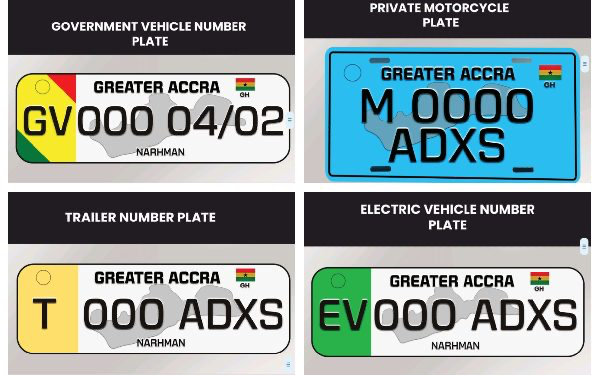
The Driver and Vehicle Licensing Authority (DVLA) has begun piloting new Radio-Frequency Identification (RFID)-enabled vehicle number plates ahead of a planned nationwide rollout in January 2027, Chief Executive Officer Julius Neequaye Kotey has announced.
Speaking at the Government Accountability Series at Jubilee House on Monday, October 12, 2026, Mr Kotey said the authority had completed the concepts and designs for the plates, which are currently being tested before their nationwide introduction. The pilot phase involves a selected number of vehicles and will allow the authority to test and refine the new system and associated processes.
“We have completed the concepts and designs of the new radio frequency identification-enabled number plates. Currently, the new number plate is being piloted ahead of nationwide rollout in 2027,” he said.
The initiative follows the passage of the Road Traffic Regulations, 2026 (L.I. 2519) and forms part of the DVLA’s broader programme to strengthen the integrity, security and efficiency of Ghana’s vehicle registration system.
Designed In-House, No Consultancy Fees
Mr Kotey said the designs were developed entirely by DVLA staff without external consultants, adding that the authority had incurred no consultancy fees for the work.
“The designs of these new number plates were carried out by the staff of DVLA. There was no consultancy fee and no external influence over the designs. It was led and completed by an in-house team,” he said.
The new RFID-enabled plates incorporate enhanced security features designed to improve traceability of registered vehicles. These include “REPUBLIC OF GHANA” prominently displayed at the top of the plate, the Ghana flag positioned at the top-right corner, a biennial renewal sticker ring at the top-left corner, the region of registration displayed at the bottom, and a watermark of the map of Ghana at the centre.
Under the new system, the year of registration will no longer appear on the number plate. The redesigned registration format will comprise numbers followed by four letters. The first two letters represent the Registration Centre Code, while the subsequent two letters constitute a Random Identification Mark, which does not follow a sequential pattern. The removal of the year identifier is expected to eliminate the practice of vehicle owners delaying registration until the beginning of a new year to obtain a newer registration number.
Real-Time Tracking and Law Enforcement Integration
Mr Kotey said the technology would allow vehicle number plates to carry information useful to law enforcement and could be integrated with electronic road tolling and traffic enforcement systems.
“The RFID technology provides the opportunity for vehicle number plates to carry information that would be useful for law enforcement in the event of crime,” Kotey said.
He added that the system would support integration with electronic road tolling and traffic enforcement technology being deployed by the Motor Traffic and Transport Department of the Ghana Police Service. The new plates will also clearly distinguish private from commercial vehicles, as well as commercial motorcycles (Okada) from private ones.
The RFID technology enables real-time tracking and authentication of vehicles, linked to a central database, making it impossible to register cars without proper documentation. It is also expected to help track stolen vehicles and enhance road safety and security. The DVLA has said it will work closely with security agencies, providing them with necessary gadgets for verification and tracking purposes.
Decentralised Embossing to Cut Delays
As part of the reform, the DVLA plans to decentralise number plate embossing to all regional offices to reduce delays in vehicle registration.
Under the new arrangement, number plates manufactured at the centre will be distributed to DVLA offices across the country for embossment. Each region will be equipped with an embossment machine to support the decentralised system. The Greater Accra and Ashanti regions, which record significant volumes of vehicle registrations, will receive five and three machines respectively.
“When we manufacture our plates, we will distribute them to our offices for embossment,” Mr Kotey said, adding that the move would take the service closer to the people and eliminate the previous bottleneck at the head office. Vehicle owners will be able to access the new plates at any DVLA regional office once the rollout is fully implemented.
The DVLA has commenced construction of a vehicle number plate manufacturing centre at its Greater Accra regional office in Accra. The facility is expected to be completed within three months and will produce number plates fitted with RFID technology.
Mr Kotey stressed that the move should not be interpreted as an attempt to eliminate private embossers from the sector. Rather, he said, the authority would regulate their activities to ensure that only qualified operators were involved in the production and embossing of approved number plates.
“What we are saying is that the era where anyone gets the means to manufacture or emboss number plates is a thing of the past. DVLA will regulate embossers to do things right,” he said.
Confronting a Fake Plate Crisis
The reforms come against the backdrop of a significant counterfeit number plate problem. In January 2026, Mr Kotey revealed that about five per cent of number plates in the system are fake, with some of the problem involving corrupt practices at certain police stations.
“About 5 per cent of number plates in the system are fake, and there are several ways people acquire the fake plates by moving through police stations,” he said.
In March 2026, the DVLA uncovered a criminal network involved in the production and distribution of fake DV number plates, with the state losing about GH¢20 million annually through the illegal trade in counterfeit plates. The introduction of RFID-enabled plates is expected to permanently eliminate the problem of counterfeit plates by making it harder for fake plates to go undetected.
The current registration system had become vulnerable to number plate cloning, manual manipulation and delays in retrieving vehicle records, making it difficult for law enforcement agencies to track vehicles linked to crime. The new system is also expected to prevent the registration of stolen and uncustomed vehicles and improve compliance with international vehicle registration standards.
Major Revenue Recovery and Contract Overhaul
At the Government Accountability Series, Mr Kotey also announced significant revenue recovery measures. The authority sealed a major revenue leakage in the sale and distribution of DP plates at the ports by replacing aluminium plates with paper-proof digital stickers. This led to monthly DP sticker issuance at the ports rising from an average of 1,800 to over 15,000 by October 2025.
Revenue from DP stickers jumped from GH¢15 million for the entire 2024 to over GH¢27 million between January and September 2026. The authority issued 76,312 DP plates in 2024, generating GH¢15 million, and 111,101 stickers in 2025, bringing in GH¢22 million.
In a related development, the authority renegotiated costly Service Level Agreements (SLAs) for roadworthiness certificates. Agreements that would have cost $155.4 million over three years were reduced to GH¢2 million for the same period, translating to an annual saving of approximately $50 million.
“The authority posted GH¢25 million as surplus after closing its accounts for the 2025 financial year, as compared to GH¢5 million in 2024,” the CEO added. For the first time since becoming semi-autonomous in 2016, the DVLA contributed GH¢17.7 million into the Consolidated Fund in 2025, in addition to a record GH¢80.4 million contribution into the Road Fund as statutorily required under the Road Fund Act 1997, Act 536. This puts the authority’s total contribution to the Mandatory Fund at GH¢98.1 million.
Nationwide Expansion and 24-Hour Services
The DVLA has also expanded its nationwide network from 33 to 63 offices within two years, comprising 12 new DVLA-owned offices and 18 Ultra Centres opened in partnership with the private sector. The authority has pioneered 24-hour service at some of its offices, with the Adenta office leading the way in August 2026, and similar round-the-clock operations running at the ports in Takoradi and Tema to ease congestion and accelerate processing. All regional offices are expected to operate 24/7.
The authority has also cleared a backlog of 440,000 driver’s licences and introduced driving tests in six local languages as part of its reform efforts.
Re-registration of Existing Vehicles
Official issuance of the new RFID-enabled number plates is expected to start from January 2027, beginning with unregistered vehicles. The authority will subsequently announce the modalities and commencement date for the re-registration of vehicles that are already registered. More than 3.7 million vehicles are expected to be re-registered under the new system.
Vehicle owners who registered their vehicles before 2023 have been encouraged to migrate their details from the manual system to the digital platform early to avoid congestion when the rollout eventually begins. The onboarding process entails capturing vehicle data onto an electronic database, a prerequisite for acquiring the new RFID-enabled plates, which has many benefits, including real-time verification of ownership and allowing law enforcement and authorised personnel to verify vehicle details instantly.
Under the new regime, number plates will be assigned to individuals rather than vehicles, allowing owners to retain their plates when they dispose of a vehicle and transfer them to another vehicle within the same category.
A nationwide sensitisation exercise has begun to educate the public on the new system ahead of the full rollout in 2027.


