



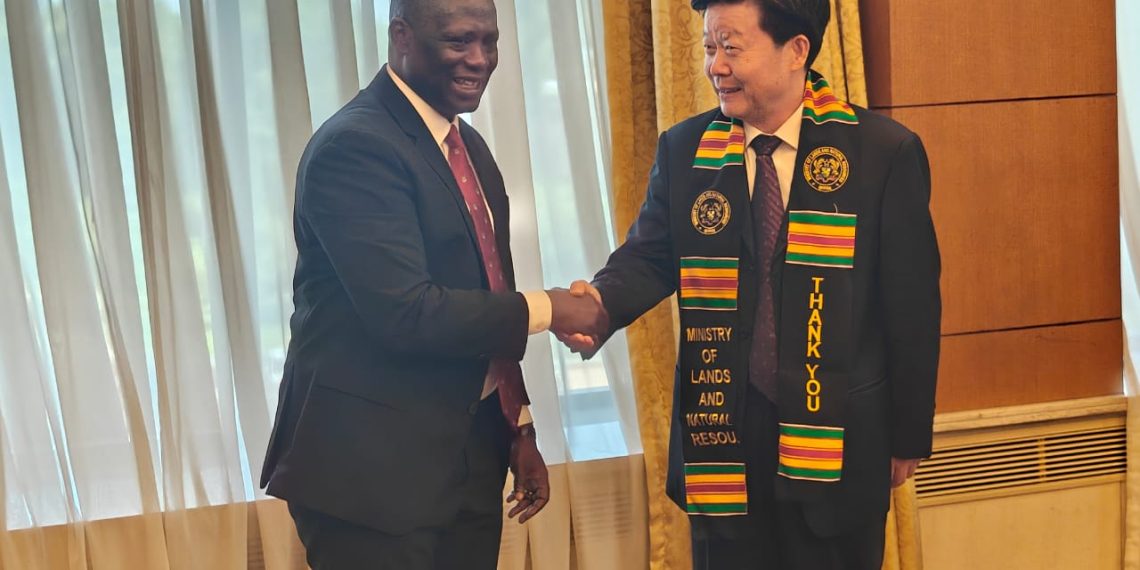
Ghana’s Ministry of Lands and Natural Resources and China’s Ministry of Natural Resources have agreed on a three-point strategy to combat illegal mining, strengthen technical cooperation in geological surveys, and promote responsible investment in Ghana’s mining sector.
The agreement was reached during a high-level meeting between the two ministers on the sidelines of the 2026 China Mining Conference in Tianjin, China, on September 13, 2026.
The Minister of Lands and Natural Resources, Emmanuel Armah-Kofi Buah, who led the Ghanaian delegation alongside Ghana’s Ambassador to China, Kojo Bonsu, described the outcome as a breakthrough in efforts to streamline Ghana’s mining industry and attract responsible investment.
“This is very important in how we collaborate on critical areas of the natural resources sector. This includes how to work with them in policing Chinese companies that are working in Ghana to make sure that they meet the highest standards,” he announced.
He said the collaboration would ensure that Chinese nationals found to be involved in illegal mining activities, popularly known as galamsey, face appropriate sanctions in both countries.
“Those who are found to have broken the law, especially those who engage in illegal mining activities (galamsey), are not only punished in Ghana, but we have a pathway where the Chinese will also police their people who are working in Ghana,” he said.
Cross-Border Enforcement Mechanism
The agreement establishes a dual-sanction framework under which Chinese citizens found engaging in illegal mining in Ghana could face punishment in both jurisdictions. This directly addresses a challenge that has plagued Ghana for nearly two decades.
Illegal mining, locally known as galamsey, escalated sharply from the mid-2000s with the influx of Chinese miners. Research shows that Chinese operators introduced heavy machinery — including changfa excavators and bulldozers — that transformed what was once artisanal, manual mining into mechanized, industrial-scale extraction. Although Ghanaian law restricts small-scale mining to citizens only, Chinese capital and technology have continued to penetrate the sector through complex networks.
Technology Transfer and Geological Surveys
The three-point strategy also includes strengthening the capacity of Ghana’s Geological Survey Authority while promoting technology transfer and investment in the mining sector.
“We are also collaborating with them on green mining technology, environmental protection and technology transfer. Critically, we will be working with them on geological surveys and mapping. These are very critical breakthroughs,” Mr. Armah-Kofi Buah explained.
The focus on geological surveys addresses a longstanding bottleneck in Ghana’s mining industry. Inadequate geological data has historically constrained resource development efficiency and deterred investment. Speaking at the China Mining Conference ministerial forum, Mr. Buah noted that “a nation must know what it has in order to manage it better, attract the right investment, and negotiate from a position of knowledge.”
Technical Team to Drive Implementation
The Lands Minister said both sides had agreed to establish a technical team to develop and implement the agreed areas of cooperation.
“We have all agreed to form a technical team to move this forward, and I want to thank Ghana’s Ambassador to China for his role,” he added.
Ambassador Bonsu, speaking at a parallel investors’ forum, conveyed Ghana’s policy resolve to the Chinese business community: “Ghana has made a clear and deliberate choice — we are no longer satisfied with exporting raw minerals and importing finished products at a higher price.”
Deepening Crisis Behind the Agreement
The cooperation agreement comes amid mounting evidence that previous efforts to curb galamsey have had limited success. Illegal mining has caused systematic environmental devastation: major rivers including the Pra, Ankobra, and Offin have suffered severe pollution, with water turbidity reaching as high as 14,000 NTU — far exceeding the 2,000 NTU treatment threshold. Ghana Water Company has warned that the country could be forced to import drinking water by 2030 if illegal mining continues unchecked.
Forest reserves have also suffered heavy losses. According to Forestry Commission data, 34 of Ghana’s 288 forest reserves have been affected by illegal mining, with 4,726 hectares of forest destroyed. The cocoa industry, a cornerstone of Ghana’s economy, has seen production fall below 55 percent of seasonal output, with over 100,000 acres of cocoa farms destroyed in Mankurom alone.
The Ghanaian government has taken a series of hardline measures in recent years. In 2025, it declared forest reserves and water bodies national security zones, deploying permanent military bases to prevent illegal miners from returning. The 2026 budget increased the allocation for combating illegal mining to 150 million cedis, triple the 50 million cedis allocated in 2025. Ghana has also established the National Anti-Illegal Mining Operation Secretariat (NAIMOS) and is advancing the Responsible Cooperative Mining and Skills Development Programme (rCOMSDEP) to formalize artisanal mining.
Analysis: From Unilateral Enforcement to Source-Level Governance
The strategic significance of the Ghana-China agreement lies in its shift from Ghana’s unilateral domestic enforcement to cross-border collaborative regulation. Over the past decade, despite repeated deportations of illegal Chinese miners, the flow of technology, capital, and equipment has never truly stopped. Research indicates that equipment left behind by deported miners — particularly changfa machines — has flowed into the hands of local operators, while Chinese suppliers have continued exporting similar machinery to Ghanaian partners.
The deeper problem is that the galamsey supply chain involves a complex web of interests linking Ghanaian politicians, traditional leaders, security personnel, and Chinese businessmen. Targeting foreign miners alone cannot reach the core of this structure. A joint Ghana-China regulatory mechanism, if effectively implemented, could apply pressure from both the demand and supply sides.
However, analysts note that implementation of such bilateral agreements faces significant challenges. Domestic skepticism about “who is really protecting illegal miners” in Ghana has never dissipated — the disappearance of 500 seized excavators in 2025 being a case in point. Security analyst Andrews Asidu Tetteh warned that oversight mechanisms must be established to prevent deployed personnel from being corrupted by bribery: “We need patriotic and loyal people to help the nation fight galamsey, not those who can easily be influenced by money.”
For Chinese mining companies operating legally in Ghana, the agreement may mean stricter compliance reviews but also provides clearer regulatory expectations. Mr. Buah’s message to Chinese investors in Tianjin was that Ghana welcomes investment, but a “win-win partnership” means Ghana must receive fair value from its resources, while investors need an environment that is stable, predictable, and commercially viable.


