



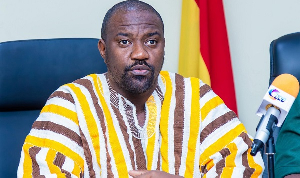
The government is constructing 1,000 kilometres of agricultural roads to improve the movement of food from farming communities to major towns and cities, Deputy Minister for Food and Agriculture John Dumelo has said, as part of a broader push to reduce post-harvest losses and curb food inflation.
Speaking at AgriFair 2026 in Obuasi on Friday, October 16, 2026, Dumelo said the road projects form part of efforts to strengthen the agricultural value chain and support food production across the country. “We are currently constructing 1,000 kilometres of agricultural roads. This is going to make it easier for us to transport food items from farming communities to towns and big cities,” he said.
Part of a GH¢828 Million Budget Allocation
The road initiative, formally known as the Agricultural Enclave Roads Programme, was announced by Finance Minister Dr Cassiel Ato Forson during the presentation of the 2026 Budget Statement to Parliament. A total of GH¢828 million was allocated specifically for the programme, which is being executed by the Department of Feeder Roads under the Ministry of Roads and Highways. The three-year programme prioritises routes that directly connect high-producing food zones to market centres, with the aim of reducing transportation costs, minimising post-harvest losses and strengthening food security.
Forson had noted that the poor condition of roads linking farms to markets had long been a major driver of food inflation, and that addressing the challenge was essential to stabilising prices and supporting farmers’ livelihoods. The roads programme sits within the broader Big Push Infrastructure Programme, for which the government has allocated GH¢30.8 billion in 2026 across roads, rail, aviation, health, education and agribusiness. It also aligns with a separate US$500 million World Bank financing package—the Ghana Market Access and Connectivity Project—approved in May 2026 to rehabilitate and maintain more than 1,000 kilometres of rural roads across key farming regions.
Processing Centres and Farm Service Centres
Beyond the roads, Dumelo said the government is establishing mini-processing centres in farming communities to help farmers process excess produce instead of allowing it to go to waste. Farm Service Centres are also being developed across the country to provide farmers with access to agricultural inputs at affordable prices.
“We want farmers to be able to access farming products at very good prices. We have already started construction on some of the centres, and we expect most of them to be ready next year,” he said. The 2026 Budget allocated GH¢690 million to commence the operationalisation of the Farmer Service Centres, with some 50 districts set to benefit from equipment including 660 tractors, 300 tractor trailers, combine harvesters and precision seed drills.
Call for Corporate Investment in Agriculture
The Deputy Minister used the platform to urge corporate institutions to invest directly in agriculture rather than limiting their support to donations and corporate social responsibility activities. He said businesses could establish vegetable farms, poultry farms, piggeries and other ventures to increase local food production. “If some of these corporate bodies can establish farms, it will go a long way to boost the agricultural output of the country,” he said.
He also encouraged churches and other institutions involved in farming to consider investing in agro-processing facilities, suggesting that groups producing large quantities of crops such as maize could work together to establish factories to process their surplus produce. Dumelo further noted that the government was supporting young people to enter farming through the provision of water pumps, fertiliser and seeds, while the National Food Buffer Stock Company was being empowered to purchase surplus produce from farmers.
A Farmer Before a Minister
Dumelo’s advocacy for agricultural infrastructure is rooted in his own experience. Born on February 3, 1984, he is a Ghanaian actor, entrepreneur and farmer who has invested in crop and livestock farming for over a decade. He established Farmeo Limited at East Legon Hills in Accra, growing lettuce, cherry tomatoes, chili peppers and carrots, while also engaging in snail farming. His produce is supplied to local grocery stores and exported to India. He owns more than 2,000 acres of farmland across Ghana, producing maize, rice, ginger, mushrooms and cabbage, and rearing snails and livestock.
Dumelo, who is also the Member of Parliament for Ayawaso West Wuogon, was sworn in as Deputy Minister of Food and Agriculture on March 13, 2025, after his appointment by President John Dramani Mahama. In Parliament, he has consistently advocated for better road infrastructure in farming communities, highlighting during debates on the 2026 Budget how poor road networks affect agricultural production and rural livelihoods.


