



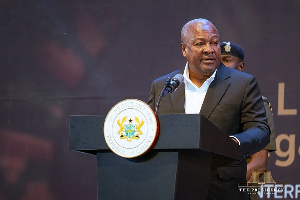
President John Dramani Mahama has said Ghana’s decision to seek partnership with the BRICS bloc is a deliberate strategy to diversify the country’s development partnerships and deepen South-South cooperation, insisting the move is about widening options rather than walking away from traditional allies.
Speaking at the Jubilee House on Friday, October 16, 2026, during the commissioning of four ambassadors-designate assigned to Angola, Qatar, Israel and Ghana’s Permanent Mission to the United Nations, Mahama charged the envoys to clearly communicate the rationale behind Ghana’s BRICS engagement to their host countries and international partners.
“Ghana’s decision to apply for partnership with the BRICS countries reflects our determination to broaden our development partnerships and deepen South-South cooperation,” the President said. He stressed that Ghana would pursue “wider opportunities for trade, investment and industrialisation, and also value addition, while sustaining our longstanding relationships and working relations with our traditional partners”.
Partner Status, Not Full Membership
The announcement follows Cabinet’s approval of a formal application, disclosed by Foreign Affairs Minister Samuel Okudzeto Ablakwa on October 6 during a joint press briefing with visiting Indian External Affairs Minister Dr Subrahmanyam Jaishankar. Ablakwa later clarified that Ghana is not seeking full membership but intends to apply as a Partner Country—a status that provides a formal channel for cooperation with the bloc without full membership.
BRICS currently has 11 full members: Brazil, Russia, India, China, South Africa, Egypt, Ethiopia, Iran, Saudi Arabia, the UAE and Indonesia. Ten countries, including Nigeria and Uganda, hold partner status, and about 40 countries have expressed interest, with 23 having formally applied. Nigeria, West Africa’s other major economy, secured partner status in January 2025.
An Economic Strategy, Not a Geopolitical Pivot
The government has positioned the BRICS bid squarely within Mahama’s “New Economy” agenda—a seven-pillar plan aimed at moving Ghana from stabilisation to transformative growth, built on jobs, investment, industrialisation and resource sovereignty. Ablakwa argued that BRICS offers additional economic options, wider markets for value-added cocoa, gold and oil, and a platform for South-South cooperation, without replacing traditional partners.
“We are not going to walk away from our traditional partners who value that relationship, but we must have new friends. BRICS offers us that opportunity to have options in our development agenda,” the minister said. He cited Ghana’s historical policy of non-alignment, recalling how first President Kwame Nkrumah secured US support for the Akosombo Dam while pursuing nuclear research cooperation with the Soviet Union.
Mahama reinforced that framing, citing shifting global alliances, increasing trade restrictions and growing competition over technology and natural resources as developments requiring a more strategic approach to Ghana’s international relations. He pointed to the establishment of the Ghana Gold Board and efforts to promote local processing of lithium, bauxite and manganese as evidence of Ghana’s determination to retain greater value from its natural resources.
Accountability for Envoys
The President used the occasion to set a performance bar for the newly commissioned envoys, telling them to judge the success of their economic diplomacy by the opportunities they bring to Ghana. He said key performance indicators had been introduced for all heads of mission to provide a framework for accountability, and urged the ambassadors to be guided by Article 40 of the 1992 Constitution, which enjoins the state to promote and protect Ghana’s interests and contribute to a just and equitable international order.
“Lead your staff with fairness and respect. Protect the integrity of your office and your dealings with your host countries, international institutions and our own citizens,” Mahama said.
Political Pushback
The BRICS decision has not gone unchallenged. The Minority in Parliament has called for an urgent parliamentary briefing on the application, questioning the urgency and seeking clarity on the implications of closer engagement with the bloc. Ablakwa has dismissed the criticism as disingenuous, accusing the Minority of double standards and disclosing that the previous Akufo-Addo administration had also weighed BRICS membership in 2023.
India, which currently chairs BRICS, has welcomed Ghana’s interest while noting that admission requires collective consideration by existing members. Ablakwa has said Ghana will count on India and other members to support its bid.
For Mahama, the message to Ghana’s diplomats is clear: the BRICS application is not a rejection of old friendships but an assertion of Ghana’s freedom to make decisions in its own interest. “Explain this approach clearly as we seek wider opportunities,” he told the envoys, “while sustaining our long-standing relationships and working relations with our traditional partners”.


