



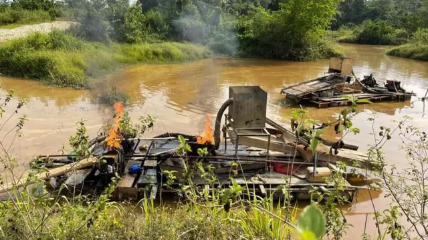
A top research scientist at the Council for Scientific and Industrial Research (CSIR) has issued a sobering warning that Ghana’s heavily polluted water bodies, ravaged by illegal small-scale mining—commonly known as galamsey—cannot be expected to heal on their own. Dr. Franklin Obiri-Nyarko, a research scientist at CSIR, has declared that relying on natural remediation to restore these contaminated rivers is a futile exercise.
Speaking on the Citi Breakfast Show on Wednesday, August 12, Dr. Obiri-Nyarko stressed that the sheer scale and chemical complexity of galamsey-induced pollution render natural recovery processes virtually impossible within any meaningful timeframe.
The Science of Persistent Contamination
The scientist explained that the primary obstacle to natural restoration lies in the specific composition of the pollutants. Illegal mining operations introduce a lethal cocktail of substances into freshwater systems, including heavy metals such as mercury, arsenic, and lead—all of which are used during the gold extraction process.
Unlike organic waste, which can be broken down by microorganisms over time, heavy metals are non-biodegradable. Dr. Obiri-Nyarko noted that while natural bioremediation relies on microbes to degrade contaminants, these microorganisms are biologically incapable of breaking down heavy metals. Instead, these toxic elements remain in the sediment and water column, posing a persistent threat.
“If you have such a complex contamination like that, it is somewhat difficult to treat, especially when you have heavy metals in the contamination,” Dr. Obiri-Nyarko stated. “Some organic contaminants are recalcitrant; they are very difficult to biodegrade. Generally, if you have heavy metals, it is very difficult for microbes to biodegrade them.”
He further warned that the presence of recalcitrant organic pollutants—such as residual cyanide and hydrocarbon fuels from mining machinery—compounds the problem, creating a toxic cocktail that nature simply cannot metabolize efficiently.
A Multi-Generational Crisis
The scientist emphasized that the recovery timeline, if left entirely to natural processes, would extend far beyond what is acceptable for communities that depend on these water sources for drinking, irrigation, and fishing. He described the waiting period as “unreasonably long,” suggesting that without intervention, these rivers could remain severely compromised for decades or even centuries.
The implication of this finding is dire for rural Ghana, where many households rely directly on streams and rivers for their daily water needs. The toxic accumulation of heavy metals in aquatic ecosystems also threatens to bioaccumulate in fish and other aquatic life, eventually making its way up the food chain to harm humans.
Call for Active Intervention
Dr. Obiri-Nyarko’s warning serves as a stark rebuttal to any notion that simply halting illegal mining activities will be enough to restore the environment. While stopping galamsey is a necessary first step, he argued that active, engineered remediation strategies are urgently required to reverse the damage.
These active interventions could include dredging contaminated sediments, applying chemical amendments to neutralize heavy metals, or implementing phytoremediation—using specially selected plants to absorb toxins from the water and soil. However, such measures are costly, technologically demanding, and require sustained government investment.
A Wake-Up Call for Policymakers
The CSIR scientist’s remarks come as Ghana grapples with an escalating environmental crisis, with major river basins—including the Pra, Ankobra, and Tano rivers—having been turned into murky, ochre-colored channels choked with silt and pollutants.
Dr. Obiri-Nyarko’s assessment places a heavy burden on policymakers. It underscores that the fight against galamsey must extend beyond law enforcement and military taskforces to include a comprehensive, well-funded national strategy for water rehabilitation.
“It will be very difficult and practically impossible for us to wait for natural remediation to take place for the polluted water to be restored,” he concluded, urging stakeholders to adopt immediate, active measures to salvage the nation’s dwindling freshwater resources before they are lost entirely.


